Research cracks puzzle of why the bumble bee can fly so well
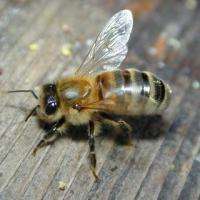
New research has cracked the old puzzle of why bees and other insects are so good at flying, paving the way for aircraft just a few centimetres wide to be built.
Many insects’ wings are a special flexible shape to increase thrust and fly efficiently, engineers have found. This shape allows them to produce the vortices – spinning masses of air – which generate lift and help them move.
The research, carried out at the University of Bath, UK, is another step on the way for engineers to make air vehicles smaller than a human hand that can be used for detecting chemicals leaks and reconnaissance.
(You can watch a demonstration of a micro air vehicle on YouTube. A video clip of the research: Research TV)
The research was carried out as part of a programme to develop tiny aircraft with cameras and sensors which could be used in traffic monitoring, border surveillance, fire and rescue operations, and hazardous substance detection.
As aircraft are made smaller, resistance due to the viscous effects of air increases proportionately, and new ways have to be found to overcome this.
In an award-winning research paper, the Bath engineers set out how they found that a wing which is rigid at the front but more flexible and bendy at the rear is the most efficient way for a small wing to generate optimum vortices and to move in air.
In doing so, they were following a path set by nature 100-350 million years ago, when bees and other insects with similar flexible wings evolved. Some birds have similar wings too.
“This is a very important step forward in understanding how we can create tiny aircraft that could be so useful for us,” said Professor Ismet Gursul, in the University of Bath’s Department of Mechanical Engineering, who heads the team at Bath.
“Large aircraft like the ones we fly in don’t have to produce vortices for propulsion, so they can have fixed wings and engines, but we have found that smaller ones will have to take a leaf out of nature’s book if they are to work efficiently.
“Our work will make the goal of tiny aircraft, perhaps eventually the size of bees, a step closer.”
Professor Gursul, who is giving a public lecture on his work on vortex flows at the University on Wednesday January 31, said that small aircraft a few centimetres in size had already been built in the USA and flown, but these could only stay airborne for a few minutes.
The research has attracted media interest: Dr Sam Heathcote, who worked on the project, gave interviews to the Radio 4 Today programme, Radio 5 Live, and the World Service, as well as local radio. Professor Gursul gave an interview to BBC Radio Wales.
His team’s work will allow them to stay in flight for longer, but more work is needed to find ways to power them more efficiently before they are viable.
If this is a success then the micro air vehicles could be also be used as spy planes, sending back clear detailed video footage of battlegrounds, allowing commanders to use their troops most effectively and avoiding the need for human scouts to risk their lives.
Researchers at other universities are developing the computer software and hardware needed for the micro air vehicles to be able to travel to preset destinations and avoid obstacles, without having to be guided remotely.
Professor Gursul’s team carried out tests on various types of wings in tanks, observing the flow of smoke or water around them.
Professor Gursul’s recent research paper ‘Unsteady vortex flows over slender delta wings’ has appeared in the American Institute of Aeronautics and Astronautics Journal. Professor Gursul was awarded a plaque and citation for it by the Institute.
Source: University of Bath


