Breakthrough in nanodevice synthesis revolutionizes biological sensors
January 31st, 2007 Breakthrough in nanodevice synthesis revolutionizes biological sensors

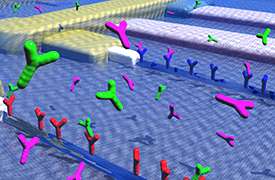
Schematic of nanowire sensors operating in solution. (image by: Reed/Yale)

A novel approach to synthesizing nanowires (NWs) allows their direct integration with microelectronic systems for the first time, as well as their ability to act as highly sensitive biomolecule detectors that could revolutionize biological diagnostic applications, according to a report in Nature.

"We electronically plugged into the biochemical system of cells," said senior author Mark Reed, Harold Hodgkinson Professor of Engineering & Applied Science. "These developments have profound implications both for application of nanoscience technologies and for the speed and sensitivity they bring to the future of diagnostics."

An interdisciplinary team of engineers in the Yale Institute for Nanoscience and Quantum Engineering has overcome hurdles in NW synthesis by using a tried-and-true process of wet-etch lithography on commercially available silicon-on-insulator wafers. These NWs are structurally stable and demonstrate an unprecedented sensitivity as sensors for detection of antibodies and other biologically important molecules.

According to Reed, not only can the NWs detect extremely minute concentrations (as few as 1000 individual molecules in a cubic millimeter), they can do it without the hazard or inconvenience of any added fluorescent or radioactive detection probes.

The study demonstrated ability of the NWs to monitor antibody binding, and to sense real-time live cellular immune response using T-lymphocyte activation as a model. Within approximately 10 seconds, the NW could register T-cell activation as the release acid to the device. The basis for the sensors is the detection of hydrogen ions or acidity, within the physiological range of reactions in the body. Traditional assays for detection of immune system cells such as T cells or for antibodies usually take hours to complete.

"The ability to differentiate between immune system cells based on their function and with label-free reagents is key for rapid and reliable diagnostics as well as for advancing basic science," said co-author Tarek Fahmy, assistant professor of biomedical engineering. "These nanosensors can replace current technology with a solid-state device and the results promise to radically change the way we assay for these cells."

"The sensor is essentially on the size scale of the molecules it is designed to sense," said lead author Eric Stern, a graduate student whose thesis work has focused on designing and building nanoscale chemical and biological sensors. His project was funded by the Department of Defense and placed high importance on the capability of detecting multiple molecules, including pathogens.

"You can think of the process of making the nanowires as sculpting. It can either be done by working down from the rock or up from the clay — we carved down from the rock," said Fahmy. "Previous approaches used the equivalent of a hacksaw, we used a molecular chisel. We were able to make exactly what we wanted with the most traditional technology out there."

According to Stern, "We not only got the high quality smooth surface we wanted, but we were also able to make them smaller than we originally defined. Using the robust 'old fashioned' technology of lithography gives us manufacturing uniformity.

The authors say that although this study focuses on device and sensor performance, the strength of the approach lies in seamless integration with CMOS technology, and the approach "appears to have potential for extension to a fully integrated system, with wide use as sensors in molecular and cellular arrays."

"This project is a powerful demonstration of what we are trying to achieve in the Yale Institute of Nanoscience and Quantum Engineering," said Paul Fleury, Dean of Engineering and Director of the Institute. "It was a remarkable collaboration, of biomedical, electrical and mechanical engineering with chemistry and applied physics, that worked for all of us. And a dedicated graduate student with a focused idea made it happen."

Source: Yale University


print this article email this article download pdf blog this article bookmark this article     Digg this Stumble it share on Facebook share on Reddit add to delicious save to Yahoo! bookmarks
4.5/5 after 12 votes


January 31st, 2007 all stories
Nanotechnology / Nanophysics

Comments: 0
Rank: 4.5/5 after 12 votes

  • Stumble this up

  • Digg this

  • Share it:
  • share on Facebook
  • share on MySpace
  • share on Slashdot
  • rss-newsfeed
  • share on Google
  • share on Reddit
  • add to delicious
  • save to Yahoo! bookmarks
  • share on Windows Live
  • Add to Mixx!
Rating: 4.5/5 after 12 votes

  • Related Stories

  • Clinical trial shows quadriplegics can operate powered wheelchair with tongue drive system
    created 1hour ago | popularity not rated yet | comments 0
  • Intelligent shoe performs pressure imaging
    created Jun 30, 2009 | popularity not rated yet | comments 0
  • Researchers unveil whiskered robot rat
    created Jun 30, 2009 | popularity not rated yet | comments 0
  • In-home health tracking system to deliver alerts to smartphones
    created Jun 26, 2009 | popularity not rated yet | comments 0
  • Students create portable device to detect suicide bombers (w/ Video)
    created Jun 24, 2009 | popularity not rated yet | comments 0

Tags


  • Physicists Demonstrate Quantum Memory with Matter Qubits
    Physicists Demonstrate Quantum Memory with Matter Qubits
    Physics / General Physics
    created Jul 03, 2009 | popularity 4.4 / 5 (17) | comments 1
  • 'Holey' Nanosheets for Wastewater Dye Removal
    Nanotechnology / Nanomaterials
    created Jul 01, 2009 | popularity 5 / 5 (5) | comments 1
  • Jellyfish Robot Swims Like its Biological Counterpart
    Jellyfish Robot Swims Like its Biological Counterpart
    Electronics / Robotics
    created Jun 26, 2009 | popularity 4.4 / 5 (8) | comments 1
  • Could Maxwell's Demon Exist in Nanoscale Systems?
    Could Maxwell's Demon Exist in Nanoscale Systems?
    Physics / General Physics
    created Jun 24, 2009 | popularity 4.4 / 5 (18) | comments 29
  • Living Safely with Robots, Beyond Asimov's Laws
    Living Safely with Robots, Beyond Asimov's Laws
    Electronics / Robotics
    created Jun 22, 2009 | popularity 4.6 / 5 (53) | comments 40
  • Other News

    Canadian researchers set to study impact of nanomaterials on aquatic ecosystems

    Nanotechnology / Bio & Medicine

    created 49 minutes ago | popularity 5 / 5 (1) | comments 0

    A team of Canadian scientists and engineers, led by the University of Alberta and the National Research Council of Canada, will collaborate on a $3.39 million, three-year study to assess the potential effects of nanoparticles ...


    Nano Measurement in the 3rd Dimension

    Nano Measurement in the 3rd Dimension

    Nanotechnology / Nanophysics

    created 2 hours ago | popularity 3 / 5 (1) | comments 0

    From the motion sensor to the computer chip - in many products of daily life components are used whose functioning is based on smallest structures of the size of thousandths - or even millionths - of millimetres. ...


    A 'quantum of sol' -- how nanotechnology could hold the key to a solar-powered future

    A 'quantum of sol' -- how nanotechnology could hold the key to a solar-powered future

    Nanotechnology / Nanomaterials

    created Jun 30, 2009 | popularity 3.9 / 5 (16) | comments 17

    (PhysOrg.com) -- A new generation of 'nano-structured' millimetre-sized solar cells that could convert the sun's energy to electricity more than twice as efficiently as current technology, is the subject of ...


    Australian researchers are set to begin human trials of a tiny nano-cell that acts as a "Trojan horse" against cancer

    Hi-tech 'Trojan horse' can kill cancer cells: researchers

    Nanotechnology / Bio & Medicine

    created Jun 29, 2009 | popularity 4.7 / 5 (12) | comments 7

    Australian researchers are set to begin human trials of a tiny nano-cell that acts as a "Trojan horse" against cancer cells, a breakthrough they say may curb the need for debilitating chemotherapy.


    'Holey' Nanosheets for Wastewater Dye Removal

    Nanotechnology / Nanomaterials

    created Jul 01, 2009 | popularity 5 / 5 (5) | comments 1

    (PhysOrg.com) -- Researchers have discovered that extremely thin sheets of nickel oxide with hexagonally shaped holes can absorb hazardous dyes from wastewater nearly as well as the best traditional methods, but are recyclable. ...