Scientists Track Earth's Water with Isotopes
January 31st, 2007 Scientists Track Earth's Water with Isotopes

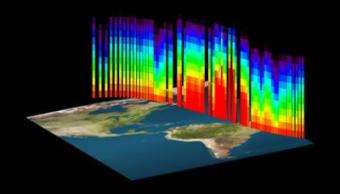
This image illustrates a study tracking the role of Earth's water in the atmosphere and its possible influence on climate. The red shows water observed in Earth's troposphere by with NASA's Aura satellite, indicating recent evaporation or transpiration. Blue and purple show water vapor that has been condensed. Enrichment over the tropical South America and the nearby Atlantic is due to strong thunderstorm activity. Image courtesy NASA, CU-Boulder

For the first time, scientists have used a spaceborne instrument to track the origin and movements of water vapor throughout Earth's atmosphere, providing a new perspective on the dominant role Earth's water cycle plays in weather and climate.

A team of scientists from the University of Colorado at Boulder and NASA's Jet Propulsion Laboratory in Pasadena, Calif., used the Tropospheric Emission Spectrometer on NASA's Aura satellite to gather data on "heavy" and "light" water vapor in order to retrace the history of water over oceans and continents, from ice and liquid to vapor and back again. The researchers were able to distinguish between the two because heavy water vapor molecules have more neutrons than lighter ones do.

By analyzing the distribution of the heavy and light molecules, the team was able to deduce the sources and processes that cycle water, the most abundant greenhouse gas in Earth's atmosphere, said David Noone of CU-Boulder's Cooperative Institute for Research in Environmental Sciences. Noone, an assistant professor in CU-Boulder's atmospheric and oceanic sciences department, is the corresponding author of a paper on the subject that appears in the Feb. 1 issue of Nature.

The team found that tropical rainfall evaporation and water "exhaled" by forests are key sources of moisture to the tropical atmosphere. The researchers noted that much more water than expected is transported into the lower troposphere over land than over oceans, especially over the Amazon River basin and in tropical Africa.

"One might expect most of the water to come directly from the wet ocean," said Noone. "Instead, it appears that thunderstorm activity over the tropical continents plays a key role in keeping the troposphere hydrated."

The team found that in the tropics and regions of tropical rain clouds, rainfall evaporation significantly adds moisture to the lower troposphere, with typically 20 percent and up to 50 percent of rain there evaporating before it reaches the ground. "This mechanism allows the atmosphere to retain some of the water, which can be used later, for instance, to make clouds," Noone said.

The strength and location of such evaporation gives scientists new insights into how water in Earth's atmosphere helps move energy from Earth's surface upward, important since the main role of the atmosphere in Earth's climate system is to take energy deposited by the sun and return it to space, said Noone.

The team also found evidence that water transported upward by thunderstorm activity over land originates from both plant "exhalation" in large forests and evaporation over nearby oceans. The balance between the two sources indicates how vegetation interacts with climate and helps maintain regional rainfall levels.

"This link between vegetation, hydrology and climate has implications for how societies choose to manage their ecological resources," said Noone. "Our measurements provide a baseline against which future changes in vegetation and climate interactions can be measured."

The team said there has been a general lack of information on the way water moves around in Earth's atmosphere - where it comes from and where it ends up.

"We know the details of this journey are critical for understanding clouds and climate, as well as changes in precipitation patterns and water resources," said Noone.

"Our study measures the conditions under which precipitation and evaporation occur, providing insights into the processes responsible. Better knowledge of these processes ultimately leads to a clearer understanding of the factors that drive the global water cycle and its importance in climate and global climate change."

"Since we measure the history of water, so to speak, we can tell the difference between air masses that have undergone extensive condensation from those that are dominated by evaporation from the ocean surface," said co-author John Worden of JPL.

"These results also lay the groundwork for research to help interpret the isotopic measurements that scientists use to study Earth's climate in the past," said JPL co-author Kevin Bowman.

For more information on the Tropospheric Emission Spectrometer on the Internet, visit: http://tes.jpl.nasa.gov .

Source: by Adriana Raudzens Bailey, University of Colorado at Boulder


print this article email this article download pdf blog this article bookmark this article     Digg this Stumble it share on Facebook share on Reddit add to delicious save to Yahoo! bookmarks
4/5 after 15 votes


January 31st, 2007 all stories
Space & Earth / Earth Sciences

Comments: 0
Rank: 4/5 after 15 votes

  • Stumble this up

  • Digg this

  • Share it:
  • share on Facebook
  • share on MySpace
  • share on Slashdot
  • rss-newsfeed
  • share on Google
  • share on Reddit
  • add to delicious
  • save to Yahoo! bookmarks
  • share on Windows Live
  • Add to Mixx!
Rating: 4/5 after 15 votes

  • Related Stories

  • Tropical zone expanding due to climate change: study
    created 10 hours ago | popularity not rated yet | comments 0
  • Global warming tactic cools climate but won’t help corals, say researchers
    created Jul 03, 2009 | popularity not rated yet | comments 0
  • Mars data published in Science this week
    created Jul 02, 2009 | popularity not rated yet | comments 0
  • New type of El Nino could mean more hurricanes make landfall
    created Jul 02, 2009 | popularity not rated yet | comments 0
  • New study reveals king crabs go deep to avoid hot water
    created Jul 02, 2009 | popularity not rated yet | comments 0

Tags


  • Physicists Demonstrate Quantum Memory with Matter Qubits
    Physicists Demonstrate Quantum Memory with Matter Qubits
    Physics / General Physics
    created Jul 03, 2009 | popularity 4.4 / 5 (17) | comments 1
  • 'Holey' Nanosheets for Wastewater Dye Removal
    Nanotechnology / Nanomaterials
    created Jul 01, 2009 | popularity 5 / 5 (5) | comments 1
  • Jellyfish Robot Swims Like its Biological Counterpart
    Jellyfish Robot Swims Like its Biological Counterpart
    Electronics / Robotics
    created Jun 26, 2009 | popularity 4.4 / 5 (8) | comments 1
  • Could Maxwell's Demon Exist in Nanoscale Systems?
    Could Maxwell's Demon Exist in Nanoscale Systems?
    Physics / General Physics
    created Jun 24, 2009 | popularity 4.4 / 5 (18) | comments 29
  • Living Safely with Robots, Beyond Asimov's Laws
    Living Safely with Robots, Beyond Asimov's Laws
    Electronics / Robotics
    created Jun 22, 2009 | popularity 4.6 / 5 (54) | comments 40
  • Other News

    Hurricane Katrina: Phone home

    Space & Earth / Earth Sciences

    created 1hour ago | popularity not rated yet | comments 0

    Though New Orleans residents were told to evacuate days before the arrival of Hurricane Katrina, no one could have predicted the real extent of the devastation.


    Space Station Marathon

    Space Station Marathon

    Space & Earth / Space Exploration

    created 3 hours ago | popularity not rated yet | comments 0

    The International Space Station (ISS) is about to make a remarkable series of flybys over the United States. Beginning this 4th of July weekend, the station will appear once, twice, and sometimes three times ...


    Researchers test new 'space Internet' system on International Space Station

    Researchers test new 'space Internet' system on International Space Station

    Space & Earth / Space Exploration

    created 3 hours ago | popularity 5 / 5 (1) | comments 1

    The University of Colorado at Boulder is working with NASA to develop a new communications technology now being tested on the International Space Station, which will extend Earth's Internet into outer space ...


    World's Largest Ocean Observatory Nears Completion

    Space & Earth / Earth Sciences

    created 1hour ago | popularity not rated yet | comments 0

    Canada is about to take the world on a 25-year non-stop research expedition—into the deep ocean.


    California to require sun-blocking car windows

    Space & Earth / Environment

    created 8 hours ago | popularity 2 / 5 (4) | comments 10

    New cars sold in California must include windshields that block or absorb the sun's rays beginning in 2012, the state's Air Resources Board recently ruled.