Space Station To Grow Faster, Mark Firsts Throughout Year
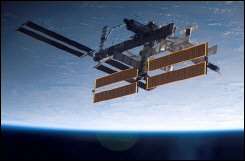
Already spanning an acre in orbit, the International Space Station this year will grow faster in size, power, volume and mass than ever before, significantly expanding its capabilities and setting new records for humans in orbit.
"This will be a challenging but rewarding year for the station program," said Kirk Shireman, deputy program manager for the International Space Station. "The station's operations will grow both in orbit and on Earth. As we launch new international components this year, we also will begin new flight control operations from facilities around the world."
In addition to control centers in the United States, Russia and Canada, control centers for the station also will be activated in France, Germany and Japan, allowing NASA's partners to oversee their contributions to the station.
In 2007, NASA and Russia plan to conduct as many as 24 spacewalks, more than has ever been done in a single year. The first spacewalk began at 9:14 a.m. CST Wednesday, Jan. 31 on NASA TV and features Mike Lopez-Alegria, the commander of the current space station mission, known as Expedition 14.
By the end of Expedition 14 in April, Lopez-Alegria should lead all astronauts in the number of spacewalks and the amount of time spent spacewalking. After returning to Earth in July, Expedition 14 and Expedition 15 Flight Engineer Sunita Williams will hold the NASA astronaut record for longest time in space. Lopez-Alegria will have set that record just months earlier. Williams also will have completed the most spacewalks by a woman by the end of February.
Also this year, the electricity generated and used on the station will more than double. By the end of 2007, the station's solar panels will extend to almost three-quarters of an acre of surface area. The extra power and cooling will allow the station's living and working space to expand by more than one-third. The complex will grow from its current size of a two-bedroom apartment to the size of a four-bedroom house by year's end.
The laboratories aboard will triple, with the addition of the European Space Agency's Columbus lab and the Japanese Experiment Module Kibo. A shuttle mission targeted for October will deliver Columbus, while another mission targeted for December will carry Kibo. The additions will mark the first time the station's interior space has grown in more than six years.
The station's supply lines also will grow. A new European cargo vehicle, called the Automated Transfer Vehicle, is set to make its first trip to the station in July. Currently, only the space shuttle and Russian Progress cargo craft deliver supplies to the orbiting laboratory.
This also will be a year of unparalleled robotic operations. For the first time, the station's robotic arm will be used to assemble large, pressurized components without a shuttle present. In the fall, the Canadarm2 will be used to move mating adapters and a large connecting module, called Node 2, into place on the station. Node 2 will provide pathways for crew members, air, electricity and water to the new international laboratories.
As the station breaks new ground in its use of robotics, its robotics system also will grow. On the same mission that delivers the first section of the Japan Aerospace Exploration Agency's Kibo lab, the Canadian Space Agency's Dextre robotic system will be delivered. Dextre, an almost human-shaped two-armed robotic system designed to work with Canadarm2, will add to the highly sophisticated robotics aboard the space station. Dextre will enable the robotics to perform even more intricate maintenance and servicing tasks, which previously would have required spacewalks.
Source: NASA


