Viewing the Future: ILC Simulations
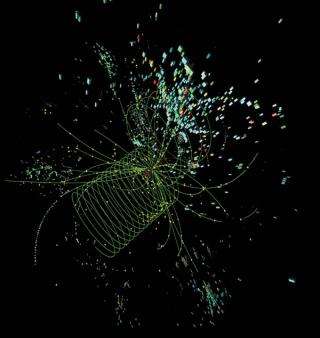
Even though it will still be several years before the International Linear Collider (ILC) comes online, scientists have already conducted millions of collision experiments, using detectors that have not been built yet. This is not the result of a new field of clairvoyant physics, but the power of computer simulations.
Scientists at SLAC and around the world are working on four detector concepts for the ILC: the silicon detector (SiD), the European-based Large Detector Concept (LDC), the Asian-based Global Large Detector (GLC), and a yet unnamed 4th detector concept. Instead of spending expensive resources on prototypes, researchers are using computer simulations to conduct virtual experiments. By doing so, they can optimize detector designs to yield the best science possible.
"We can design the detector on paper, but we make computer simulations and see if these designs are right," said John Jaros, one of the co-leaders of the SiD concept, which is being developed at SLAC. "Are we measuring what we want to measure? Are we measuring them well enough?"
A group led by SLAC physicist Norman Graf has made their simulation software available to the international community. Researchers who want to use the software submit a list of interactions they would like to simulate, as well as configurations for the detector they want to test. The software simulates the particle interactions millions of times, producing a statistical picture of what the actual experiment would look like. The results will not only aid detector designs, but also provide researchers with simulated datasets for scientific analysis.
When the ILC is complete, physicists will be able to compare these simulations with actual experiments. "That's when it gets exciting," Graf said. Deviations from simulations might indicate calculation errors or bugs in the software, but could also hint at exciting scientific discoveries.
"We prepare ourselves for the bug, but we always aspire toward new physics," Graf said.
Source: by Marcus Woo, Stanford Linear Accelerator Center


