February 1, 2007 feature
Quantum mechanics may explain how humans smell
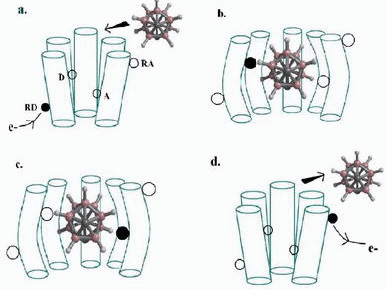
Scientists from the London Centre for Nanotechnology (LCN) at University College London have newly analyzed an intriguing 10-year-old theory of smell, finding that the idea may make more sense than once thought.
Regarding smell, scientists only have a few pieces of the puzzle, and it’s unclear how they fit into the big picture. Basically, scientists know that odorant molecules in the air actuate several types of receptors in our noses, which then trigger nerve cells for the brain to analyze. But while scientists know that the shape and size of molecules can make odors smell differently, some molecules with nearly identical shapes smell nothing alike.
This apparent conundrum is due to the lack of understanding of what happens before and as the odorant molecules interact with the nasal receptors. These initial atomic-scale processes must include some selection criteria that explain why receptors react differently to molecules of the same (or different) shapes.
The possibility that LCN physicists Jennifer Brookes, Filio Hartoutsiou, Andrew Horsfield and Marshall Stoneham have looked into is that electrons in the receptors can be triggered to tunnel between energy states, provided the odorant molecule’s vibration frequency matches the energy difference of these states. The LCN group tested the physical viability of this mechanism, first suggested in 1996 by a scientist named Luca Turin, and found that a general model of this electron tunneling is consistent with physics laws as well as with known features of smell.
Quantum mechanical tunneling, a process often exploited in technology, occurs when a particle passes through a barrier despite being forbidden by classical physics. This is possible for small-scale objects, such as electrons, due to their wave-like properties. If an odorant molecule’s vibrations (or phonons) cause electrons in a nasal receptor to tunnel between energy states, nerve signals are sent to the brain. Different vibrational frequencies are detected by different receptors, so because different odorants have different frequencies, odorants smell different.
“I personally was surprised that our answer seems so robust—we don't need to fudge or to take special helpful values of parameters,” Stoneham told PhysOrg.com. “At the start, we could not have been sure at all. In fact, when I first heard of the ideas 10 years ago, I did not expect them to work out. I liked Luca Turin's idea—it was interesting—but what we did was certainly not proving the obvious.”
Whereas the basic chemical image of smell in the past was a “lock and key” model, with different shaped molecules fitting in different receptors, the LCN team explains how the electron tunneling mechanism is more of a “swipe card” model. Similar to a credit card, an odorant molecule would be “read” by receptors that picked up its vibration spectrum, along with matching its shape.
“The major other theories of how receptors generate signals that are specific to certain molecules are all ones depending on molecular shape, mainly ‘lock and key’ mechanisms,” said Stoneham. “As we say in our Physical Review Letter, this popular model fails badly for these small scent molecules (similar molecules smell different, differently-shaped molecules smell the same, the actuation process is ill-defined).”
As the LCN group’s calculations show, this non-mechanical actuation is physically plausible: the charge transfer rate is consistent with the observed time scale; the inelastic electron signal is decipherable; and there does appear to be a link between a molecule’s vibration spectrum and its odor. Although the scientists still need to know more about the properties of receptors, the swipe card model offers insight into how selectivity works for human smell.
“On the possibility of whether or not we might completely understand smell in the near future, there are many levels of understanding,” Stoneham explained. “But to a level such that scents might be designed, probably yes (and indeed Luca Turin and his firm, Flexitral, have been reasonably successful).”
Citation: Brookes, Jennifer C., Hartoutsiou, Filio, Horsfield, A. P., and Stoneham, A. M. “Could Humans Recognize Odor by Phonon Assisted Tunneling?” Physical Review Letters 98, 038101 (2007).
By Lisa Zyga, Copyright 2007 PhysOrg.com.
All rights reserved. This material may not be published, broadcast, rewritten or redistributed in whole or part without the express written permission of PhysOrg.com.


