December 11, 2005 feature
Safe Nuclear Power and Green Hydrogen Fuel
Nuclear power is being shunned. It’s not surprising, after the serious accident at Chernobyl in 1986 that made the Russian city’s name synonymous with disaster. The potential exists for more of the same and many countries have given up on nuclear power altogether.
But in other countries, they’ve been able to make it work. In France, for instance, about 75 percent of electricity is generated from nuclear power. Worldwide, it provides 17% of our energy. The US has not brought a new plant online since 1996 yet still generates 788.6 billion kilowatt-hours (KWh) yearly – almost 20% of the US total – accident free.
Nuclear power is like a handgun. It’s the people handling it who are dangerous. But there is one big difference: with a handgun, you shoot a few people at most. A reactor accident could wipe several hundred square miles – permanently.
But all technologies start out crawling before they can walk or even run. The nuclear scientists have been working on the safety problems and already may have solved them.
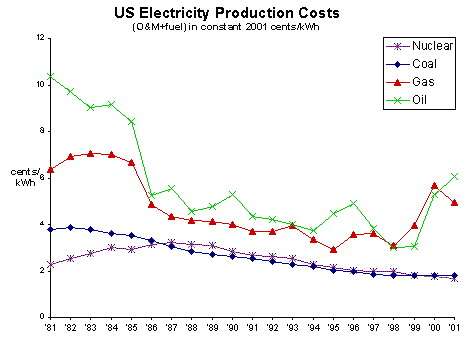
Danger aside, what makes nuclear power attractive? It’s competitive or cheaper than other forms of power generation. It’s easy to build compact plants that generate hundreds if not thousands of megawatts – something wind and solar can never hope to match. See the chart below to compare energy generation costs.
Compared with coal, still used to produce 50% of the US electricity needs, nuclear is clean. It creates no greenhouse gases. Its waste, although highly toxic, is compact and when handled correctly, safe.
Uranium, the fuel reactors use, is widely available in the continental US and Canada. Australia has the largest known reserves. This makes it unlikely rouge states can affect supply. Stable supply means lower long-term costs – especially when compared with oil and gas fired plants which are now producing about 20% of US electricity.
Reactor designs such as the Canadian CANDU can be very safe and less expensive to build than most reactors in use today. One drawback to this design, unfortunately, is its ability to produce weapons grade plutonium as a byproduct. On the plus side, it can use unenriched uranium – about .07% uranium 235. Regular plants require between 2% and 7% uranium 235 in reactor fuel to run properly.
Physicists and engineers at Beijing's Tsinghua University have made the first great leap forward in a quarter century, building a new nuclear power facility: a pebble-bed reactor (PBR) – sometimes also known as a Pebble Bed Modular Reactor (PBMR). This reactor is small enough to be assembled from mass-produced parts and cheap enough for emerging economies. Its safety is a matter of physics, not operator skill or reinforced concrete. This reactor is meltdown-proof.
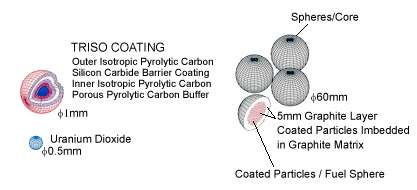
What makes it so safe is the fuel: instead of conventional fuel rods made of enriched uranium, PBRs use small, pyrolytic graphite coated pebbles with uranium cores. As a PBR reactor gets hotter, the rapid motion of atoms in the fuel decreases probability of neutron capture by U-235 atoms. This effect is known as Doppler Broadening. Nuclei of heated uranium move more rapidly in random directions generating a wider range of neutron speeds. U-238, the isotope which makes up most of the uranium in the reactor, is much more likely to absorb the faster moving neutrons. This reduces the number of neutrons available to spark U-235 fission. This, in turn, lowers heat output. This built-in negative feedback places a temperature limit on the fuel without operator intervention.
PBRs use high-pressure helium gas, not water, for cooling. Reactors have been “run dry” – without cooling gas. Result: they simply stabilize at a given temperature – lower than the pebbles’ shell melting point. No meltdown can occur.
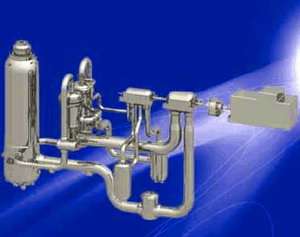
South Africa may have the most modern PBR on the drawing board. With the help of German scientists – acknowledged leaders in the field - they have planned to build several reactors within the next five years. Images in this article come from their design.
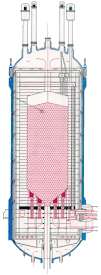
The reactor core is a bin of uranium fuel pebbles. Each tennis ball-sized pebble is rotated and/or checked for reactivity by removing them from the bottom of the funnel shaped reactor core. Spent pebbles are replaced by adding new ones at the top of the stack. Used ones that are still reactive also go to the top of the bin. The reactor can be re-fueled without stopping power production – not possible in conventional rod reactors which requires a full shut down.
Pebbles, because of their round nature, allow the cooling gas to be introduced at the bottom and pass freely through the stack. The heated gas is removed to perform work like spinning a turbine to generate electricity then recycled in a closed loop back to the reactor core.
PBRs use helium, which has high thermal conductivity and inertness (read: fireproof and noncorrosive) for cooling. This makes them more efficient at capturing heat energy from nuclear reactions than standard reactor designs. The ratio of electrical output to thermal output is about 50%.
The high-temperature gas design also has a silver lining – it can produce hydrogen. Think about that – fuel cell vehicles need expensive-to-produce hydrogen to run on – this reactor could make hydrogen as a byproduct.
Generation of hydrogen has been the biggest stumbling block to it adoption as a clean fuel. Hydrogen, found primarily in water, is expensive to extract as a gas. While the technical problems of handling, storage and use as fuel are largely solved, the high energy cost to produce hydrogen has made it an energy transport medium, not a source.
These new reactors run at high temperatures which are perfect for cracking abundant water or helium gas into hydrogen which can then be used as a green fuel – burning hydrogen just produces water vapor.
PBRs could produce cheap hydrogen that could be piped to areas of need or used in the local communities.
Plant sites are much smaller than traditional nuclear power plants. Their modular design allows for smaller plants that can grow with needs. A single PBR reactor would consist of one main building covering an area of about 1,300 square meters – less than half a football field. It would be about 42m high (6 stories), some of it below ground level. Billion dollar steel reinforced concrete containment vessels are not required – any coolant leak would be in the form of nonradioactive helium gas which would quickly disperse with out causing any ill effects.
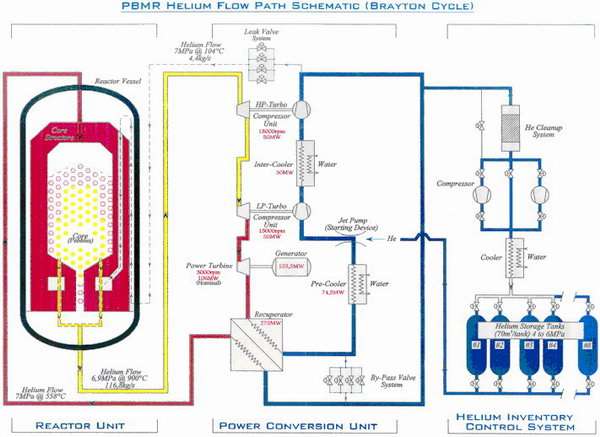
Each PBR would produce between 100 and 200 MW – small, in comparison to light and heavy water reactors which typically product around 1,000 MW. But they could easily be scaled up by adding reactors.
Ten PBR reactors producing 1,100 MW would occupy an area of no more than three football fields. Each PBR could serve about 30,000 to 40,000 homes.
Control rooms - much simpler than standard ones - would have a few PCs and extra monitors instead of banks of valves and dials. Each control room could monitor and manage up to 10 reactors.
One of the key features to this technology, especially important in China where energy demand is exploding, is its modular nature. While conventional reactors in operation today are all one of a kind – although many are based on the same designs – PBR reactors could de built with standard rail-movable components. When a new power plant is needed, they simply load the parts on a train with a construction crew and can have it delivering power in short order. Traditional plants in the US were sunk principally by long construction times and cost overruns, not environmental regulations.
Nuclear waste disposal has become a hot-button issue. Standard nuclear waste is very radioactive for 10,000 years or more. It must be transported to and stored in special containment facilities – normally underground. It can also be reprocessed but this is costly and technically difficult. There are only 3 reprocessing facilities worldwide: Thorpe in England, Cogema in France and Myakrt1 Chemical Combine in Russia. Far away from most of the world that needs clean, inexpensive power.
Fuel pebbles have 4 caps of containment built in. Many authorities consider pebbled radioactive waste stable enough it can be safely disposed of in geological storage – without any additional shielding or protection. Even in tests where pebbles were exposed to very high heat without coolant for long periods, they showed no outward damage. If one did manage to break a pebble it would only release one tiny (0.05mm) uranium dioxide particle. This particle is too heavy to be wind borne and so could not be blown into other areas like the fallout from the explosion at Chernobyl.
PBR proponents state they plan to store all waste products on the plant site – avoiding costly and dangerous radioactive material movement.
Even with the long term radioactivity and highly toxic nature of nuclear waste, some environmentalists are voicing support for nuclear energy.
James Lovelock, well known green activist and creator of the Gaia hypothesis that Earth is a single self-regulating organism, published a plea to phase out fossil fuels. Nuclear power, he argued, is the best short term hope for averting climatic catastrophe:
"Opposition to nuclear energy is based on irrational fear fed by Hollywood-style fiction, the Green lobbies, and the media. … Even if they were right about its dangers - and they are not - its worldwide use as our main source of energy would pose an insignificant threat compared with the dangers of intolerable and lethal heat waves and sea levels rising to drown every coastal city of the world. We have no time to experiment with visionary energy sources; civilization is in imminent danger and has to use nuclear, the one safe, available energy source, now, or suffer the pain soon to be inflicted by our outraged planet." - From the London Independent – May, 2004
Nuclear power, shunned after so many years, may be ready for resurgence. For some countries, like China, it may offer the only hope to meet its energy needs of its billion plus population in the 21st century. Indeed, they already have the first 10MW test reactor up and running.
By Philip Dunn, Copyright 2005 PhysOrg.com


