Artificial atoms make microwave photons countable
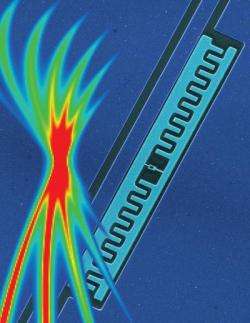
February 1st, 2007 An Artificial Atom Inside of a Transmission Line Cavity

Scanning electron micrograph of an artificial atom (light blue) inside of a transmission line cavity (dark blue). The "atom," composed of over a billion atoms of aluminum, gives a distinct signal for each possible photon number in the cavity. The theoretical prediction (color plot) was verified by these experiments. Credit: Schuster / Yale

Using artificial atoms on a chip, Yale physicists have taken the next step toward quantum computing by demonstrating that the particle nature of microwave photons can now be detected, according to a report spotlighted in the February 1 issue of the journal Nature.

Quantum theories are often considered to apply best to processes that happen on the smallest scale of atoms and molecules. By making artificial atoms larger — to a size that is nearly visible — and using microwaves as the source of energy, the collaborative research from the laboratory of Professor Robert Schoelkopf and the theory group of Professor Steven Girvin in the departments of Applied Physics and Physics at Yale created an electronic circuit that stores and measures individual microwave photons. In the process, they bring quantum mechanics to a larger scale and hope to employ it to build new kinds of quantum machines.

"The radiation from a microwave oven or cell phone does not seem to have much in common with light, but like its visible counterpart, microwaves are made of individual photons," said Schoelkopf. "A single microwave photon is quite large, extending over one centimeter in length, and yet has one hundred thousand times less energy than even a visible photon. Unlike a camera, which absorbs the light it detects, our measurement preserves the photons for later use."

"Advances in quantum computing are among the goals of the recently launched Yale Institute of Nanoscience and Quantum Engineering (YINQE), of which Girvin and Schoelkopf are core members," said Paul Fleury, Dean of Yale Engineering and Director of YINQE. "Such manipulation of single microwave photons is an important step towards realizing a quantum computer, which could exponentially speed up computations of difficult problems in cryptography, quantum physics and chemistry."

"Much like the children's game 'telephone,' current solid state quantum computing schemes can only make nearest-neighbor interactions. This forces distant quantum bits (qubits) to communicate by passing through many intermediates causing errors," said lead author David Schuster, a graduate student who completed this work as part of his thesis in January 2007. "Single microwave photons can be used as mobile carriers of quantum information allowing distant qubits to communicate directly, avoiding these problems."

The measurements they made represent the next step in circuit quantum electrodynamics, a field introduced by the same groups at Yale in 2004 to study quantum optics with microwaves using integrated circuits. According to Girvin, the detector they designed works "as if we made an antenna on an atom." Their results demonstrate that microwaves are particles because the system gives a response representing a discrete number of interactions of the microwave with the atom.

In addition to circuits, microwaves interact with a variety of physical systems, including atomic spins, molecules, and even nuclei. Single microwave photons can act as a bridge between these naturally occurring quantum systems and fabricated electrical circuits, resulting in a hybrid processor of quantum information. The next phase of the work, according to the authors, is to connect up multiple "atoms", using the photons to transfer the information between them.

Citation:
Nature 445, 515-518 (February 1, 2007.) doi:10.1038/nature05461
Nature 431, 162-167 (September 9, 2004)

Source: Yale University


print this article email this article download pdf blog this article bookmark this article     Digg this Stumble it share on Facebook share on Reddit add to delicious save to Yahoo! bookmarks
4.8/5 after 41 votes


February 1st, 2007 all stories
Physics / General Physics

Comments: 0
Rank: 4.8/5 after 41 votes

  • Stumble this up

  • Digg this

  • Share it:
  • share on Facebook
  • share on MySpace
  • share on Slashdot
  • rss-newsfeed
  • share on Google
  • share on Reddit
  • add to delicious
  • save to Yahoo! bookmarks
  • share on Windows Live
  • Add to Mixx!
Rating: 4.8/5 after 41 votes


Tags


  • Physicists Demonstrate Quantum Memory with Matter Qubits
    Physicists Demonstrate Quantum Memory with Matter Qubits
    Physics / General Physics
    created Jul 03, 2009 | popularity 4.4 / 5 (17) | comments 1
  • 'Holey' Nanosheets for Wastewater Dye Removal
    Nanotechnology / Nanomaterials
    created Jul 01, 2009 | popularity 5 / 5 (5) | comments 1
  • Jellyfish Robot Swims Like its Biological Counterpart
    Jellyfish Robot Swims Like its Biological Counterpart
    Electronics / Robotics
    created Jun 26, 2009 | popularity 4.4 / 5 (8) | comments 1
  • Could Maxwell's Demon Exist in Nanoscale Systems?
    Could Maxwell's Demon Exist in Nanoscale Systems?
    Physics / General Physics
    created Jun 24, 2009 | popularity 4.4 / 5 (18) | comments 29
  • Living Safely with Robots, Beyond Asimov's Laws
    Living Safely with Robots, Beyond Asimov's Laws
    Electronics / Robotics
    created Jun 22, 2009 | popularity 4.6 / 5 (52) | comments 40
  • Other News

    Scientists create first electronic quantum processor

    Scientists create first electronic quantum processor

    Physics / General Physics

    created Jun 28, 2009 | popularity 4.8 / 5 (53) | comments 39

    A team led by Yale University researchers has created the first rudimentary solid-state quantum processor, taking another step toward the ultimate dream of building a quantum computer.


    Science journals

    How to Spot an Influential Paper Based on its Citations

    Physics / General Physics

    created Jul 04, 2009 | popularity 4 / 5 (9) | comments 5

    (PhysOrg.com) -- At first it may seem that the number of citations received by a published scientific paper is directly related to that paper's quality of content. The higher the quality, the more people read ...


    Fermilab's CDF observes Omega-sub-b baryon

    Fermilab's CDF observes Omega-sub-b baryon

    Physics / General Physics

    created Jun 29, 2009 | popularity 4.7 / 5 (16) | comments 7

    (PhysOrg.com) -- At a recent physics seminar at the Department of Energy’s Fermi National Accelerator Laboratory, Fermilab physicist Pat Lukens of the CDF experiment announced the observation of a new particle, ...


    New insights, and a new angle, on high-temperature superconductivity

    New insights, and a new angle, on high-temperature superconductivity

    Physics / Superconductivity

    created Jun 29, 2009 | popularity 4.8 / 5 (13) | comments 6

    (PhysOrg.com) -- A Princeton-led research team has revealed surprising information about how electron behavior influences the conduction of electricity in a class of high-temperature superconductors. An increased ...


    The art of invisibility and the perfect cat's eye

    The art of invisibility and the perfect cat's eye

    Physics / Optics & Photonics

    created Jun 30, 2009 | popularity 4 / 5 (8) | comments 6

    (PhysOrg.com) -- In recent years scientists have explored the impossible by developing invisibility or 'cloaking' devices, but can the same technology also help make things more visible?