Bones in motion: Scientists to create new 3-D X-ray system
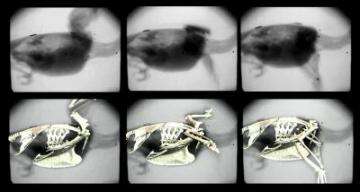
Brown University researchers are creating a technology that will allow doctors and scientists to do the seemingly impossible: See inside living humans and animals and watch their bones move in 3-D as they run, fly, jump, swim and slither.
This high-resolution, high-speed imaging system will contribute to better treatments for knee, shoulder, wrist and back injuries and help scientists understand the evolution of complex movements, from the flight of birds to the leap of frogs.
"This will be like having X-ray vision – you'll be able to see through skin and muscle and watch a skeleton move in 3-D," said Elizabeth Brainerd, the Brown University biology professor overseeing development of the new system. "Imagine animated X-ray movies of flying bats or flexing knees. It's very cool technology that is also very important from a biomedical standpoint."
The system will be designed and built with a $1.8-million grant from the W.M. Keck Foundation, one of the nation's largest philanthropic organizations and a major supporter of pioneering discoveries in science, engineering and medical research.
The system will fill a void in medical and scientific imaging. Right now, researchers trying to understand the complex motions of bones and joints are held back by technology. Computed tomography, or CT, delivers detailed 3-D images, but CT scanners are too slow to capture rapid motion. Cinefluoroscopy, a technique that uses X-rays to view objects, can produce moving images in two dimensions, but not 3-D.
An orthopedic surgeon trying to figure out the best way to repair a torn knee ligament or an evolutionary biologist tracing the disappearance of digits in pigs would face a difficult task. To see the exact position and movement of bones and the ligaments, tendons and cartilage that surround them, would require cutting into flesh – not a desirable option.
The new system, dubbed CTX, will combine the 3-D capability of CT scanners and the real-time movement tracking of cinefluoroscopy. CTX technology is expected to deliver images with exceptional precision and detail. Researchers will be able to track 3-D skeletal movements with 0.1 millimeter accuracy and see the equivalent of 1,000 CT images per second.
The result will be a powerful tool with applications for basic and applied research:
-- testing new theories of biomechanics, such as muscle-tendon interactions;
-- studying the evolution of bodies and how they move, such as birds' multijointed wings;
-- planning orthopedic surgeries and comparing the effectiveness of different approaches;
-- creating better treatments for shoulder, wrist, knee and back injuries;
-- driving innovations in computer graphics and scientific visualization.
The project cuts across disciplines and brings together a diverse team of Brown researchers. They include bioengineer Joseph Crisco, computer scientist David Laidlaw, orthopedic experts Braden Fleming and Douglas Moore, and biologists Stephen Gatesy, Thomas Roberts and Sharon Swartz. Brainerd, a professor of medical science in Brown's Department of Ecology and Evolutionary Biology, leads the team.
The grant from the W.M. Keck Foundation, paired with matching funds from Brown, will pay for the X-ray machines, treadmills and other equipment for a new CTX facility on campus. But creating the imaging technology will be a mainly computational challenge, so funding will also support substantial software development.
Brown faculty and students are already at work on pilot projects to visualize pigs walking, birds flying and frogs jumping, using seed funds from Brown's Office of the Vice President for Research and the National Science Foundation. Software will be rolled out in phases, Brainerd said, with a complete system available by 2010.
The project builds on orthopedic imaging work at Henry Ford Hospital in Detroit and on original research in skeletal imaging at Brown, including a trailblazing technique developed by Gatesy that uses animation software to combine CT scanner data with X-ray images. Images created using this technique – the forerunner of CTX – can be viewed at http://brown.edu/ctx/
Source: Brown University


