Sea level on the rise – in real and virtual worlds
February 1, 2007 Sea level on the rise – in real and virtual worlds

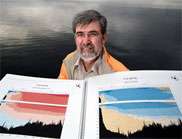
CSIRO Marine and Atmospheric Research and Antarctic Climate & Ecosystems CRC scientist, Dr John Church.

The climate system, and in particular sea level, may be responding more quickly to rising carbon emissions than climate scientists have estimated with climate models.

An international team of climate scientists has cautioned against suggestions that the Intergovernmental Panel on Climate Change (IPCC) has previously overestimated the rate of climate change.

The team, from six institutions around the world, reviewed actual observations of carbon dioxide, temperature and sea level from 1990 to 2006 and compared them with projected changes for the same period.

In a review published in the journal Science today, the authors found that carbon dioxide concentration followed the modelled scenarios almost exactly, that global-mean surface temperatures were in the upper part of the range projected by the IPCC, and that observed sea level has been rising faster than the models had projected and closely followed the IPCC Third Assessment Report upper limit of an 88 cm rise between 1990 and 2100.

The scientists noted that because the review period (1990-2006) was short, it would be premature to conclude that sea levels will continue to increase at the same rate in the future. However, they also said their findings show that previous projections have not exaggerated the rate of change but may in some respects have underestimated it.

Measurements of carbon dioxide through facilities such as the Australian Bureau of Meteorology’s Cape Grim observatory in Tasmania support the paper’s conclusions. The global average temperature estimates are collated separately by NASA’s Goddard Institute for Space Studies in the USA and the Hadley Centre and Climatic Research Unit in the UK. The sea level observations come from both coastal and island tide gauges and data provided by satellites.

Sea levels have risen largely due to warming of the ocean and the consequent thermal expansion and melting of non-polar glaciers and ice caps and the ice sheets of Antarctica and Greenland.

One of the authors of the review, Dr John Church of the Antarctic Climate & Ecosystems CRC and CSIRO, noted that any (or all) of the modelled contributions could be underestimated but that there is most uncertainty about the contribution made by ice-sheet melts. “Models of the potential contribution of the Greenland and Antarctic ice sheets need to be improved to include the potential of a relatively dynamic response,” Dr Church said.

Source: CSIRO


print this article email this article download pdf blog this article bookmark this article     Stumble it Digg this share on Facebook retweet share on Reddit add to delicious
Rate this story - 3.9 /5 (18 votes)


February 1, 2007 all stories

Comments: 0

3.9 /5 (18 votes)
  • Stumble this up

  • Digg this

  • share this

  • hide
  • Related Stories

  • Dead Sea needs world help to stay alive
    created 15 hours ago | popularity not rated yet | comments 0
  • Antarctic ice loss vaster, faster than thought: study
    created Nov 22, 2009 | popularity not rated yet | comments 0
  • Dutch build more dunes against rising seas
    created Nov 20, 2009 | popularity not rated yet | comments 0
  • Mysteriously warm times in Antarctica
    created Nov 18, 2009 | popularity not rated yet | comments 0
  • Extinct moa rewrites New Zealand's history
    created Nov 18, 2009 | popularity not rated yet | comments 0


  • hide
  • Relevant PhysicsForums posts

  • The IPCC and the term "most"
    created Nov 23, 2009
  • Is global warming a fact?
    created Nov 23, 2009
  • Random variability of wind patterns
    created Nov 23, 2009
  • Record precipitation in the UK
    created Nov 22, 2009
  • More from Physics Forums - Earth

Other News

America's increasing food waste is laying waste to the environment

Space & Earth / Environment

created 25 minutes ago | popularity not rated yet | comments 0

Food waste contributes to excess consumption of freshwater and fossil fuels which, along with methane and carbon dioxide emissions from decomposing food, impacts global climate change. In a new paper published in the open-access, ...


Shuttle Atlantis leaves space station, headed home (AP)

Shuttle Atlantis leaves space station, headed home

Space & Earth / Space Exploration

created 35 minutes ago | popularity not rated yet | comments 0

(AP) -- Atlantis and its seven astronauts have left the International Space Station.


First black holes may have incubated in giant, starlike cocoons, says CU-Boulder study

First black holes may have incubated in giant, starlike cocoons

Space & Earth / Astronomy

created 16 hours ago | popularity 4.4 / 5 (10) | comments 15

(PhysOrg.com) -- The first large black holes in the universe likely formed and grew deep inside gigantic, starlike cocoons that smothered their powerful x-ray radiation and prevented surrounding gases from ...


Cassini Captures Ghostly Dance of Saturn's Northern Lights

Cassini Captures Ghostly Dance of Saturn's Northern Lights (w/ Video)

Space & Earth / Space Exploration

created 13 hours ago | popularity 5 / 5 (5) | comments 0

(PhysOrg.com) -- In the first video showing the auroras above the northern latitudes of Saturn, Cassini has spotted the tallest known "northern lights" in the solar system, flickering in shape and brightness ...


ET: Check your voicemail

ET: Check your voicemail

Space & Earth / Space Exploration

created 13 hours ago | popularity 3.4 / 5 (5) | comments 5

(PhysOrg.com) -- Alien beings on faraway planets may not have noticed, but it’s been 35 years since human beings made the first deliberate effort to send them a message.