Cassini images mammoth cloud engulfing Titan’s North Pole
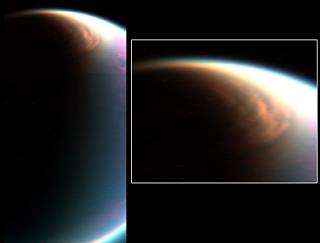
February 1st, 2007 Cassini images mammoth cloud engulfing Titan’s North Pole

Cassini's visual and infrared mapping spectrometer (VIMS) has imaged a huge cloud system covering the north pole of Titan. This composite image shows the cloud, imaged at a distance of 90 000 kilometers during a 29 December 2006 flyby designed to observe the limb of the moon. Cassini's visual and infrared mapping spectrometer scanned the limb, revealing this spectacular cloud system. It covers the north pole down to a latitude of 62 degrees north and at all observed longitudes. Such a cloud cover was expected, according to the atmospheric circulation models of Titan, but it had never been observed before with such details. The condensates may be the source of liquids that fill the lakes recently discovered by the radar instrument. This image was color-coded, with blue, green and red at 2 microns, 2.7, and 5 microns, respectively. Credits: NASA/JPL/University of Arizona

A giant cloud half the size of the United States has been imaged on Saturn’s moon Titan by the Cassini spacecraft. The cloud may be responsible for the material that fills the lakes discovered last year by Cassini's radar instrument.

Cloaked by winter's shadow, this cloud has now come into view as winter turns to spring. The cloud extends down to 60 degrees north latitude, is roughly 2400 kilometers in diameter and engulfs almost the entire north pole of Titan.

The new image was acquired on 29 December 2006, by Cassini's visual and infrared mapping spectrometer (VIMS). Scientific models predicted this cloud system but it had never been imaged with such details before.

"We knew this cloud had to be there but were amazed at its size and structure," said Dr. Christophe Sotin of the University of Nantes, France, a member of the visual and infrared mapping spectrometer team and distinguished visiting scientist at NASA's Jet Propulsion Laboratory, Pasadena, California. "This cloud system may be a key element in the global formation of organics and their interaction with the surface."

The same cloud system seen on 29 December 2006, was still there two weeks later during the flyby which took place on 13 January 2007, even though observing conditions were slightly less favorable than in December.

The Cassini radar team reported last year that the lakes at the north pole are partly filled and some appear to have evaporated, likely contributing to this cloud formation, which is made up of ethane, methane and other organics.

These findings reinforce the idea that methane rains down onto the surface to form lakes, and then evaporates to form clouds. Scientists compare this methane cycle to the hydrological cycle on Earth, dubbing it 'methane-ologic cycle'.

Ground-based observations show this Titan cloud system comes and goes with the seasons. A season on Titan lasts approximately seven Earth years. Based on the global circulation models, it seems that such cloud activity can last about 25 Earth years before almost vanishing for four to five years, and then appearing again for 25 years.

Scientists expect this cloud to be around for several years. As the seasons change, scientists expect a shift of these clouds and lakes from the north pole to the south pole. On Titan's south pole, scientists have seen only one kidney-shaped lake with Cassini’s imaging cameras.

"With 16 more flybys to come this year, we should have the opportunity to monitor the evolution of this cloud system over time," said Dr. Stephane Le Mouelic, working with the Cassini visual and infrared mapping spectrometer team, and also at the University of Nantes.

Source: ESA


print this article email this article download pdf blog this article bookmark this article     Digg this Stumble it share on Facebook share on Reddit add to delicious save to Yahoo! bookmarks
4.4/5 after 18 votes


February 1st, 2007 all stories
Space & Earth / Astronomy

Comments: 0
Rank: 4.4/5 after 18 votes

  • Stumble this up

  • Digg this

  • Share it:
  • share on Facebook
  • share on MySpace
  • share on Slashdot
  • rss-newsfeed
  • share on Google
  • share on Reddit
  • add to delicious
  • save to Yahoo! bookmarks
  • share on Windows Live
  • Add to Mixx!
Rating: 4.4/5 after 18 votes

  • Related Stories

  • Mars data published in Science this week
    created Jul 02, 2009 | popularity not rated yet | comments 0
  • Science of Santa: Researcher Says St. Nick Can Deliver Presents in One Night
    created Dec 08, 2008 | popularity not rated yet | comments 0
  • Giant Cyclones at Saturn's Poles Create a Swirl of Mystery
    created Oct 13, 2008 | popularity not rated yet | comments 0
  • Unlocking the secret of the Kondo Effect
    created Sep 22, 2008 | popularity not rated yet | comments 0
  • The puzzling 'eye of a hurricane' on Venus
    created Mar 13, 2008 | popularity not rated yet | comments 0

Tags


  • Physicists Demonstrate Quantum Memory with Matter Qubits
    Physicists Demonstrate Quantum Memory with Matter Qubits
    Physics / General Physics
    created Jul 03, 2009 | popularity 4.4 / 5 (17) | comments 1
  • 'Holey' Nanosheets for Wastewater Dye Removal
    Nanotechnology / Nanomaterials
    created Jul 01, 2009 | popularity 5 / 5 (5) | comments 1
  • Jellyfish Robot Swims Like its Biological Counterpart
    Jellyfish Robot Swims Like its Biological Counterpart
    Electronics / Robotics
    created Jun 26, 2009 | popularity 4.4 / 5 (8) | comments 1
  • Could Maxwell's Demon Exist in Nanoscale Systems?
    Could Maxwell's Demon Exist in Nanoscale Systems?
    Physics / General Physics
    created Jun 24, 2009 | popularity 4.4 / 5 (18) | comments 29
  • Living Safely with Robots, Beyond Asimov's Laws
    Living Safely with Robots, Beyond Asimov's Laws
    Electronics / Robotics
    created Jun 22, 2009 | popularity 4.6 / 5 (52) | comments 40
  • Other News

    Forty years ago man first walked on the moon

    Space & Earth / Space Exploration

    created 9 hours ago | popularity 5 / 5 (2) | comments 0

    Forty years ago on July 20, 1969, American astronaut Neil Armstrong realized the oldest dream of human civilizations when he became the first man to walk on the moon.


    The least sea ice in 800 years

    The least sea ice in 800 years

    Space & Earth / Earth Sciences

    created Jul 01, 2009 | popularity 4.3 / 5 (59) | comments 52

    New research, which reconstructs the extent of ice in the sea between Greenland and Svalbard from the 13th century to the present indicates that there has never been so little sea ice as there is now. The ...


    Gas around young galaxy

    Intense heat killed the Universe's would-be galaxies, researchers say

    Space & Earth / Astronomy

    created Jul 01, 2009 | popularity 3.2 / 5 (19) | comments 25

    (PhysOrg.com) -- Our Milky Way galaxy only survived because it was already immersed in a large clump of dark matter which trapped gases inside it, scientists led by Durham University's Institute for Computational ...


    Scientists' Drill Hits Magma: Only Third Time on Record

    Scientists' Drill Hits Magma: Only Third Time on Record

    Space & Earth / Earth Sciences

    created Jun 29, 2009 | popularity 4.7 / 5 (20) | comments 19

    (PhysOrg.com) -- Scientists drilling a borehole deep into Iceland’s rocky crust to explore new methods of using geothermal energy hit a major roadblock on Thursday: Their drill ran into molten rock at a depth ...


    NASA manager pitches a cheaper return-to-moon plan

    Space & Earth / Space Exploration

    created Jun 30, 2009 | popularity 4 / 5 (7) | comments 18

    (AP) -- Like a car salesman pushing a luxury vehicle that the customer no longer can afford, NASA has pulled out of its back pocket a deal for a cheaper ride to the moon.