Microprinting Technique for Patterning Single Molecules
February 1, 2007
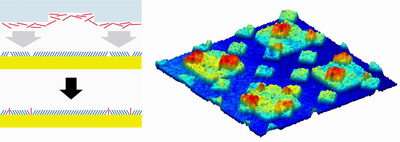
Microcontact Insertion Printing. Left: Single molecules are inserted into a preexisting layer in microscopic regions that are defined by a patterned elastomeric stamp. Right: Complex and overlapping chemical patterns can be fabricated employing multiple stamping steps. (scanning electron micrograph, field of view 90 µm x 90 µm)
A new process for creating patterns of individual molecules on a surface combines control of self-assembled monolayers (SAMs) and a soft lithography technique known as microcontact printing. Scientists use the process, known as "microcontact insertion printing" to build surfaces that have molecules with specific functions inserted at known intervals on a surface.
The new technique, with potential applications ranging from analysis of biochemical mixtures to molecular-scale electronic components, will be described as the cover story of the 5 February 2007 issue of the journal Applied Physics Letters by a team led by Penn State researchers Paul S. Weiss, distinguished professor of chemistry and physics; Mark Horn, associate professor of engineering science and mechanics; and Anne M. Andrews, assistant professor of veterinary and biomedical sciences.
Microcontact insertion is based on the technique of microcontact printing, in which a patterned rubber-like stamp is "inked" with a solution of molecules and then applied to a surface. However, the insertion technique does not apply molecules to the entire surface contacted, but instead fills only defects -- molecule-sized gaps -- in a layer of molecules that previously has been placed on and attached to the surface. "Lithography cannot place molecules with nanometer precision," says Weiss, "but by building the defects into the surface and then filling them selectively with this process, we can place the isolated molecules in a predesigned nano-scale or micro-scale pattern."
The process of microcontact insertion printing starts with a self-assembled monolayer (SAM) -- a chemical deposition on the surface that is one molecule thick. The researchers can build the SAM with defects, or regions in which the surface is not covered by the film. By controlling the type, size, and number of the defects, they create a pattern in which the surface appears as a matrix of exposed dots. In one example, there is an average of 10 molecules between defects, making an average separation between inserted molecules of about 5 nanometers. If defects are made larger, then more molecules are inserted in each one.
After the formation of the matrix with controlled defects, the microcontact printing technique is used to fill the exposed parts of the surface. "We use the stamp to attach molecules to the open surface," says Weiss. "Because each molecule is surrounded by the SAM, it stays in place and there is no migration." Using a series of stamps allows different molecules to be placed on the surface in a pattern, with each region of the surface holding a different type of functional molecule tethered to the surface and held in place by the surrounding inert monolayer.
The chemical functionality of the attached molecule can be made in a way that will capture specific types of molecules from a mixture. The pattern of functionalities creates a multiplexed capture surface on which chemical compounds, such as proteins, other biological molecules, or environmental contaminants can be separated from a complex mixture. Each part of the pattern can be designed for specific classes of target molecules so that a single patterned surface can be used to determine the identity and concentration of multiple components of the mixture.
In addition to its application in creation of surfaces with specific selectivity, the microcontact-insertion process could allow the controlled deposition of molecules that can interact in specific ways. This application could be used to build electronic components or other functional surfaces.
Source: Penn State
-
Smallest tools could give biggest results in bone repair
Feb 06, 2012 |
not rated yet |
0
-
Discovery of extremely long-lived proteins may provide insight into cell aging
Feb 03, 2012 |
4.9 / 5 (13) |
0
-
Study finds potential key to immune suppression in cancer
Jan 19, 2012 |
not rated yet |
0
-
Stem cell odyssey leads from tusks and teeth to gut
Jan 11, 2012 |
4 / 5 (1) |
0
-
Signaling to chromatin
Jan 03, 2012 |
4.5 / 5 (2) |
0
-
Engineers build first sub-10-nm carbon nanotube transistor
Feb 01, 2012 |
4.9 / 5 (31) |
30
-
Something old, something new: Evolution and the structural divergence of duplicate genes
Jan 31, 2012 |
4.6 / 5 (7) |
1
-
The hidden nanoworld of ice crystals: Revealing the dynamic behavior of quasi-liquid layers
Jan 30, 2012 |
5 / 5 (3) |
1
-
Stock market network reveals investor clustering
Jan 27, 2012 |
3.9 / 5 (23) |
8
-
Of microchemistry and molecules: Electronic microfluidic device synthesizes biocompatible probes
Jan 26, 2012 |
5 / 5 (1) |
0
-
Understanding induced emfs
41 minutes ago
-
What is the precise definition of a year?
1 hour ago
-
Universe as a cellular automaton
3 hours ago
-
Question about Newton's laws
3 hours ago
-
Gravity Question (I think) with mass and speed
6 hours ago
-
Can you manipulate any formula in Physics?
6 hours ago
- More from Physics Forums - General Physics
More news stories
New kind of solar cell could capture significantly more energy than current cells
New solar cells could increase the maximum efficiency of solar panels by over 25%, according to scientists from the University of Cambridge.
Feb 08, 2012 |
4.5 / 5 (12) |
14
|
Nanoshell whispering galleries improve thin solar panels
Visitors to Statuary Hall in the U.S. Capitol Building may have experienced a curious acoustic feature that allows a person to whisper softly at one side of the cavernous, half-domed room and for another on ...
Nanotechnology / Nanomaterials
Feb 07, 2012 |
4.3 / 5 (6) |
6
|
'Dark plasmons' transmit energy
Microscopic channels of gold nanoparticles have the ability to transmit electromagnetic energy that starts as light and propagates via "dark plasmons," according to researchers at Rice University.
Feb 09, 2012 |
4.8 / 5 (9) |
1
|
Revealing how a battery material works
Since its discovery 15 years ago, lithium iron phosphate (LiFePO4) has become one of the most promising materials for rechargeable batteries because of its stability, durability, safety and ability to deliver ...
Nanotechnology / Nanomaterials
Feb 08, 2012 |
5 / 5 (5) |
0
|
Nanotube therapy takes aim at breast cancer stem cells
Wake Forest Baptist Medical Center researchers have again proven that injecting multiwalled carbon nanotubes (MWCNTs) into tumors and heating them with a quick, 30-second laser treatment can kill them.
Nanotechnology / Bio & Medicine
Feb 09, 2012 |
5 / 5 (1) |
0
|
Walney offshore wind farm is world's biggest (for now)
(PhysOrg.com) -- The Walney wind farm on the Irish Sea--characterized by high tides, waves and windy weather--officially opened this week. The farm is treated in the press as a very big deal as the Walney ...
GPS court ruling leaves US phone tracking unclear
A US Supreme Court decision requiring a warrant to place a GPS device on the car of a criminal suspect leaves unresolved the bigger issue of police tracking using mobile phones, legal experts say.
Europeans protest controversial Internet pact
Tens of thousands of people marched in protests in more than a dozen European cities Saturday against a controversial anti-online piracy pact that critics say could curtail Internet freedom.
Europe stakes billion-dollar bet on new rocket
A pencil-slim rocket is scheduled to lift into space from South America on Monday, carrying a billion-dollar bet that Europe can grab a juicy slice of the market to place satellites in low orbit.
Study finds that anti-diabetic medication can prevent the long-term effects of maternal obesity
In a study to be presented today at the Society for Maternal-Fetal Medicine's annual meeting, The Pregnancy Meeting, in Dallas, Texas, researchers will report findings that show that short therapy with the anti-diabetic medication ...
Netflix settlement trims 14 pct off 4Q earnings
(AP) -- Netflix pressed the rewind button on its fourth-quarter earnings after settling allegations that the video subscription service violated a consumer-privacy law.