Scientists develop portable generator that turns trash into electricity
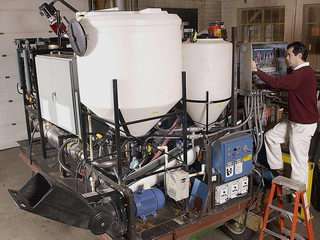
A group of scientists have created a portable refinery that efficiently converts food, paper and plastic trash into electricity. The machine, designed for the U.S. military, would allow soldiers in the field to convert waste into power and could have widespread civilian applications in the future.
"This is a very promising technology," said Michael Ladisch, the professor of agricultural and biological engineering at Purdue University who leads the project. "In a very short time it should be ready for use in the military, and I think it could be used outside the military shortly thereafter."
The "tactical biorefinery" processes several kinds of waste at once, which it converts into fuel via two parallel processes. The system then burns the different fuels in a diesel engine to power a generator. Ladisch said the machine's ability to burn multiple fuels at once, along with its mobility, make it unique.
Roughly the size a small moving van, the biorefinery could alleviate the expense and potential danger associated with transporting waste and fuel. Also, by eliminating garbage remnants - known in the military as a unit's "signature" - it could protect the unit's security by destroying clues that such refuse could provide to enemies.
Researchers tested the first tactical biorefinery prototype in November and found that it produced approximately 90 percent more energy than it consumed, said Jerry Warner, founder of Defense Life Sciences LLC, a private company working with Purdue researchers on the project. He said the results were better than expected.
The U.S. Army subsequently commissioned the biorefinery upon completion of a functional prototype, and the machine is being considered for future Army development.
The tactical biorefinery first separates organic food material from residual trash, such as paper, plastic, Styrofoam and cardboard. The food waste goes to a bioreactor where industrial yeast ferments it into ethanol, a "green" fuel. Residual materials go to a gasifier where they are heated under low-oxygen conditions and eventually become low-grade propane gas and methane. The gas and ethanol are then combusted in a modified diesel engine that powers a generator to produce electricity.
Ladisch and Warner said the machine eventually could be deployed in disaster situations, similar to Hurricane Katrina, or at any crisis location where people are stranded without power. Emergency crews could then use the machine to turn debris such as woodchips into much-needed electricity, Warner said.
The refinery also could provide supplementary power for factories, restaurants or stores, Ladisch said.
"At any place with a fair amount of food and scrap waste the biorefinery could help reduce electricity costs, and you might even be able to produce some surplus energy to put back on the electrical grid," he said.
Much of the fuel the system combusts is carbon-neutral, said Nathan Mosier, a Purdue professor of agricultural and biological engineering involved in the project. Carbon-neutral fuels like ethanol do not cause an appreciable net increase in atmospheric levels of the greenhouse gas carbon dioxide. This is because the fuel releases carbon that has only recently been taken up by plants during photosynthesis, the process by which plants convert carbon dioxide to oxygen and sugars. The same is not true for petroleum, in which the carbon contents were removed from the atmosphere millions of years ago.
The biorefinery generator initially runs on diesel oil for several hours until the gasifier and the bioreactor begin to produce fuel, Warner said. In the initial commissioning test, researchers measured the amount of diesel oil burned and electricity produced to calculate its efficiency.
The machine produces a very small amount of its own waste, Warner said, mostly in the form of ash that the Environmental Protection Agency has designated as "benign," or non-hazardous. Any leftover materials from the bioreactor are put into the gasifier, which has to be emptied every two to three days.
"It's about enough to fill a regular sized trash bag, and it represents about a 30-to-1 volume reduction," Warner said.
Other companies collaborated in this project, including Bowen Engineering of Indianapolis, Huston Electric of Lafayette, Ind., and Community Power Corp. of Littleton, Colo.
Source: by Douglas M Main, Purdue University


