Titanic sunk faster than thought
December 12, 2005 Titanic

After visiting the bottom of the Atlantic Ocean in August 2005, scientists have discovered that Titanic took just five minutes to sink – much faster than previously thought.

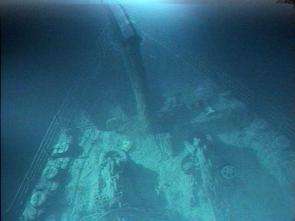
The scientists also discovered that after hitting an iceberg, the ship split into three pieces. During their visit they found two large pieces of the ship's hull half a kilometer away from the stern.

Before this discovery, experts had believed the hull was shattered into hundreds of pieces and that Titanic had split into two halves as depicted by James Cameron's 1997 movie.

The two large pieces discovered in August were in good condition, measured 12 meters by 27 meters and were coated with red paint. When Titanic's wreck was first discovered in 1985, scientists reported the hull remained missing.

According to Roger Long, a naval architect who studied the recent discovery, the vessel hit the iceberg and the hull broke loose before the stern split. He said the ship only took five minutes to sink. Before the August expedition, David Brown, a Titanic historian had said the stern took twenty minutes to plunge into the ocean.

Measured at 46,000 tons by its builders, Titanic was branded as unsinkable by most media of the early 1900s. After two and a half hours into its first voyage, the gigantic vessel hit an iceberg and made its way in pieces to the bottom of the Atlantic on April 14, 1912. The disaster claimed 1,500 lives and the ship remained missing until Robert Ballard, a twentieth century explorer, found the bulk of the wreck in 1985. The broken pieces remained lying at a depth of 13,000 feet below sea level and some 380 miles southeast of Newfoundland.

After the August trip, Ballard said, "They found a fragment. Big deal. Am I surprised? No. When you go down there, there's stuff all over the place. It hit an iceberg and it sank. Get over it."

The expedition was financed by the The History Channel, who have scheduled a single piece documentary on February 26th 2006 to present the findings.

Copyright 2005 PhysOrg.com


print this article email this article download pdf blog this article bookmark this article     Stumble it Digg this share on Facebook retweet share on Reddit add to delicious
Rate this story - 2.9 /5 (76 votes)


December 12, 2005 all stories

Comments: 0

2.9 /5 (76 votes)
  • Stumble this up

  • Digg this

  • share this

  • hide
  • Related Stories

  • Planet Smash-Up Sends Vaporized Rock, Hot Lava Flying (w/ Video)
    created Aug 10, 2009 | popularity not rated yet | comments 0
  • Speed matters for ice-shelf breaking
    created Nov 27, 2008 | popularity not rated yet | comments 0
  • Another Titanic expedition possible in 2010
    created Oct 26, 2009 | popularity not rated yet | comments 0
  • First black holes born starving (w/ Video)
    created Aug 10, 2009 | popularity not rated yet | comments 0
  • Ice Bridge Supporting Wilkins Ice Shelf Collapses
    created Apr 08, 2009 | popularity not rated yet | comments 0


Other News

Grand Canyon to change 'unfair' permit system

Other Sciences / Other

created 53 minutes ago | popularity not rated yet | comments 0

(AP) -- Getting one of the roughly 11,500 permits granted each year to backpack overnight in the Grand Canyon has become so competitive and "unfair" that managers at the national park have decided to change the system.


Researcher: Faint writing seen on Shroud of Turin (AP)

Researcher: Faint writing seen on Shroud of Turin (Update)

Other Sciences / Archaeology & Fossils

created Nov 20, 2009 | popularity 2.3 / 5 (28) | comments 30

(AP) -- A Vatican researcher has rekindled the age-old debate over the Shroud of Turin, saying that faint writing on the linen proves it was the burial cloth of Jesus. Experts say the historian may be reading ...


Museum: Galileo's fingers, tooth are found (AP)

Museum: Galileo's fingers, tooth are found

Other Sciences / Archaeology & Fossils

created Nov 21, 2009 | popularity 4.3 / 5 (3) | comments 7

(AP) -- Two fingers and a tooth removed from Galileo Galilei's corpse in a Florentine basilica in the 18th century and given up for lost have been found again and will soon be put on display, an Italian museum ...


Maya

New insights into the life of the Maya

Other Sciences / Archaeology & Fossils

created Nov 16, 2009 | popularity 4.6 / 5 (15) | comments 7

(PhysOrg.com) -- Ancient artifacts are almost always concerned with rich and powerful religious and political leaders, but new excavations of an ancient Maya site have unearthed a pyramid decorated with murals ...


Three of a kind

Three of a kind: Revealing language’s universal essence

Other Sciences / Social Sciences

created Nov 20, 2009 | popularity 4.1 / 5 (13) | comments 6

(PhysOrg.com) -- On the surface, English, Japanese, and Kinande, a member of the Bantu family of languages spoken in the Democratic Republic of Congo, have little in common. It is not just that the vocabularies ...