Printers to produce life-saving organs
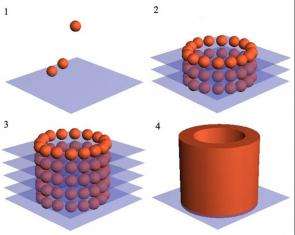
December 12th, 2005  Schematics of building a tubular organ module by bioprinting

A team of American scientists is studying the potential of printers being developed to produce life-saving organs, reports Wired.com. They believe that any organ, a skin graft, a new trachea or a heart patch for example, can be created using special printers. The team has already discovered the required ink and paper for the project.

Image: Schematics of building a tubular organ module by bioprinting. The blue sheets represent the biopaper or scaffold gel. The gel and the histotypical spherical bioink particles are deposited/printed layer-by-layer. Credit: University of Missouri

The research team is led by professor Gabor Forgacs, a biological physics researcher from the University of Missouri-Columbia. Having received a grant of $5 million from the National Science Foundation, the team of researchers from three universities has developed the bio-ink and bio-paper, a step that could soon lead to organ printing. The team has also developed tubes that simulate human blood vessels as well as sheets of heart muscle cells that can be printed by the concept organ printer.

Professor Glenn D. Prestwich of University of Utah, who developed the bio-paper admits that while some organs would be difficult to print, others such as livers and kidneys would be easier to create. The professor estimates that mass organ printing could be common within the next ten, or maybe even five, years.

To print the organs, a customized milling machine first prints a small sheet of bio-paper. The bio-paper is a variable gel of modified gelatin and hyaluronan, a sugar-rich material. Bio-ink blots - small balls of cellular material a few hundred microns in diameter - are then printed onto the paper. The process is repeated as necessary with the sheets stacking on top of each other. When they reach the required thickness, say 2cm, with a ring of blots and a tube similar to blood vessels, the printing process is complete. The stack is then incubated inside a bioreactor to fuse the cells together. The paper acts a support and nurtures the cells. While the printing process takes just a couple of minutes, it can take up to a week for the cells to fuse together.

The National Science Foundation - Frontiers of Integrative Biological Research program believe that this research will further our understanding of self-assembly during the organization of cells and tissues into functional organ modules.

More information: Organ printing research project

Copyright 2005 PhysOrg.com


print this article email this article download pdf blog this article bookmark this article     Digg this Stumble it share on Facebook share on Reddit add to delicious save to Yahoo! bookmarks
4.9/5 after 16 votes


December 12th, 2005 all stories
Other Sciences /

Comments: 0
Rank: 4.9/5 after 16 votes

  • Stumble this up

  • Digg this

  • Share it:
  • share on Facebook
  • share on MySpace
  • share on Slashdot
  • rss-newsfeed
  • share on Google
  • share on Reddit
  • add to delicious
  • save to Yahoo! bookmarks
  • share on Windows Live
  • Add to Mixx!
Rating: 4.9/5 after 16 votes

  • Related Stories

  • Human cardiac master stem cells identified
    created Jul 01, 2009 | popularity not rated yet | comments 0
  • Salamanders, regenerative wonders, heal like mammals, people
    created Jul 01, 2009 | popularity not rated yet | comments 0
  • Magic ingredient in breast milk protects babies' intestines
    created Jun 30, 2009 | popularity not rated yet | comments 0
  • Early heart attack therapy with bone marrow extract improves cardiac function
    created Jun 29, 2009 | popularity not rated yet | comments 0
  • Cancer researchers link DICER1 gene mutation to rare childhood cancer
    created Jun 25, 2009 | popularity not rated yet | comments 0

Tags


  • Physicists Demonstrate Quantum Memory with Matter Qubits
    Physicists Demonstrate Quantum Memory with Matter Qubits
    Physics / General Physics
    created Jul 03, 2009 | popularity 4.4 / 5 (17) | comments 1
  • 'Holey' Nanosheets for Wastewater Dye Removal
    Nanotechnology / Nanomaterials
    created Jul 01, 2009 | popularity 5 / 5 (5) | comments 1
  • Jellyfish Robot Swims Like its Biological Counterpart
    Jellyfish Robot Swims Like its Biological Counterpart
    Electronics / Robotics
    created Jun 26, 2009 | popularity 4.4 / 5 (8) | comments 1
  • Could Maxwell's Demon Exist in Nanoscale Systems?
    Could Maxwell's Demon Exist in Nanoscale Systems?
    Physics / General Physics
    created Jun 24, 2009 | popularity 4.4 / 5 (18) | comments 29
  • Living Safely with Robots, Beyond Asimov's Laws
    Living Safely with Robots, Beyond Asimov's Laws
    Electronics / Robotics
    created Jun 22, 2009 | popularity 4.6 / 5 (52) | comments 40
  • Other News

    Creation Museum president Ken A. Ham

    Paleontologists brought to tears, laughter by Creation Museum

    Other Sciences / Other

    created Jun 30, 2009 | popularity 4.3 / 5 (41) | comments 120

    For a group of paleontologists, a tour of the Creation Museum seemed like a great tongue-in-cheek way to cap off a serious conference.


    Tourists enjoy a "Pineapple Tour" in Costa Rica

    Costa Rica tops happiness, 'green living' poll

    Other Sciences / Social Sciences

    created 23 hours ago | popularity 2 / 5 (2) | comments 0

    Costa Rica is the happiest place on earth, and one of the most environmentally friendly, according to a new survey by a British non-governmental group.


    Mummified dinosaur skin yields up new secrets

    Mummified dinosaur skin yields up new secrets

    Other Sciences / Archaeology & Fossils

    created Jul 01, 2009 | popularity 4.7 / 5 (14) | comments 10

    (PhysOrg.com) -- Scientists from The University of Manchester have identified preserved organic molecules in the skin of a dinosaur that died around 66-million years ago.


    Liberal? Conservative? Stanford study says mental nudge can make voters flip-flop

    Liberal? Conservative? Stanford study says mental nudge can make voters flip-flop

    Other Sciences / Social Sciences

    created Jul 02, 2009 | popularity 3.8 / 5 (5) | comments 4

    (PhysOrg.com) -- No doubt you’ve worked hard for your success. But chances are you’ve also had some help and lucky breaks along the way.


    Probing Question: How do Ponzi Schemes work?

    Other Sciences / Economics

    created Jul 02, 2009 | popularity 5 / 5 (1) | comments 2

    Imagine the shock, the horror, and the sheer panic that would come with learning that the financial plan you’d sunk your life savings into was a sham, the financial experts you trusted were crooks, and all your money was ...