Researchers build lasers for NASA climate studies
NASA has given researchers at Montana State University $1.14 million to study two important, but poorly understood, pieces in the global-warming puzzle: aerosols and water vapor in the atmosphere.
"Aerosols are any kind of gunk in the sky. They can be dust, soot, pollution or any number of particulates," said Kevin Repasky, MSU electrical engineering professor and principal investigator for the project.
Some aerosols, like black soot, absorb energy and contribute to atmospheric warming. Others, such as light-colored dust, reflect sunlight back into space and help hold temperatures down.
"There is some evidence that, in general, aerosols are causing a little cooling of the atmosphere," Repasky said. "However at the same time, greenhouse gases are causing warming. Overall, there is a net increase of energy in the atmosphere, so the greenhouse gases are winning out.
"It's a very interesting issue," Repasky said. "If cars burn cleaner and there are fewer particulates coming out of smokestacks, could that potentially accelerate global warming? That's why more information is needed to understand these complex relations."
A portion of the two-year grant will be used to build a two-color light-detection and ranging system (LIDAR) to determine the concentration of aerosols in the atmosphere from the earth's surface continuously to more than a mile high. The device will also be able to tell if the aerosols are from Asian dust storms, forest fires, industrial pollution or other sources.
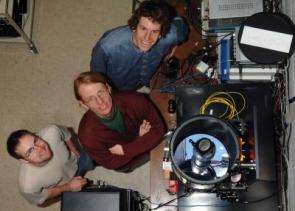
Repasky is working on the project with fellow MSU professors Joe Shaw, electrical engineering, and John Carlsten, physics, as well as master's degree candidate David Hoffman of Salt Lake City, electrical engineering, and doctoral candidate Michael Obland of Colstrip, physics.
John Reagan, an electrical and computer engineer from the University of Arizona, will assist the Repasky group in processing the data gathered from the LIDAR. Reagan has helped design a number of NASA instruments.
The MSU group will also use the grant to build a second device for determining how much water vapor is in the atmosphere up to several miles high. Water vapor is the chief greenhouse gas, but unlike carbon dioxide, its concentration varies widely over the globe from day to day.
"Water vapor is a big unknown for climate change," Repasky said.
Current instruments for detecting water vapor are "about the size of a UPS truck," expensive, and require a great deal of power, Repasky said.
For those reasons, there is no network for monitoring the global changes in water vapor. Repasky is hoping to build a device that weighs roughly 80 pounds, can fit in the back of a pickup, be relatively inexpensive and operate on its own.
"We are hoping to build devices that we can just put in a field and leave to run," Repasky said.
The water-vapor-detection device utilizes a laser equipped with a new technology developed by Repasky's group that allows the laser to be tuned to detect specific gases in the atmosphere. Such tuning could make the laser useful for detecting pollutants or other greenhouse gases such as methane or nitrous oxide.
The NASA grant also provides money for MSU to purchase, set up, and maintain two other sensors for gathering atmospheric data. One sensor will be an addition to Aeronet, a worldwide network that tracks how much sunlight is reaching the earth's surface. The other sensor will be added to the Micropulse LIDAR Network, which examines aerosols, but to a lesser extent than the laser Repasky and his colleagues are building.
"We fill a unique niche in this whole area, known as remote-sensing, because we can build lasers for very specific uses," Repasky said. "And we build them right here on campus."
Source: Montana State University


