Professor on the scent of the world's smelliest flower
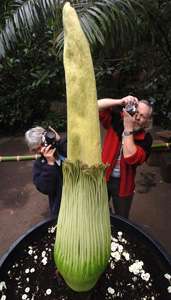
A University of Sussex biochemist will brave the stench of the world's smelliest - and largest - flower, the Titan arum, when he gives a series of public lectures about the plant's special heat-producing properties.
Professor Anthony Moore will be standing next to a mighty Titan, which is about to bloom at the Eden Project in Cornwall, for three days next week (6, 7, 9 February) while he describes the process of thermogenesis.
"It will be a challenging experience," anticipates Professor Moore. "The plant only blooms once every seven years and the flower, which is about two metres long, is magnificent. But its smell is reminiscent of decaying flesh."
The Titan arum (Amorphophallus titanum), also called the "corpse flower" on account of its fetid fumes, was first discovered in the rain forests of Sumatra in 1878. It is a distant relative of the lilies known as "lords and ladies", which are commonly found in British hedgerows.
Its disgusting smell is due to the release of compounds produced when the spike (or spadix) of the Titan arum warms up, reaching temperatures in excess of 10-15oC above ambient. The heat is generated by an enzyme called the alternative oxidase, which is found in abundance in the Titan arum, and in smaller quantities in other lilies and most other plants.
Professor Moore has just received a £360,000 grant from the Biotechnology and Biological Sciences Research Council (BBSRC), in collaboration with Professors Peter Heathcote (Queen Mary College) and Po Iwata (Imperial College), to investigate the structural properties of the enzyme, which is also found in the parasite responsible for African sleeping sickness and in fungi.
Professor Moore says: "This is a very rare and exciting opportunity to study and talk about one of the great wonders of the plant world, one that is hard to observe in the wild and so far has only been cultivated as isolated individuals rather than colonies. There is still a great deal that remains unknown, even in their native Indonesia.
"The enzyme may well have considerable industrial and medical relevance, as it has the potential to help scientists design certain fungicides and anti-parasitic pharmaceuticals. And given the wasteful effect that alternative oxidase activity has on plant respiration, this enhanced understanding could lead to the development of more energy-efficient plants."
The specimen that is about to flower in the Rainforest Bioeme at the Eden Project is growing at the rate of 10 to 15 cms a day, and is astounding the horticultural team.
Biome Curator, Don Murray, a rainforest expert, says: "We are very excited that the Titan is starting to flower at this time of year. It is possibly the earliest this plant has ever come to bloom outside the tropics. It is causing a sensation among visitors and we have to let them know that it gives off a unique odour when it is in its final hours."
When the plant is ready to attract pollinators, the spike heats up and gives off the smell, which is very alluring to tiny sweat bees or carrion beetles. If the flowers are pollinated olive-sized fruits, which are attractive to birds, are formed in cylindrical clusters. The whole process is being captured on webcam at www.edenproject.com/ .
Source: University of Sussex


