Iron fused with magnesium: New discovery may explain composition of Earth's core
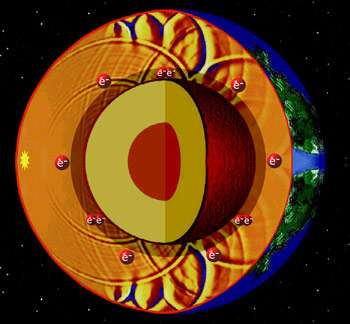
The outer core of the Earth, whose composition until now has been a mystery, may consist of an alloy of iron and magnesium. This discovery by an international team of scientists with members from Linköping University in Sweden, being published in the journal Physical Review Letters, is, among other things, a major step toward being able to predict earthquakes.
In theoretical and experimental studies under extremely high pressure, the team has succeeded in mixing iron and magnesium.
“To be able to model what happens in the interior of the Earth, we have to know the composition of the core,” says Igor Abrikosov, professor of theoretical physics at Linköping University in Sweden and one of the authors of the article being published in Friday’s issue of the journal.
In the Earth’s core the temperature (6,000 degrees C) and pressure (3 million times the pressure of the atmosphere) are so high that it can’t be studied experimentally. However, it is known that it is too light to consist solely of iron, and among other elements, silicone, sulfur, and oxygen have been proposed as being mixed in. On the other hand, magnesium has been excluded even though it is one of the Earth’s most common elements.
“It has been thought that iron and magnesium cannot be mixed in molten form, since the iron atomic volume is too small in relation to the magnesium atomic volume. But if we increase the pressure, the volume diminishes more rapidly in magnesium than in iron,” explains Igor Abrikosov.
The theoretical studies were followed up with a unique experiment in a so-called diamond anvil cell, which can withstand extremely high pressures. It turned out that it was possible to make alloys of iron and magnesium at pressures as low as 200,000 atmospheres.
The findings may also be of great significance in the search for new materials for industrial applications.
Other members of the team behind the article “Beating the miscibility barrier between iron and magnesium by high-pressure alloying” are L. Dubrovinsky, N. Dubrovinskaia , I. Kantor, W. A. Crichton, V. Dmitriev, V. Prakapenka, G. Shen, L. Vitos, R. Ahuja, and B. Johansson. The article is published in Physical Review Letters, vol. 95 no. 24.
Source: The Swedish Research Council


