Nanoengineered Silicon-Germanium Improves Chips
Georgia Tech scientists and engineers are pursuing the dictum that “smaller is better” to develop a new breed of highly-integrated silicon-based microchips capable of operating in ultra-sophisticated radar systems – and in new generations of NASA spacecraft.
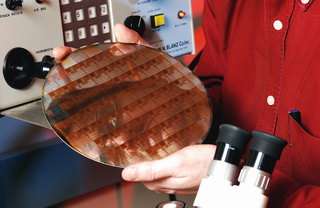
Image: Professor John Cressler is reflected in a 200 GHz silicon-germanium integrated circuit wafer.
Their research is focused on silicon-germanium (SiGe) integrated circuit technology, which can provide cost savings, compact size and improved efficiency in the same way that advances in silicon technology have made consumer electronics smaller and less expensive.
This research is supported by the U.S. Department of Defense and is known as the “Silicon-Germanium Transmit-Receive Module Project.” A joint effort between the Georgia Tech Research Institute (GTRI) and faculty within the Georgia Electronic Design Center (GEDC) at Georgia Tech, its objective is to develop silicon-germanium technology for next-generation phased-array radar systems.
"The GTRI folks have a strong background in radar systems, while we have the silicon-germanium (Si-Ge) device and circuit expertise,” said John D. Cressler, Byers professor in Georgia Tech’s School of Electrical and Computer Engineering and a GEDC researcher. “We've teamed up to work on a new approach that literally has the capability to revolutionize the way radar systems are built, and this new GTRI-GEDC synergy is very exciting.”
Phased-array radar systems under development by the Department of Defense, such as the Theater High-Altitude Area Defense Radar, are large, bulky and consume huge amounts of energy to power thousands of modules and thousands of gallium arsenide chips to electronically direct the radar beams.
"We’re trying to put all the functionality of those complex modules onto a single chip, essentially reaching for the same level of functional integration in radar systems that has been going on in consumer electronics for the past decade,” explained co-principal investigator Mark Mitchell, a GTRI senior research engineer.
Silicon-germanium chips may hold the answer, according to researchers, because of their capacity to hold an extraordinary number of very high-speed circuits on a single chip. In addition, silicon-germanium is a less expensive material than the compound semiconductors such as gallium arsenide or indium phosphide that have long been used in radar systems.
"In SiGe, you take a conventional silicon integrated circuit and use nanotechnology techniques to introduce germanium inside the silicon on an atomic scale,” explained Cressler.
These nanoscale silicon-germanium layers can double or even triple chip performance, according to Cressler. The procedure is “completely compatible with conventional silicon chip manufacturing, so there’s no cost penalty for the improved performance,” he noted.
The main benefit, adds Mitchell, is cost. Phased-array radar systems, as presently constituted, are quite expensive. More affordable systems could also open up new applications for communications, aircraft weather radar and mobile uses such as collision-avoidance radar devices for automobiles, he notes.
Silicon-germanium is not without drawbacks for radar systems, however.
"The biggest limitation for the radar application is the amount of power that you can generate,” said Mitchell. Silicon-germanium amplifiers can only produce about one watt of radio frequency (RF) power, versus 10 watts from a typical gallium arsenide device.
"While that’s not adequate for some applications, it could be perfect for radar,” said Mitchell, citing a GTRI study conducted for the Missile Defense Agency several years ago.
"They told us to ignore current technology and focus on the system parameters to determine how much power per element we'd want to get,” he explained. “Our conclusion was roughly one watt per element. So the fact that silicon-germanium has the potential of delivering that makes it a perfect match for this particular application.”
Even in cases where the lower power-handling capability of silicon-germanium might necessitate a design change, such as adding more antenna elements to generate the same output, “we’re potentially saving so much money that we can make tradeoffs in the design that get around those limitations,” he added. “If our elements are two or three orders of magnitude cheaper, and we only need twice as many, we still come out way ahead in terms of cost.”
Another consideration that may be more of a design challenge than a drawback is that SiGe-based radar’s lower per-element power equates to a larger antenna for greater sensitivity - perhaps tens of meters in size, depending on the application.
GTRI researchers such as senior research engineer Tracy Wallace are exploring ways to make these larger systems “tactically transportable.” The work is being supported by the U.S. Missile Defense Agency.
"They can be much thinner and they can be folded up onto themselves,” Wallace explained. “We have sketches, models and drawings of how that can be done.”
Depending on the radar’s destination, or if the fabrication cost of folding the radar is too high, the antenna and its supporting systems may simply be fashioned in a manner that facilitates final assembly on site, says Wallace, noting that some types of radar are already constructed that way.
Designers are also investigating ways to measure and compensate for deformities caused by the effect of gravity on a large aperture. One aspect of that is knowing the exact locations of all radiating elements to within a fraction of a wavelength, according to Wallace. One approach favored by Wallace and his team involves photogrammetry, which provides information about physical objects by interpreting patterns of electromagnetic radiant energy and multiple digital photographs taken from different locations.
Another consideration arising from larger antenna arrays is the increased amount of data they collect, “so more computer resources are needed,” Wallace said. “But as technology advances, that comes pretty cheap.”
In another major government contract, GEDC researchers are developing silicon-germanium technology for electronic systems for NASA to use in lunar and Martian exploration, and interplanetary space probes.
Besides the advantages of low cost, high integration capability and high speed, SiGe chips are ideally suited for space because of the material’s natural radiation hardness, a key concern for all space electronics, Cressler says.
Of particular interest to NASA is that silicon-germanium circuits also perform well in space’s cryogenic temperatures - close to absolute zero, according to Cressler. Most electronic components do not work well in a very cool environment such as space. At present, spacecraft, probes and planetary rovers must be fitted with electronic “warm boxes,” which add significant bulk, weight and cost to missions.
"If you want your electronics to operate in the shadows of craters on the lunar landscape, for example, you’re talking about an extremely frigid environment - minus 230 degrees Celsius or 43 Kelvins above absolute zero,” Cressler noted. “Silicon-germanium electronics can operate at temperatures approaching absolute zero, and thus are ideally suited for such applications. It would be a huge advantage from a space-mission perspective to be able to simply let your electronics operate at those cold temperatures, and thus NASA is very interested in our SiGe research.”
The first silicon-germanium transistors were demonstrated in the late 1980s, but only in the past five years or so has the field attracted widespread attention from the private sector, Cressler says.
With more than 20 scientists and graduate students involved in silicon-germanium research, Cressler’s GEDC group is the largest university team in the world devoted to device and circuit research in SiGe.
“Anybody involved in high-speed communications circuits cares about SiGe,” he said. “This new technology is an enabler for rethinking the way business-as-usual is done across a wide array of electronics applications, and that makes it really exciting to work on - and of course it is very nice that Georgia Tech is leading the way.”
Source: Georgia Tech


