181 Things To Do On The Moon
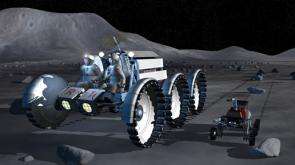
If you woke up tomorrow morning and found yourself on the moon, what would you do? NASA has just released a list of 181 good ideas.
Ever since the end of the Apollo program, "folks around the world have been thinking about returning to the moon, and what they would like to do there," says Jeff Volosin, strategy development lead for NASA's Exploration Systems Mission Directorate. Now, NASA is going back; the agency plans to send astronauts to the Moon no later than 2020. "So we consulted more than 1,000 people from businesses, academia and 13 international space agencies to come up with a master list of 181 potential lunar objectives."
For example, the moon could be a good location for radio astronomy. A radio telescope on the far side of the Moon would be shielded from Earth's copious radio noise, and would be able to observe low radio frequencies blocked by Earth's atmosphere. Observations at these frequencies have never been made before and opening up a window into this low frequency universe will likely lead to many exciting new discoveries.
The moon would also be an excellent place to study the high-energy particles of the solar wind, as well as cosmic rays from deep space. Earth's magnetic field and atmosphere deflect many of these particles, so even satellites in low-Earth orbit can't observe them all. The moon has virtually no atmosphere, and it spends most of its 28-day orbit outside of Earth's magnetosphere. Detectors placed on the moon could get a complete profile of solar particles, which reveal processes going on inside the sun, as well as galactic cosmic radiation from distant black holes and supernovas.
Bonus: These particles are trapped by lunar regolith, the layer of crushed rock and dust covering the moon's surface. This means that lunar regolith contains a historical record of solar output: core samples could tell us about changes in solar output over billions of years. "We believe that the moon's preservation of this solar record is unique and can provide us with insights on how past fluctuations in the solar output have affected, for example, the history of life on Earth," says Volosin. In particular, it could shed light on the extent to which solar variability and galactic cosmic radiation influence climate change.
But the moon would be far more than just a platform for scientific instruments gazing into space. The moon itself is a scientific gold mine, a nearby example of planetary formation largely unaltered by the passage of time. Some scientists call it "a fossil world." The moon is a small, non-dynamic planetary body and its interior state is largely preserved since the early days of solar system history. Studying its interior would tell scientists a lot about how a planet's internal layers separate and solidify during planetary formation.
Even something as simple as establishing the dates when various craters on the moon were formed can provide us with a unique picture of how the flux of meteoroids in the vicinity of Earth has changed over time. This impact history is lost on Earth by the constant renewal of the crust but on the moon it is intact, rich with clues to periods in the past when an increase in bombardment may have affected the climatic history of Earth and even the evolution of life.
Science accounts for only about a third of the 181 objectives, however. More than half of the list deals with the many challenges of learning to live on an alien world: everything from keeping astronauts safe from radiation and micrometeors to setting up power and communications systems to growing food in the airless, arid lunar environment.
"We want to learn how to live off the land and not depend so much on supplies from Earth," says Tony Lavoie, leader of NASA's Lunar Architecture Team (Phase 1) at the Marshall Space Flight Center.
Astronauts would face the same problems on a manned mission to Mars, so much of the experience gained on the moon would carry over when NASA eventually sends people to the Red Planet.
The moon could also provide some creative commercial opportunities: lunar power from solar cells, protected data archives, mining of lunar metals, and research under conditions of low gravity and high vacuum, to name a few. In fact, mining the moon may eventually yield rocket propellant that could be sold to commercial satellite operators to access and service their satellite assets in Earth orbit. Beyond charging space tourists for a chance to visit the moon, lunar entrepreneurs might host special television events from the moon to boost publicity, or place a remote-controlled rover on the moon. People back on Earth could pay to take turns controlling the rover from their Internet-connected computers, letting them take a virtual drive across the moon's crater-pocked surface. In short, let your imagination be your guide!
Not all of the ideas on the list will necessarily happen. From the master list of 181, NASA currently is selecting the a smaller number of high priority goals for its initial return to the moon. Other goals could be considered by other space agencies or private entrepreneurs who have an interest in exploring the moon. NASA continues to receive input from scientists at space agencies and universities around the world, the list itself is still evolving and expanding.
There's a lot to do on the moon. See for yourself: complete list.
Source: by Patrick L. Barry, Science@NASA


