'Good vibrations' from deep-sea smokers may keep fish out of hot water
February 5th, 2007 'Good vibrations' from deep-sea smokers may keep fish out of hot water

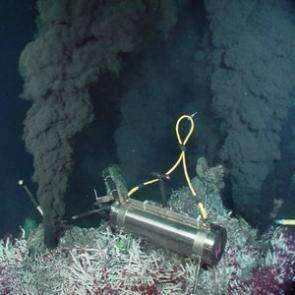
The recording device that captured the sounds of black smoker venting sits here between waters that are 660 F, hot enough to poach unsuspecting fish, and cooler places lush with tube worms. It is speculated that the sound generated by hydrothermal vents may help fish navigate around such structures. Credit: University of Washington

So you're a fish. Right now some tubeworm tartare and clams on the half shell would really hit the spot, so you're headed for the all-night café. "All-night" being the operative word because the volcanic ridge you're tooling along is nearly 1.5 miles below the surface. The term "where the sun don't shine" perfectly describes the place. It's pitch black. Darn, but what's that loud rumbling up ahead? Must be one of those pesky black smokers. Some of those babies can fry your face off. A detour is highly indicated.

The long-held assumption that black smokers are silent is wrong, according to recently published research led by Timothy Crone, a University of Washington doctoral student in oceanography. It's prompting scientists to wonder: Could the sound and vibrations of black smokers be the reason fish in total darkness avoid being poached by waters as hot as 750 F? And might similar sounds guide them to the smorgasbord of tube worms, mussels, shrimp, snails and other fauna at vents with more temperate waters?
'Good vibrations' from deep-sea smokers may keep fish out of hot water

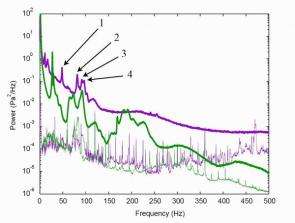
Our ears can't easily discern the resonant tones buried in the rumblings generated by black smokers, but the UW's Timothy Crone has filtered out four examples for you to hear by clicking on the buttons above. The purple line is from the black smoker named Sully and the green is from Puffer, giving you an idea of how individual black smokers differ in the sounds they make. The lighter lines in the lower part of the chart represent ambient, or background, noise. Credit: University of Washington

The research was reported online during the inaugural month of the Public Library of Sciences' interactive journal, PLoS ONE. Aimed at involving more people in science, published results are available without a subscription and can include a wealth of audio, video and other materials.

Hydrothermal vents, discovered in the 1970s, are found along volcanically active ridges where seawater seeps into the seafloor, picks up heat and minerals and then vents back into the ocean depths. The hottest and most vigorous of the vents are black smokers, so called because when the fluids they emit hit the icy cold seawater, minerals in the fluids precipitate out and it looks just like dark, billowing smoke.

Because of a paper published 15 years ago, it had been thought the vents were probably playing only the sounds of silence. Still a number of scientists suspected that the vents could be generating sounds, given the obvious turbulence of the flows, Crone says.

It was decided that new recordings should be attempted because Crone and other oceanographers are looking for new ways to measure vent flows, which are a source of heat and minerals in the world's oceans that scientists would like to understand better. Commonly used instruments to measure flow are often short lived when inserted in the superheated, corrosive black-smoker fluids.

How much simpler if the vents were generating some kind of sound that could be recorded and correlated to flows, Crone says.

With funding from two organizations that help take fields of research and instrumentation in new directions, the UW Royalty Research Fund and the W.M. Keck Foundation, a deep-sea digital acoustic recording system was deployed in the Main Endeavour vent field. The field is on the seafloor about 300 miles west of Seattle on the Juan de Fuca Ridge. Crone recorded 45 hours of sound at the vent scientists call "Sully" and 136 hours at the vent called "Puffer."

That's the sound of Sully you're hearing as the video runs. Crone likens the sound to the rumbling of an avalanche or a forest fire.

How loud would it be if you were sitting a foot away? (That's something you couldn't actually do because the pressure where most black smokers are found is so intense that you'd implode.) The sound level would be somewhere between conversational speech and a hairdryer, Crone says.

Four possible mechanisms might be causing -- or contributing to -- the noise, the researchers say. For example, the flow could be pulsating or its volume could be changing as its waters cool. Dissimilar fluids in the flow could generate noise where they mix. Or the fluids rushing through the nooks and crannies of the smoker vent itself could be creating noise.

The sounds also appear to change as flows change in reaction to such things as the Earth's tides, the authors say. Read the full report on PLoS ONE at http://dx.doi.org/10.1371/journal.pone.0000133 .

Buried within the broad range of sounds that produce the rumbling, Crone's analysis revealed the surprise that the vents also produce resonant tones. There could be a number of things generating such tones. For example, flows along the cavities and bumps inside the vent structures may cause tones in the same way jug band members produce sound by blowing across the mouths of their jugs, causing the air inside the jug to resonate and produce a deep tone.

Both Sully and Puffer produce resonant tones at several different frequencies that we can't discern with all the other noise generated by the vents.

"With these resonant tones, each vent within the vent field is likely to have its own unique acoustic signature," Crone says.

If so, and if fish are actually using vent sounds to navigate, then the distinctive tones might be how fish find their way back to cooler vents where the eats have been particularly good.

In that case, being on top of old smoky -- all covered in sounds -- would be a good thing indeed.

Source: University of Washington


print this article email this article download pdf blog this article bookmark this article     Digg this Stumble it share on Facebook share on Reddit add to delicious save to Yahoo! bookmarks
4.2/5 after 13 votes


February 5th, 2007 all stories
Biology /

Comments: 0
Rank: 4.2/5 after 13 votes

  • Stumble this up

  • Digg this

  • Share it:
  • share on Facebook
  • share on MySpace
  • share on Slashdot
  • rss-newsfeed
  • share on Google
  • share on Reddit
  • add to delicious
  • save to Yahoo! bookmarks
  • share on Windows Live
  • Add to Mixx!
Rating: 4.2/5 after 13 votes

  • Related Stories

  • Going, going green
    created Jun 22, 2009 | popularity not rated yet | comments 0
  • Marine scientists find massive volcanic cone, new deep-sea animal species
    created May 05, 2009 | popularity not rated yet | comments 0
  • The limits of life on Earth extended... in water
    created Apr 28, 2009 | popularity not rated yet | comments 0
  • Microbe Survives in Ocean's Deepest Realm, Thanks to Genetic Adaptations
    created Feb 06, 2009 | popularity not rated yet | comments 0
  • Genetic adaptations are key to microbe's survival in challenging environment
    created Feb 06, 2009 | popularity not rated yet | comments 0

Tags


  • Physicists Demonstrate Quantum Memory with Matter Qubits
    Physicists Demonstrate Quantum Memory with Matter Qubits
    Physics / General Physics
    created Jul 03, 2009 | popularity 4.4 / 5 (17) | comments 1
  • 'Holey' Nanosheets for Wastewater Dye Removal
    Nanotechnology / Nanomaterials
    created Jul 01, 2009 | popularity 5 / 5 (5) | comments 1
  • Jellyfish Robot Swims Like its Biological Counterpart
    Jellyfish Robot Swims Like its Biological Counterpart
    Electronics / Robotics
    created Jun 26, 2009 | popularity 4.4 / 5 (8) | comments 1
  • Could Maxwell's Demon Exist in Nanoscale Systems?
    Could Maxwell's Demon Exist in Nanoscale Systems?
    Physics / General Physics
    created Jun 24, 2009 | popularity 4.4 / 5 (18) | comments 29
  • Living Safely with Robots, Beyond Asimov's Laws
    Living Safely with Robots, Beyond Asimov's Laws
    Electronics / Robotics
    created Jun 22, 2009 | popularity 4.6 / 5 (54) | comments 40
  • Other News

    Songbirds reveal how practice improves performance

    Songbirds reveal how practice improves performance

    Biology / Plants & Animals

    created 39 minutes ago | popularity not rated yet | comments 0

    (PhysOrg.com) -- Learning complex skills like playing an instrument requires a sequence of movements that can take years to master. Last year, MIT neuroscientists reported that by studying the chirps of tiny ...


    Study finds role for parasites in evolution of sex

    Biology / Plants & Animals

    created 1hour ago | popularity not rated yet | comments 0

    What's so great about sex? From an evolutionary perspective, the answer is not as obvious as one might think. An article published in the July issue of the American Naturalist suggests that sex may have evolved in part a ...


    New research shows key player in mitosis not required for chromosome alignment

    New research shows key player in mitosis not required for chromosome alignment

    Biology / Microbiology

    created 2 hours ago | popularity 5 / 5 (1) | comments 0

    (PhysOrg.com) -- K-fibers, structures long thought to play a key role in the alignment of chromosomes prior to cell division, are not required after all, say Indiana University and New York State Department ...


    Battle of the sexes benefits offspring, says research

    Battle of the sexes benefits offspring, says research

    Biology / Plants & Animals

    created 7 hours ago | popularity 5 / 5 (1) | comments 0

    Parents compensate for a lazy partner by working harder to bring up their offspring, but not enough to completely make up for the lack of parenting, says research by bird biologists at the University of Bath.


    Scientists are learning more about big birds from feathers

    Scientists are learning more about big birds from feathers

    Biology / Plants & Animals

    created 2 hours ago | popularity not rated yet | comments 0

    (PhysOrg.com) -- Catching adult eagles for research purposes is no easy task, but a Purdue University researcher has found a way around the problem, and, in the process, gathered even more information about ...