Chemists show that nature could have used different protein building blocks
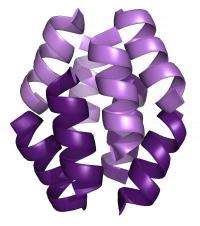
February 5, 2007 Beta-Bundles -- Ribbon Diagram Representations of a Beta-Peptide Bundle

Beta-Bundles: Ribbon diagram representations of a beta-peptide bundle illustrating packing between helices and within the hydrophobic (green) core. Credit: Schepartz/Yale

Chemists at Yale have done what Mother Nature chose not to — make a protein-like molecule out of non-natural building blocks, according to a report featured early online in the Journal of the American Chemical Society.

Nature uses alpha-amino acid building blocks to assemble the proteins that make life as we know it possible. Chemists at Yale now report evidence that nature could have used a different building block – beta-amino acids — and show that peptides assembled from beta-amino acids can fold into structures much like natural protein.
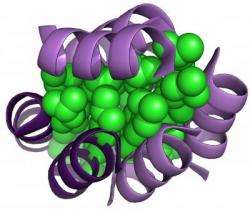
Beta-Bundles -- Ribbon Diagram Representations of a Beta-Peptide Bundle

Beta-Bundles: Ribbon diagram representations of a beta-peptide bundle illustrating packing between helices and within the hydrophobic (green) core. Credit: Schepartz/Yale

"The x-ray structure featured in the report shows a molecule that shares many of the structural characteristics of natural proteins," said principal author Alanna Schepartz, the Milton Harris '29 Ph.D. Professor of Chemistry at Yale and a Howard Hughes Medical Institute Professor. "Related studies show that the physical properties of the molecule are also remarkably similar to natural proteins. In other words, the beta-peptide assembly looks and acts a lot like a real protein."

The ability to mimic natural proteins makes beta-peptides powerful new tools for basic research and drug discovery. Like a taped recording, their greatest value may be in their difference from a live performance.

"Since beta-peptides are not processed in the cell like natural peptides or proteins, it may be possible in the future to design beta-peptides that perform better or in more locations than current protein drugs," said Schepartz. "They also may have unique properties as biomaterials."

Natural proteins are composed of linear chains of alpha-amino acids. Beta-peptides are composed of beta-amino acids, which have an extra carbon in their backbone. Like alpha-amino acids, beta-amino acids are generated under simulated pre-biotic conditions, are isolated from meteorites, and are byproducts of metabolism, but they are not genetically encoded like natural proteins, nor are they built into chains by cells.

Since the early 1990's, scientists have been able to assemble beta-peptides into isolated helices. Until now, however, creating a structure that mimics the larger size and complex folded architecture of a natural protein had been an elusive goal. Schepartz's team solved the dilemma by designing a molecule that could form a bundle using characteristics found in natural proteins — a greasy interior that repels water and a water-friendly exterior. This paper, which provides the first high-resolution picture of such a structure, shows a bundle of eight beta-peptides.

"The structure we see is intriguing, as it suggests that natural proteins could have been composed of beta-amino acids, but were not chosen to do so," said Schepartz.

Citation: J. American Chemical Society, ASAP Article DOI:10.1021/ja068678n (January 19, 2007)

Source: Yale University


print this article email this article download pdf blog this article bookmark this article     Stumble it Digg this share on Facebook retweet share on Reddit add to delicious
Rate this story - 4.5 /5 (26 votes)


February 5, 2007 all stories

Comments: 0

4.5 /5 (26 votes)
  • Stumble this up

  • Digg this

  • share this

  • hide
  • Related Stories


Other News

New hydrogen-storage method discovered

New hydrogen-storage method discovered

Chemistry / Materials Science

created 10 hours ago | popularity 4.3 / 5 (23) | comments 4

Scientists at the Carnegie Institution have found for the first time that high pressure can be used to make a unique hydrogen-storage material. The discovery paves the way for an entirely new way to approach ...


Accidental discovery produces durable new blue pigment for multiple applications

Accidental discovery produces durable new blue pigment for multiple applications

Chemistry / Biochemistry

created Nov 16, 2009 | popularity 4.5 / 5 (32) | comments 6

An accidental discovery in a laboratory at Oregon State University has apparently solved a quest that over thousands of years has absorbed the energies of ancient Egyptians, the Han dynasty in China, Mayan ...


New on-off 'switch' triggers and reverses paralysis in animals with a beam of light

New on-off 'switch' triggers and reverses paralysis in animals with a beam of light (w/ Video)

Chemistry / Biochemistry

created Nov 18, 2009 | popularity 4.8 / 5 (5) | comments 4

In an advance with overtones of Star Trek phasers and other sci-fi ray guns, scientists in Canada are reporting development of an internal on-off "switch" that paralyzes animals when exposed to a beam of ultraviolet ...


One word: bioplastics

One word: bioplastics

Chemistry / Materials Science

created Nov 17, 2009 | popularity 4.6 / 5 (13) | comments 4

(PhysOrg.com) -- Every year, more than 250 billion pounds of plastic are produced worldwide. Much of it ends up in the world's oceans, a fact that troubles MIT biology professor Anthony Sinskey.


New research provides blueprint for molecular basis of global warming

New research provides blueprint for molecular basis of global warming

Chemistry / Materials Science

created Nov 17, 2009 | popularity 4 / 5 (4) | comments 3

A new study indicates that major chemicals most often cited as leading causes of climate change, such as carbon dioxide and methane, are outclassed in their warming potential by compounds receiving less attention.