Liquid Crystal Lasers the size of a human hair
web.jpg)
The University of Cambridge has been awarded ~£2.4M under the Basic Technology Research Initiative for the development of microscopic lasers.
Above: A photograph of a lasing liquid crystal cell
This is a multidisciplinary collaborative research project between the Department of Engineering (lead by Professor Harry Coles as Principal Investigator with Prof Ian White and Dr Tim Wilkinson), the Department of Physics (Prof Sir Richard Friend and Prof. Eugene Terentjev) and the Department of Chemistry (Dr. Wilhelm Huck).
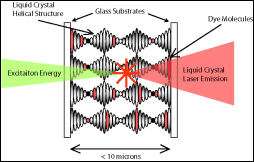
These new lasers, based on liquid crystals and light emitting polymers, will combine the best features of dye, gas and diode lasers. Dye lasers can be tuned to emit different wavelengths, but they are big. Gas lasers are powerful and stable, but they cannot be tuned and are also rather large. Diode lasers, such as those used in CD and DVD players, are small but cannot be tuned. These new lasers will be extremely small in size; less than the width of a human hair. They will be stable and emit very pure light, because they will not hop from one mode of emissions to another. And it will be possible to tune them to any wavelength from ultraviolet to infrared simply by sending an electrical signal to them. On top of this, it should be possible to manufacture them at extremely low cost.
The lasers will find use in medical science given their small size, tuneability and low cost. They may be incorporated into fibre optics and this opens up applications in dermatology, cancer and diabetes detection as well as the possibility of using them in the so-called 'lab on a chip' technology. These devices will combine spectroscopic measurement and analysis on a single chip making it possible for medical staff, environmental officers, and others to conduct sophisticated analyses in the field rather than send samples to a lab and wait for the results.
The potential applications span many different technology areas including telecommunications devices and the booming display market for televisions, computers, mobile phones, etc. The lasers are small enough to act as individual picture elements of a display. They can be switched fast enough to provide bright pure light of any colour. No filters or backlighting will be required so the display will be brighter, sharper and consume less power.
Harry Coles is delighted with the award and said, "This is fantastic news particularly because it is the first award to be granted that involves such a large collaboration between faculties at the University. The principle elements that each discipline will bring to this project are invaluable and will enable the development of this technology to progress rapidly. The underlying concept of the recently established Centre of Molecular Materials for Photonics and Electronics (CMMPE) is to establish a wide knowledge base centre specific to the development of organic photonics and electronics. This project complements the CAPE (Centre for Advanced Photonics and Electronics) concept nicely."
Source: University of Cambridge


