Action video games sharpen vision 20 percent
Video games that contain high levels of action, such as Unreal Tournament, can actually improve your vision.
Researchers at the University of Rochester have shown that people who played action video games for a few hours a day over the course of a month improved by about 20 percent in their ability to identify letters presented in clutter—a visual acuity test similar to ones used in regular ophthalmology clinics.
In essence, playing video game improves your bottom line on a standard eye chart.
"Action video game play changes the way our brains process visual information," says Daphne Bavelier, professor of brain and cognitive sciences at the University of Rochester. "After just 30 hours, players showed a substantial increase in the spatial resolution of their vision, meaning they could see figures like those on an eye chart more clearly, even when other symbols crowded in."
Bavelier and graduate student Shawn Green tested college students who had played few, if any, video games in the last year. "That alone was pretty tough," says Green. "Nearly everybody on a campus plays video games."
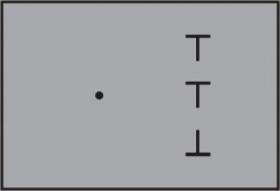
At the outset, the students were given a crowding test, which measured how well they could discern the orientation of a "T" within a crowd of other distracting symbols—a sort of electronic eye chart. Students were then divided into two groups. The experimental group played Unreal Tournament, a first-person shoot-'em-up action game, for roughly an hour a day. The control group played Tetris, a game equally demanding in terms of motor control, but visually less complex.
After about a month of near-daily gaming, the Tetris players showed no improvement on the test, but the Unreal Tournament players could tell which way the "T" was pointing much more easily than they had just a month earlier.
"When people play action games, they're changing the brain's pathway responsible for visual processing," says Bavelier. "These games push the human visual system to the limits and the brain adapts to it. That learning carries over into other activities and possibly everyday life."
The improvement was seen both in the part of the visual field where video game players typically play, but also beyond—the part of your vision beyond the monitor. The students' vision improved in the center and at the periphery where they had not been "trained." That suggests that people with visual deficits, such as amblyopic patients, may also be able to gain an increase in their visual acuity with special rehabilitation software that reproduces an action game's need to identify objects very quickly.
The team is now delving into how the brain responds to other visual stimuli. They plan to use what would be a video gamer's dream: a new 360-degree virtual-reality computer lab now being completed at the University of Rochester.
This research appears next week in the journal Psychological Science.
Source: University of Rochester


