Universe contains more calcium than expected
February 6, 2007
Universe contains more calcium than expected

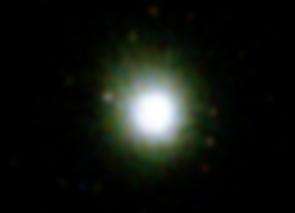
This image was taken by ESA's XMM-Newton X-ray observatory, and shows the cluster of galaxies Abell 1689. The hot gas in clusters of galaxies tells astronomers something about the way supernova's explode. Credits: ESA, Jelle de Plaa (SRON)

The universe contains one and a half times more calcium than previously assumed. This conclusion was drawn by astronomers of the SRON Netherlands Institute for Space Research, after observations with ESA's XMM-Newton X-ray observatory.

This research offers scientists new insights in the formation history of the elemental building blocks of the cosmos in which supernovae play a crucial role.


The iron in our blood, the oxygen we breathe, the calcium in our bones, the silicon in the sand box, all the atoms we are made of are released during the violent final moments of massive stars in the act of dying. These so-called supernova explosions eject newly made chemical elements into space where they become the building blocks for new stars, planets, or even life. However, many questions concerning the very formation of elements and the way they get distributed across the universe still remain open.

According to Jelle de Plaa, space researcher at SRON, many answers can be found in distant clusters of galaxies. "Clusters are in many ways the big cities of the universe", he says.

"They consist of hundreds of galaxies, each containing thousands of millions of stars. The galaxies are embedded in a gigantic cloud of hot gas that fills this cluster like a smog. Due to their enormous size and numbers, clusters contain a large fraction of the total amount of matter in the universe. During the past thousand-millions of years supernova explosions have enriched the surrounding hot gas with heavier elements, like oxygen, silicon and iron."

Using XMM-Newton, De Plaa determined the abundances of oxygen, neon, silicon, sulphur, argon, calcium, iron and nickel in 22 clusters of galaxies. In total he saw the 'pollution' produced by about 100 thousand million supernovae. When he compared the measured amounts of elements in the clusters with theoretical models of supernovae, the calcium abundance measured thanks to XMM-Newton appeared to be one and a half times higher than theoreticians previously assumed.

Dance of death

De Plaa and his colleagues also found that many supernovae in clusters are the result of a dance of death between two stars that revolve around each other. A very compact white dwarf withdraws matter from its unfortunate companion star. The matter forms a layer on the surface of the white dwarf. When the dwarf reaches a certain mass, its core cannot any longer support the weight of the matter and explodes as a supernova.

"Roughly half of the number of supernovae that ever exploded in clusters appear to have exploded this way", says De Plaa. "This is much more than the fraction of this kind of supernovae in our own galaxy, which we estimate to be 15 percent."

The results will be valuable for the scientists who make supernova models. "Until now, supernova experts had to make educated guesses about how a supernova exactly explodes," continues De Plaa. "Because we measure the remains of 100 thousand million supernovae at once, we find more accurate averages than before. This will help the supernova community to learn how white dwarfs die."

These findings will be published in the scientific journal Astronomy & Astrophysics, in the article titled: "Constraining supernova models using the hot gas in clusters of galaxies", by J. de Plaa, N. Werner, J. A.M. Bleeker, J. S. Kaastra, M. Mendez, and J.Vink (http://www.aanda.o … ng&Itemid=18 , DOI: 10.1051/0004-6361:20066382).

The findings also appear on line at Astro-ph in the article titled: "Constraining supernova models using the hot gas in clusters of Galaxies", by J. de Plaa, N. Werner, J.A.M. Bleeker, J. Vink, J.S. Kaastra, M. Mendez (astro-ph/0701553).

Source: European Space Agency

4.6 /5 (16 votes)  

Rank 4.6 /5 (16 votes)
Tags

Related Stories
Relevant PhysicsForums posts
  • Scale of the Universe
    created8 hours ago
  • Titan's lack of impact craters
    createdFeb 09, 2012
  • Real pictures of black hole eating a star?
    createdFeb 08, 2012
  • Hypothetical way to travel faster than light, but not technically exceed lightspeed
    createdFeb 06, 2012
  • How do scientists monitor the Sun's activity?
    createdFeb 05, 2012
  • Search patterns in observational studies
    createdFeb 05, 2012
  • More from Physics Forums - General Astronomy

More news stories

Humans may have helped the decline of African rainforests 3000 years ago

(PhysOrg.com) -- Large areas of rainforests in Central Africa mysteriously disappeared over three thousand years ago, to be replaced by savannas. The prevailing theory has been that the cause was a change ...

Space & Earth / Environment

created 19 hours ago | popularity 4.3 / 5 (11) | comments 12 | with audio podcast report

Could Venus be shifting gear?

(PhysOrg.com) -- ESA’s Venus Express spacecraft has discovered that our cloud-covered neighbour spins a little slower than previously measured. Peering through the dense atmosphere in the infrared, the ...

Space & Earth / Space Exploration

created 15 hours ago | popularity 5 / 5 (7) | comments 7 | with audio podcast

NASA budget will axe Mars deal with Europe: scientists

US President Barack Obama's budget proposal to be submitted next week for 2013 will cut NASA's budget by 20 percent and eliminate a major partnership with Europe on Mars exploration, scientists said Thursday.

Space & Earth / Space Exploration

created 18 hours ago | popularity 5 / 5 (2) | comments 18

Mars Science Laboratory computer issue resolved

(PhysOrg.com) -- Engineers have found the root cause of a computer reset that occurred two months ago on NASA's Mars Science Laboratory and have determined how to correct it.

Space & Earth / Space Exploration

created 16 hours ago | popularity 4.7 / 5 (6) | comments 3 | with audio podcast

Two new moons for Jupiter

Advances in technology have lead to the discovery of new planets outside of our Solar System, and now even new moons in our own backyard.

Space & Earth / Space Exploration

created 15 hours ago | popularity 4 / 5 (1) | comments 7


Google users warned of threat to smartphone wallets

Users of Google smartphone wallets were being warned on Friday that there is a way to crack pass codes intended to thwart thieves from going on illicit shopping sprees.

Anonymous knocks CIA website offline (Update)

The website of the Central Intelligence Agency was inaccessible on Friday after the hacker group Anonymous claimed to have knocked it offline.

New error-correcting codes guarantee the fastest possible rate of data transmission

Error-correcting codes are one of the triumphs of the digital age. They’re a way of encoding information so that it can be transmitted across a communication channel — such as an optical fiber o ...

New power source discovered

(PhysOrg.com) -- Researchers at the Massachusetts Institute of Technology (MIT) and RMIT University have made a breakthrough in energy storage and power generation.

Complex wiring of the nervous system may rely on a just a handful of genes and proteins

Researchers at the Salk Institute have discovered a startling feature of early brain development that helps to explain how complex neuron wiring patterns are programmed using just a handful of critical genes. ...

The power of estrogen -- male snakes attract other males

A new study has shown that boosting the estrogen levels of male garter snakes causes them to secrete the same pheromones that females use to attract suitors, and turned the males into just about the sexiest ...