Researcher Hopes to Unlock Evolutionary Secrets
February 6, 2007 Researcher Hopes to Unlock Evolutionary Secrets

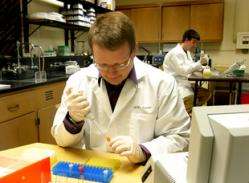
Eric Linton, assistant professor of biology at Central Michigan University, (foreground) prepares euglenoid plastid DNA samples to produce a polymerase chain reaction, a method of producing many copies of DNA from a single copy so that Linton can sequence its DNA. Undergraduate Stephen Dawson works in the background. Credit: Robert Barclay, Central Michigan University

Roughly 2 1/2 billion years ago, some algae began to photosynthesize, an astonishing development that led to the creation of plants and a myriad of complex life forms, including, incidentally, mankind.

Today, Eric Linton, a Central Michigan University assistant professor of biology, is studying the gene makeup of single-celled euglenoids — organisms that acquired the ability to photosynthesize from algae — to learn whether that evolutionary step was a single hallmark moment or a series of events over time.

Eventually, Linton hopes to learn whether dormant genes that once controlled photosynthesis in certain euglenoids can reactivate, shedding light on whether scientists can jumpstart long-dormant genes in other organisms, such as in humans to fight a host of diseases.

With a $354,000 grant from the National Science Foundation, Linton has begun a three-year project to perform complete genome sequencing of six forms of euglenoids, some of which long ago lost the ability to photosynthesize.

A focus of Linton’s research is chloroplasts — components of euglenoid cells that serve as an engine for photosynthesis, or the synthesis of sugar from light, carbon dioxide and water. Some of the euglenoids under study have functioning chloroplasts, enabling photosynthesis; in others, the chloroplasts apparently are dormant.

By examining the genes for chloroplasts from six different euglenoids, Linton hopes to learn whether all acquired the ability to photosynthesize from the same ancestor, or multiple ancestors. Also, Linton wants to deduce how the genes are transferred, lost or evolved when two genomes are combined.

The discovery of supposedly dormant genes in the euglenoids raises questions about whether such genes — both in euglenoids and humans — can receive a man-made jump-start one day.

“If they are keeping these genes around,” Linton said, “they must be achieving something.”

Most genome sequencing will occur off-campus, but Linton plans on using a $50,000 differential interference contrast microscope — which provides near 3D imaging — for much of the study. A graduate student and two undergraduates will assist him.

Source: Central Michigan University


print this article email this article download pdf blog this article bookmark this article     Stumble it Digg this share on Facebook retweet share on Reddit add to delicious
Rate this story - 4.3 /5 (8 votes)


February 6, 2007 all stories

Comments: 0

4.3 /5 (8 votes)
  • Stumble this up

  • Digg this

  • share this

  • hide
  • Related Stories

  • Prostaglandin receptor key to atherosclerosis development
    created Dec 15, 2008 | popularity not rated yet | comments 0
  • Heavy metals in the Peak District -- evidence from bugs in blanket bogs
    created Apr 01, 2008 | popularity not rated yet | comments 0
  • NNSA/LLNL supercomputer breaks computing record: exceeds 100 teraflops
    created Mar 24, 2005 | popularity not rated yet | comments 0
  • Researchers launch Smart Parking project at Rockridge BART
    created Dec 07, 2004 | popularity not rated yet | comments 0
  • Optics Center to Build New Laser Lab
    created Jul 16, 2004 | popularity not rated yet | comments 0


Other News

Fruit Fly

Latest epidemic? High cholesterol, obesity in fruit flies

Biology / Cell & Microbiology

created 28 minutes ago | popularity not rated yet | comments 0

How do fruit flies get high cholesterol and become obese? The same way as people do - by eating a diet that's too rich in fats.


Lizards change their diet to avoid predators

Lizards change their diet to avoid predators

Biology / Plants & Animals

created 45 minutes ago | popularity not rated yet | comments 0

A scientist from the University of Salamanca and another from Yale University have shown that the presence of predators affects the behaviour of Acanthodactylus beershebensis, a lizard species from the Ne ...


King crab family bigger than ever

King crab family bigger than ever

Biology / Ecology

created 46 minutes ago | popularity 5 / 5 (1) | comments 0

Sally Hall, a PhD student at the University of Southampton's School of Ocean and Earth Science (SOES) at the National Oceanography Centre, Southampton (NOCS) has formally described four new species of king ...


Some birds listen, instead of look, for mates

Biology / Plants & Animals

created 1hour ago | popularity not rated yet | comments 0

Looks can be deceiving, but certain bird species have figured out that a voice can tell them most of what they need to know to find the right mate.


Illinois to poison canal in hopes of killing invasive carp

Biology / Ecology

created 8 hours ago | popularity not rated yet | comments 0

The largest fish kill in Illinois history -- expected to net 100 tons of fish including, hopefully, some Asian carp -- is to start Wednesday south of Chicago in an attempt to make sure none of the feared carp make it past ...