Physicists Unite Light And Matter (Update)
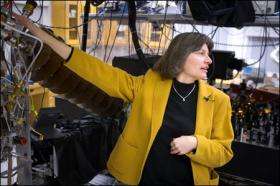
Physicists have for the first time stopped and extinguished a light pulse in one part of space and then revived it in a completely separate location. They accomplished this feat by completely converting the light pulse into matter that travels between the two locations and is subsequently changed back to light.
Two years later, she brought light to a complete halt in a cloud of ultracold atoms. Next, she restarted the stalled light without changing any of its characteristics, and sent it on its way. These highly successful experiments brought her a tenured professorship at Harvard University and a $500,000 MacArthur Foundation award to spend as she pleased.
Now Mallinckrodt Professor of Physics and of Applied Physics, Hau has done it again. She and her team made a light pulse disappear from one cold cloud then retrieved it from another cloud nearby. In the process, light was converted into matter then back into light. For the first time in history, this gives science a way to control light with matter and vice versa.
It's a thing that most scientists never thought was possible. Some colleagues had asked Hau, "Why try that experiment? It can't be done."
In the experiment, a light pulse was slowed to bicycle speed by beaming it into a cold cloud of atoms. The light made a "fingerprint" of itself in the atoms before the experimenters turned it off. Then Hau and her assistants guided that fingerprint into a second clump of cold atoms. And get this - the clumps were not touching and no light passed between them.
"The two atom clouds were separated and had never seen each other before," Hau notes. They were eight-thousandths of an inch apart, a relatively huge distance on the scale of atoms.
The experimenters then nudged the second cloud of atoms with a laser beam, and the atomic imprint was revived as a light pulse. The revived light had all the characteristics present when it entered the first cloud of atomic matter, the same shape and wavelength. The restored light exited the cloud slowly then quickly sped up to its normal 186,000 miles a second.
Communicating by light
Light carries information, so think of information being manipulated in ways that have never before been possible. That information can be stored - put on a shelf, so to speak - retrieved at will, and converted back to light. The retrieved light would contain the same information as the original light, without so much as a period being lost.
Or the information could be changed. "The light waves can be sculpted," is the way Hau puts it. "Then it can be passed on. We have already observed such re-sculpted light in our lab."
A weird thing happens to the light as it enters the cold atomic cloud, called a Bose-Einstein condensate. It becomes squeezed into a space 50 million times smaller. Imagine a light beam 3,200 feet (one kilometer) long, loaded with information, that now is only a hair width in length but still encodes as much information.
From there it becomes easier to imagine new types of computers and communications systems - smaller, faster, more reliable, and tamper-proof.
Atoms at room temperature move in a random, chaotic way. But when chilled in a vacuum to about 460 degrees below zero Fahrenheit, under certain conditions millions of atoms lock together and behave as a single mass. When a laser beam enters such a condensate, the light leaves an imprint on a portion of the atoms. That imprint moves like a wave through the cloud and exits at a speed of about 700 feet per hour. This wave of matter will keep going and enter another nearby ultracold condensate. That's how light moves darkly from one cloud to another in Hau's laboratory.
This invisible wave of matter keeps going unless it's stopped in the second cloud with another laser beam, after which it can be revived as light again.
Atoms in matter waves exist in slightly different energy levels and states than atoms in the clouds they move through. These energy states match the shape and phase of the original light pulse. To make a long story short, information in this form can be made absolutely tamper proof. Personal information would be perfectly safe.
Such a light-to-matter, matter-to-light system "is a wonderful thing to wrap your brain around," Hau muses.
Details of the experiments appear as the cover story of the Feb. 8 issue of Nature. Authors of the report include graduate student Naomi Ginsberg, postdoctoral fellow Sean Garner, and Hau.
In a practical manner
You won't see a light-matter converter flashing away in a factory, business, or mall anytime soon. Despite all the intriguing possibilities, "there are no immediate practical uses," Hau admits.
However, she has no doubt that practical systems will come. And when they do, they will look completely different from anything we are familiar with today. They won't need a lot of wires and electronics. "Instead of light shining through optical fibers into boxes full of wires and semiconductor chips, intact data, messages, and images will be read directly from the light," Hau imagines.
Creating those ultracold atomic clouds in a factory, office, or recreation room will be a problem, but one she believes can be solved. "The atomic clouds we use in our lab are only a tenth of a millimeter (0.004 inch) long," she points out. "Such atom clouds can be kept in small containers, not all of the equipment has to be so cold. Most likely, a practical system designed by engineers will look totally unlike the setup we have in our lab today."
There are no "maybes" in Hau's voice. She is coolly confident that light-to-matter communication networks, codes, clocks, and guidance systems can be made part of daily life. If you doubt her, remember she is the person who stopped light, converted it to matter, carried it around, and transformed it back to light.
Source: Harvard University, by William J. Cromie


