NASA's Largest Space Telescope Mirror Will See Deeper Into Space
February 7th, 2007 NASA's Largest Space Telescope Mirror Will See Deeper Into Space

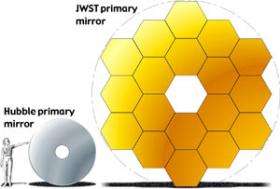
JWST will have a 6.6 meter (21.65 feet) diameter primary mirror, which would give it a significant larger collecting area than the mirrors available on the current generation of space telescopes. Hubble Space Telescope's mirror is a much smaller 2.4 meters (7.8 feet) in diameter. Click on image to enlarge. Credit: NASA

When scientists are looking into space, the more they can see, the easier it is to piece together the puzzle of the cosmos. The James Webb Space Telescope's mirror blanks have now been constructed. When polished and assembled, together they will form a mirror whose area is over seven times larger than the Hubble Telescope's mirror.

A telescope’s sensitivity, or how much detail it can see, is directly related to the size of the mirror area that collects light from the cosmos. A larger area collects more light to see deeper into space, just like a larger bucket collects more water in a rain shower than a small one. The larger mirror also means the James Webb Space Telescope (JWST) will have excellent resolution. That's why the telescope's mirror is made up of 18 mirror segments that form a total area of 25 square-meters (almost 30 square yards) when they all come together.

The challenge was to make the mirrors lightweight for launch, but nearly distortion-free for excellent image quality. That challenge has been met by AXSYS Technologies., Inc., Cullman, Ala. "From the start, AXSYS Technologies has been a key player in the mirror technology development effort," said Kevin Russell, mirror development lead at NASA's Marshall Spaceflight Center, Huntsville, Ala.

If the mirror were assembled completely and fully opened on the ground, there would be no way to fit it into a rocket. Therefore, the Webb Telescope's 18 mirror segments must be set into place when the telescope is in space. Engineers solved this problem by allowing the segmented mirror to fold, like the leaves of a drop-leaf table.

Each of the 18 mirrors will have the ability to be moved individually, so that they can be aligned together to act as a single large mirror. Scientists and engineers can also correct for any imperfections after the telescope opens in space, or if any changes occur in the mirror during the life of the mission. Each segment is made of beryllium, one of the lightest of all metals known to man. Beryllium has been used in other space telescopes and has worked well at the super-frigid temperatures of space in which the telescope will operate.

Each of the hexagonal-shaped mirror segments is 1.3 meters (4.26 feet) in diameter, and weighs approximately 20 kilograms or 46 pounds. The completed primary mirror will be over 2.5 times larger than the diameter of the Hubble Space Telescope's primary mirror, which is 2.4 meters in diameter, but will weigh roughly half as much.

"The James Webb Space Telescope will collect light approximately 9 times faster than the Hubble Space Telescope when one takes into account the details of the relative mirror sizes, shapes, and features in each design," said Eric Smith, JWST program scientist at NASA Headquarters, Washington. The increased sensitivity will allow scientists to see back to when the first galaxies formed just after the Big Bang. The larger telescope will have advantages for all aspects of astronomy and will revolutionize studies of how stars and planetary systems form and evolve.

The 18 mirrors have now been shipped to L-3 Communications SSG-Tinsley, Richmond, Calif. where they can be ground and polished.

After the grinding and polishing, the mirror segments will be delivered to Ball Aerospace in small groups where they will be assembled. Once the mirrors are completed, they will go to NASA's Goddard Space Flight Center, Greenbelt, Md., for final assembly on the telescope.

Upon successful launch in 2013, JWST will study the first stars and galaxies following the Big Bang.

Source: by Rob Gutro, Goddard Space Flight Center


print this article email this article download pdf blog this article bookmark this article     Digg this Stumble it share on Facebook share on Reddit add to delicious save to Yahoo! bookmarks
4.6/5 after 16 votes


February 7th, 2007 all stories
Space & Earth / Astronomy

Comments: 0
Rank: 4.6/5 after 16 votes

  • Stumble this up

  • Digg this

  • Share it:
  • share on Facebook
  • share on MySpace
  • share on Slashdot
  • rss-newsfeed
  • share on Google
  • share on Reddit
  • add to delicious
  • save to Yahoo! bookmarks
  • share on Windows Live
  • Add to Mixx!
Rating: 4.6/5 after 16 votes

  • Related Stories

  • Herschel Opens Its Infrared Eyes
    created Jun 29, 2009 | popularity not rated yet | comments 0
  • Big Bear Solar Observatory captures sun's magnetic field
    created May 19, 2009 | popularity not rated yet | comments 0
  • Astronauts to undertake fourth walk to repair Hubble telescope
    created May 17, 2009 | popularity not rated yet | comments 0
  • Spacewalkers pull off toughest Hubble repairs yet
    created May 16, 2009 | popularity not rated yet | comments 0
  • Herschel and Planck space telescopes lift off
    created May 14, 2009 | popularity not rated yet | comments 0

Tags


  • Physicists Demonstrate Quantum Memory with Matter Qubits
    Physicists Demonstrate Quantum Memory with Matter Qubits
    Physics / General Physics
    created 18 hours ago | popularity 4.5 / 5 (11) | comments 1
  • 'Holey' Nanosheets for Wastewater Dye Removal
    Nanotechnology / Nanomaterials
    created Jul 01, 2009 | popularity 5 / 5 (5) | comments 1
  • Jellyfish Robot Swims Like its Biological Counterpart
    Jellyfish Robot Swims Like its Biological Counterpart
    Electronics / Robotics
    created Jun 26, 2009 | popularity 4.4 / 5 (7) | comments 1
  • Could Maxwell's Demon Exist in Nanoscale Systems?
    Could Maxwell's Demon Exist in Nanoscale Systems?
    Physics / General Physics
    created Jun 24, 2009 | popularity 4.4 / 5 (18) | comments 29
  • Living Safely with Robots, Beyond Asimov's Laws
    Living Safely with Robots, Beyond Asimov's Laws
    Electronics / Robotics
    created Jun 22, 2009 | popularity 4.6 / 5 (50) | comments 39
  • Other News

    Global warming tactic cools climate but won’t help corals, say researchers

    Space & Earth / Earth Sciences

    created 15 hours ago | popularity 2.3 / 5 (3) | comments 5

    (PhysOrg.com) -- “Geoengineering” experiments proposed to reduce global warming by blocking sunlight with atmosphere-injected particles may cool the world but still leave carbon dioxide levels dangerously high, Stanford scientists ...


    Coolest spacecraft ever in orbit around L2

    Coolest spacecraft ever in orbit around L2

    Space & Earth / Space Exploration

    created 17 hours ago | popularity 4.8 / 5 (4) | comments 3

    (PhysOrg.com) -- Last night, the detectors of Planck's High Frequency Instrument reached their amazingly low operational temperature of -273°C, making them the coldest known objects in space. The spacecraft ...


    Senator may have won fight over private rocket manufacturing

    Space & Earth / Space Exploration

    created 18 hours ago | popularity 4.5 / 5 (2) | comments 2

    For months, a powerful Republican senator from Alabama has fought the Obama administration to block $150 million that the White House wanted to spend to help private companies build rockets capable of reaching the international ...


    The least sea ice in 800 years

    The least sea ice in 800 years

    Space & Earth / Earth Sciences

    created Jul 01, 2009 | popularity 4.3 / 5 (57) | comments 43

    New research, which reconstructs the extent of ice in the sea between Greenland and Svalbard from the 13th century to the present indicates that there has never been so little sea ice as there is now. The ...


    Gas around young galaxy

    Intense heat killed the Universe's would-be galaxies, researchers say

    Space & Earth / Astronomy

    created Jul 01, 2009 | popularity 3.1 / 5 (18) | comments 23

    (PhysOrg.com) -- Our Milky Way galaxy only survived because it was already immersed in a large clump of dark matter which trapped gases inside it, scientists led by Durham University's Institute for Computational ...