ESA accelerates towards a new space thruster
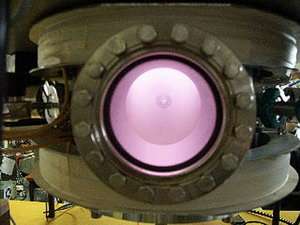
ESA has confirmed the principle of a new space thruster that may ultimately give much more thrust than today's electric propulsion techniques. The concept is an ingenious one, inspired by the northern and southern aurorae, the glows in the sky that signal increased solar activity.
"Essentially the concept exploits a natural phenomenon we see taking place in space," says Dr Roger Walker of ESA's Advanced Concepts Team. "When the solar wind, a 'plasma' of electrified gas released by the Sun, hits the magnetic field of the Earth, it creates a boundary consisting of two plasma layers. Each layer has differing electrical properties and this can accelerate some particles of the solar wind across the boundary, causing them to collide with the Earth's atmosphere and create the aurora." In essence, a plasma double layer is the electrostatic equivalent of a waterfall. Just as water molecules pick up energy as they fall between the two different heights, so electrically charged particles pick up energy as they travel through the layers of different electrical properties.
Researchers Christine Charles and Rod Boswell at the Australian National University in Canberra, first created plasma double layers in their laboratory in 2003 and realised their accelerating properties could enable new spacecraft thrusters. This led the group to develop a prototype called the Helicon Double Layer Thruster.
The new ESA study, performed as part of ESA's Ariadna academic research programme in association with Ecole Polytechnique, Paris, confirms the Australian findings by showing that under carefully controlled conditions, the double layer could be formed and remains stable, allowing the constant acceleration of charged particles in a beam. The study also confirmed that stable double layers could be created with different propellant gas mixtures.
"The collaboration has been absolutely excellent," says Dr Pascal Chabert, of Laboratoire de Physique et Technologie des Plasmas, Ecole Polytechnique. "It has been a real kick-off for me and has given me lots of new ideas for plasma propulsion concepts to investigate with the Advanced Concepts Team. The new direction for our laboratory had led to a patent on a promising new electric propulsion device called an Electronegative Plasma Thruster."
To create the double layer, Chabert and colleagues created a hollow tube around which was wound a radio antenna. Argon gas was continuously pumped into the tube and the antenna transmitted helicoidal radio waves of 13 megahertz. This ionised the argon creating a plasma. A diverging magnetic field at the end of the tube then forced the plasma leaving the pipe to expand. This allowed two different plasmas to be formed, upstream within the tube and downstream, and so the double layer was created at their boundary. This accelerated further argon plasma from the tube into a supersonic beam, creating thrust.
Calculations suggest that a helicon double layer thruster would take up a little more space than the main electric thruster on ESA's SMART-1 mission, yet it could potentially deliver many times more thrust at higher powers of up to 100 kW whilst giving a similar fuel efficiency.
In the next steps, ESA will now construct a detailed computer simulation of the plasma in and around the thruster and use the laboratory results to verify its accuracy, so that the in-space performance can be fully assessed and larger high power experimental thrusters can be investigated in the future.
Source: ESA


