Hey Porky Pig: You Deserve Some Respect, Expert Says
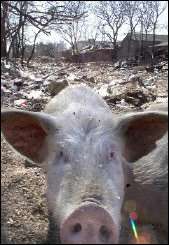
It’s the Chinese Year of the Pig, and if any animal ever needed a good PR campaign, it might be the pig. Many animal experts think pigs get a bad rap. They are often viewed as dirty creatures that are not smart and show little affection.
“That’s not true at all,” says Dr. Bruce Lawhorn, a swine expert at Texas A&M University’s College of Veterinary Medicine & Biomedical Sciences. “There are a lot of misconceptions about pigs, and it’s one animal people don’t really seem to understand.”
Pig facts include:
• Intelligence. Pigs are highly intelligent animals and are ranked No.4 in the smart department, behind chimpanzees, dolphins and elephants. “They are considered the smartest of the ‘barnyard’ animals and can be easily trained,” Lawhorn says.
• Cleanliness. “People think pigs are filthy, but that’s not really true,” he adds. “Pigs can’t sweat because they have few sweat glands, so when they roll around in the mud, they are trying to stay cool. But in most months, they are clean animals.”
• Not all pigs have curly tails – some have straight tails, Lawhorn adds.
• Pig valves have been used in human heart operations for years and there are more than 40 drugs made from pigs, among them insulin.
Lawhorn says piglet is a term referring to a small pig that is yet to be weaned, while hog refers to a mature pig. Boars are males, and gilts are females until they have piglets, and then they are called sows.
He adds that hogs can be quite large; they average about 260 to 280 pounds at only six months, the age when most are taken to a plant for processing. In the United States, about 100 million hogs are slaughtered each year for the meat packing industry, Lawhorn adds.
“The hog industry is different from other livestock in that almost all of it is run by big businesses and not by individual farmers or ranchers,” he says. “There’s one company in the U.S. that controls about 25 percent of all the hogs in America.”
Pigs have four toes on each hoof but only walk on two of those toes, often appearing as if they are tip-toeing. Also, pigs can easily get sunburned and have sensitive skin, he notes.
“They don’t have very good vision, but their sense of smell is highly developed,” Lawhorn says.
“In France and other countries, they are trained to locate mushrooms. But in many parts of the world, such as the Middle East and Arabian countries, people there are no fans of pigs. Their religious beliefs forbid eating or owning pigs.”
“That’s far different than here in the U.S., where pigs are often raised as pets and are groomed as show animals at FFA and 4-H events. Texas is the biggest ‘show pig’ state in the country.”
But even in the U.S, pigs can be seen as pests, most notably in the form of feral hogs. Even though hunters enjoy stalking wild pigs, the creatures are considered severe nuisances to farmers and ranchers, and the feral hog population has more than doubled in the last 10 years, Lawhorn says.
Texas has an estimated two million feral hogs, more than any state, and the meat is prized by many restaurants where it is served as wild boar at expensive prices.
And yes, hungry diners like to pig-out on its exotic taste.
Source: Texas A&M University


