Revealing secret intentions in the brain
February 8, 2007
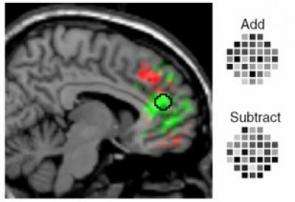
Brain regions from which it was possible to "read out" peoples' intentions. In specific regions fine-grained patterns of brain activity showed slight differences depending on whether a person was preparing to perform an addition or a subtraction. From activity patterns in the green regions it was possible to read out covert intentions before subjects began to perform the calculation. From the regions marked in red it was possible to read out intentions that were already being acted upon. Credit: Bernstein Center for Computational Neuroscience Berlin
Every day we plan numerous actions, such as to return a book to a friend or to make an appointment. How and where the brain stores these intentions has been revealed by John-Dylan Haynes from the Max Planck Institute for Human Cognitive and Brain Sciences, in cooperation with researchers from London and Tokyo. For the first time they were able to "read" participants' intentions out of their brain activity.
This was made possible by a new combination of functional magnetic resonance imaging and sophisticated computer algorithms (Current Biology, 20th February 2007, online: 8th February).
Our secret intentions remain concealed until we put them into action -so we believe. Now researchers have been able to decode these secret intentions from patterns of their brain activity. They let subjects freely and covertly choose between two possible tasks - to either add or subtract two numbers. They were then asked to hold in mind their intention for a while until the relevant numbers were presented on a screen. The researchers were able to recognize the subjects intentions with 70% accuracy based alone on their brain activity - even before the participants had seen the numbers and had started to perform the calculation.
Participants made their choice covertly and initially did not know the two numbers they were supposed to add or subtract. Only a few seconds later the numbers appeared on a screen and the participants could perform the calculation. This ensured that the intention itself was being read out, rather than brain activity related to performing the calculation or pressing the buttons to indicate the response. "It has been previously assumed that freely selected plans might be stored in the middle regions of the prefrontal cortex, whereas plans following external instructions could be stored on the surface of the brain. We were able to confirm this theory in our experiments", Haynes explained.
The work of Haynes and his colleagues goes far beyond simply confirming previous theories. It has never before been possible to read out of brain activity how a person has decided to act in the future. The trick by which the invisible is made visible lies in a new method called "multivariate pattern recognition". A computer is programmed to recognize characteristic activation patterns in the brain that typically occur in association with specific thoughts. Once this computer has been "trained" it can be used to predict the decisions of subjects from their brain activity alone. An important technical innovation also lies in combining information across extended regions of the brain to strongly increase sensitivity.
The study also reveals fundamental principles about the way the brain stores intentions. "The experiments show that intentions are not encoded in single neurons but in a whole spatial pattern of brain activity", says Haynes. They furthermore reveal that different regions of the prefrontal cortex perform different operations. Regions towards the front of the brain store the intention until it is executed, whereas regions further back take over when subjects become active and start doing the calculation. "Intentions for future actions that are encoded in one part of the brain need to be copied to a different region to be executed", says Haynes.
These findings also raise hope for improvement of clinical and technical applications. Already today the first steps are being made in easing the lives of paralyzed patients with computer-assisted prosthetic devices and so-called brain computer interfaces. These devices focus on reading out the movement the patient intends to - but is unable to - perform. Previous research has shown that patients can move artificial limbs or computer cursors purely by the power of their mind. The current research by Haynes and colleagues now opens up a completely new perspective.
In future it will be possible to read even abstract thoughts and intentions out of patients' brains. One day even the intention to "open the blue folder" or "reply to the email" could be picked up by brain scanners and turned into the appropriate action.
Source: Max-Planck-Gesellschaft
-
It's not solitaire: Brain activity differs when one plays against others
Feb 06, 2012 |
4.8 / 5 (5) |
2
-
The influence of estrogen on female mood changes
Jan 22, 2012 |
3.3 / 5 (3) |
0
-
Blocking metabolic protein improves movement in animals with amyotrophic lateral sclerosis
Jan 17, 2012 |
not rated yet |
0
-
How to make New Year's resolutions that you'll actually follow
Dec 29, 2011 |
4.5 / 5 (2) |
0
-
A radar for ADAR: Altered gene tracks RNA editing in neurons
Dec 25, 2011 |
4 / 5 (1) |
0
-
Engineers build first sub-10-nm carbon nanotube transistor
Feb 01, 2012 |
4.9 / 5 (31) |
30
-
Something old, something new: Evolution and the structural divergence of duplicate genes
Jan 31, 2012 |
4.6 / 5 (7) |
1
-
The hidden nanoworld of ice crystals: Revealing the dynamic behavior of quasi-liquid layers
Jan 30, 2012 |
5 / 5 (3) |
1
-
Stock market network reveals investor clustering
Jan 27, 2012 |
3.9 / 5 (23) |
8
-
Of microchemistry and molecules: Electronic microfluidic device synthesizes biocompatible probes
Jan 26, 2012 |
5 / 5 (1) |
0
More news stories
Entire genome of extinct human decoded from fossil
(PhysOrg.com) -- In 2010, Svante Pääbo and his colleagues presented a draft version of the genome from a small fragment of a human finger bone discovered in Denisova Cave in southern Siberia. The ...
Feb 07, 2012 |
4.7 / 5 (58) |
44
|
Why are there so few fish in the Earth's oceans?
(PhysOrg.com) -- A Stony Brook University researcher has found that, contrary to popular belief, there are not plenty of fish in the sea.
Feb 08, 2012 |
4.3 / 5 (17) |
25
|
Miami battling invasion of giant African snails
No one knows how they got there. But an invasion of African giant snails has southern Florida in a panic over potential crop damage, disease and general yuckiness surrounding the slimy gastropods.
Feb 10, 2012 |
4.5 / 5 (2) |
5
The power of estrogen -- male snakes attract other males
A new study has shown that boosting the estrogen levels of male garter snakes causes them to secrete the same pheromones that females use to attract suitors, and turned the males into just about the sexiest ...
Feb 10, 2012 |
4.8 / 5 (6) |
2
|
Deciding to go left or right: Researchers use device to determine that lower animals can navigate too
For decades, scientists have associated binary decision making opting to go left or right with higher-ranking animals, including humans. A team of Harvard researchers, however, is rewriting that ...
Feb 09, 2012 |
4 / 5 (1) |
4
|
Walney offshore wind farm is world's biggest (for now)
(PhysOrg.com) -- The Walney wind farm on the Irish Sea--characterized by high tides, waves and windy weather--officially opened this week. The farm is treated in the press as a very big deal as the Walney ...
GPS court ruling leaves US phone tracking unclear
A US Supreme Court decision requiring a warrant to place a GPS device on the car of a criminal suspect leaves unresolved the bigger issue of police tracking using mobile phones, legal experts say.
Europeans protest controversial Internet pact
Tens of thousands of people marched in protests in more than a dozen European cities Saturday against a controversial anti-online piracy pact that critics say could curtail Internet freedom.
Europe stakes billion-dollar bet on new rocket
A pencil-slim rocket is scheduled to lift into space from South America on Monday, carrying a billion-dollar bet that Europe can grab a juicy slice of the market to place satellites in low orbit.
Study finds that anti-diabetic medication can prevent the long-term effects of maternal obesity
In a study to be presented today at the Society for Maternal-Fetal Medicine's annual meeting, The Pregnancy Meeting, in Dallas, Texas, researchers will report findings that show that short therapy with the anti-diabetic medication ...
Netflix settlement trims 14 pct off 4Q earnings
(AP) -- Netflix pressed the rewind button on its fourth-quarter earnings after settling allegations that the video subscription service violated a consumer-privacy law.