Catalyst breakthrough boosts hydrogen fuel cells
Researchers at the U.S. Department of Energy's Argonne National Laboratory have discovered new information on the behavior of nano-engineered platinum surfaces – information that may bring polymer electrolyte membrane fuel cells for hydrogen-powered vehicles another step closer to full development.
Two Argonne researchers, Nenad Markovic and Vojislav Stamenkovic, in collaboration with colleagues Philip Ross and Bongjin Mun at DOE's Lawrence Berkeley National Laboratory, Christopher Lucas from the University of Liverpool and Guofeng Wang from the University of South Carolina, have recently discovered that the nanosegregated platinum-nickel alloy surface has unique catalytic properties, opening up important new directions for the development of active and stable practical cathode catalysts in fuel cells. The results are published in the journal Science.
Rather than use trial-and-error or combinatorial approach, Stamenkovic and Markovic examined platinum-nickel single crystal alloy surfaces with state-of-the-art ex-situ and in-situ surface sensitive probes so that the mechanism of action has been attributed to specific properties at the atomic and molecular level of the surface.
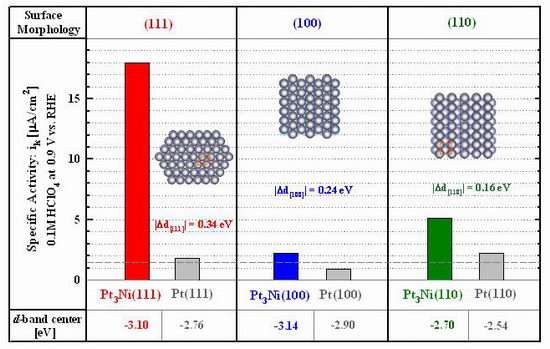
The research identified the platinum-nickel alloy surface as displaying an unusual electronic structure and arrangement of surface atoms in the near-surface region. This structure enhanced activity of the platinum catalysts by several orders of magnitude, resulting in the highest activity ever observed on a cathode catalyst. The platinum-nickel alloy configuration inhibits oxide formation, breaking the oxygen bond on active platinum sites.
According to Stamenkovic, “This discovery sets a new bar for catalytic activity in fuel cells and makes it feasible to meet U.S. Department of Energy targets for platinum-specific power densities without a loss in cell voltage.
“We have identified a cathode surface that is capable of achieving and even exceeding the target for catalytic activity, with improved stability for the cathodic reaction in fuel cells,” said Stamenkovic. “Although the platinum-nickel alloy itself is well-known, we were able to control and tune key parameters, which enabled us to make this discovery. Our study demonstrates the potential of new analytical tools for characterizing nanoscale surfaces in order to fine tune their properties in a desired direction.”
In these fuel cells, the main fuel is hydrogen which, through its reaction with oxygen, produces water as its only product.
“Although there are signs that in the near future these fuel cells may become the modern equivalent of the Carnot cycle engine,” Markovic said, “in order to make hydrogen-based energy systems a vibrant and competitive force, many problems still need to be solved.
"First," he said, "at practical operating current densities, the significant over potential for the oxygen reduction reaction reduces the thermal efficiency well below its thermodynamic limits. Second, an approximately five-fold reduction of the amount of platinum-loading in current fuel cell stacks is needed to meet cost requirements for large scale automotive applications. Finally, the dissolution or loss of platinum surface area in the cathode must be greatly reduced. To overcome these limitations and to make hydrogen viable as a renewable energy source, a breakthrough in catalyst research was needed.”
George Crabtree, director of Argonne's Materials Science Division, emphasized the path-breaking importance of the research. “ This dramatic increase," he said, "addresses one of the grand challenges of the hydrogen economy, reducing the amount of expensive platinum catalyst needed to operate fuel cells efficiently. It is not only world-class basic science, it is a major advance for energy research.”
The next step will be to build and analyze a conceptual and structural ‘bridge” between the single crystal system and working electrocatalysts. To achieve this, the researchers will try to create nanostructures that preserve the most technologically interesting characteristic of the platinum-nickel alloy single crystal system.
To meet this goal, Markovic and Stamenkovic have recently moved from Lawrence Berkeley National Laboratory to Argonne, where they expect to do research well beyond the present frontier of electrocatlysis. The unique activity of nanosegregated platinum-nickel alloy catalysts will be the foundation for the new research program at Argonne. The program will build on the electrochemical and electrocatalytic strengths already existing at Argonne in the research of materials scientist Hoydoo You.
Three new laboratories, equipped with the-state-of-the-art ex-situ and in-situ surface sensitive probes, spectroscopes and electrochemical techniques will provide new environment to resume the critical work in electrocatalysis.
The project will also use major facilities at Argonne, including the Advanced Photon Source, the Center for Nanoscale Materials, the Electron Microscopy Center and a strong interaction with theory.
The techniques and concepts derived from this program are expected to make overarching contribution to other areas of science well beyond the focus on electrocatalysis. “We hope that this program will lead the nation to more secure energy independence and a cleaner environment for future generations,” Markovic said.
Source: Argonne National Laboratory


