AMO Manufactures First Graphene Transistors
February 8, 2007 AMO Manufactures First Graphene Transistors

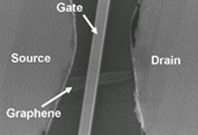
In the scope of his innovative project ALEGRA the AMO nanoelectronics group of Dr. Max Lemme was able to manufacture top-gated transistor-like field-effect devices from monolayer graphene.

Compared to conventional silicon and SOI MOSFETs the researchers realized a significant enhancement of electron and hole mobility.

Moore’s law, which has dictated ambitious innovation cycles to the semiconductor industry over the last decades, may finally be running out of steam. In the future, innovations for silicon technology may only be realized by integrating new functionalities or novel materials.

Carbon is one of the most probable candidates: impressive potential for nanoelectronics applications has been demonstrated with carbon nanotubes – and graphene!

A conventional CMOS-compatible process has been applied to fabricate a graphene field-effect device – a transistor made from a monolayer of carbon. The observed mobility in the devices exceeds the universal mobility in silicon MOSFETs. Furthermore, a second transistor gate was placed on top of the graphene film for the first time. AMO’s results confirm the high potential of graphene for future nanoelectronic devices.

First experimental details will be published in IEEE Electron Device Letters in April 2007.

Citation: M.C. Lemme, T.J. Echtermeyer, M. Baus, H. Kurz, “A Graphene Field Effect Device”, IEEE Electron Device Letters, Vol. 28, No. 4, April 2007.

Source: AMO


Rate this story - 4.1 /5 (18 votes)


February 8, 2007 all stories

Comments: 0

4.1 /5 (18 votes)

  • hide
  • Related Stories


  • hide
  • Relevant PhysicsForums posts

Other News

Nanoscale Structures with Superior Mechanical Properties Developed

Nanoscale Structures with Superior Mechanical Properties Developed

Nanotechnology / Nanomaterials

created 17 hours ago | popularity 4.6 / 5 (9) | comments 2 | with audio podcast

(PhysOrg.com) -- Researchers at the California Institute of Technology have developed a way to make some notoriously brittle materials ductile -- yet stronger than ever -- simply by reducing their size.


Spray-on liquid glass

Spray-on liquid glass is about to revolutionize almost everything

Nanotechnology / Nanomaterials

created Feb 02, 2010 | popularity 4.7 / 5 (240) | comments 93 | with audio podcast report

(PhysOrg.com) -- Spray-on liquid glass is transparent, non-toxic, and can protect virtually any surface against almost any damage from hazards such as water, UV radiation, dirt, heat, and bacterial infections. ...


IBM Scientists Demonstrate World's Fastest Graphene Transistor

IBM Scientists Demonstrate World's Fastest Graphene Transistor

Nanotechnology / Nanophysics

created Feb 05, 2010 | popularity 4.9 / 5 (38) | comments 25 | with audio podcast

(PhysOrg.com) -- In a just-published paper in the magazine Science, IBM researchers demonstrated a radio-frequency graphene transistor with the highest cut-off frequency achieved so far for any graphene device ...


Conductive eTextiles: Stanford finds a new use for cloth

Conductive eTextiles: Researchers move from making batteries from paper to making batteries from cloth

Nanotechnology / Nanomaterials

created Feb 05, 2010 | popularity 4.3 / 5 (7) | comments 4 | with audio podcast

(PhysOrg.com) -- Stanford researchers have moved from making batteries from paper to making batteries from cloth. Your-T-shirt could become a lighted, moving display.


Carbon Based Chips May One Day Replace Silicon Transistors

Carbon Based Chips May One Day Replace Silicon Transistors

Nanotechnology / Nanomaterials

created Feb 03, 2010 | popularity 4.7 / 5 (18) | comments 3 | with audio podcast weblog

(PhysOrg.com) -- IBM researchers are hopeful that, over the next decade, silicon-based transistors will be replaced by carbon-based transistors. IBM has already laid out the ground work for carbon-based transistors.