Nanopatterns Regulate Electricity
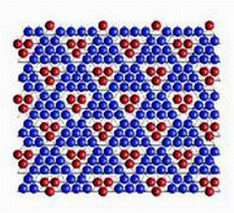
Regular arrangements of sodium atoms make sodium cobalt oxide a perfect material for laptop batteries, an efficient cooling material and a superconductor. The concentration of sodium atoms in the material can vary and the material's behaviour depends sensitively on this number.
As reported in the latest issue of the magazine Nature, scientists from the Hahn Meitner Institute (Berlin), the CEA research centre in Saclay (Paris), and the University of Liverpool have shown that the sodium atoms always arrange in regular patterns, and these patterns determine the properties of the material.
The image shows the pattern created when four fifths of the available places are occupied by sodium atoms. The concentration of sodium atoms can easily be varied using chemical methods, and it is possible to change the material from a metal to an insulator, and then to superconductor, just by putting it into an electrochemical cell and changing the applied voltage.
On the microscopic level, sodium cobalt oxide has a characteristic layered structure: cobalt oxide layers alternate with layers of sodium atoms ordered on a nanoscale. The concentration of sodium atoms can vary over a large range, and the detailed arrangement of the sodium atoms determines the electrical properties of the material. When they are far apart from each other, each atom acts as a well confining the electrons constituting the current flow - the material becomes an insulator. If they are arranged in lines, they form wire-like structures allowing current to flow along one direction.
Alan Tennant, head of the department Magnetism at the Hahn-Meitner-Institut explains that "the electrons responsible for the current flow behave like waves and they like to arrange their wavelength and their behaviour to fit the predefined structure. In this way the electrons can be controlled by the chemical composition of the material. If the sodium atoms were arranged at random, small changes in their number would hardly influence the current flow."
Controlling the transport of electrons provides the basis for our modern information and communications technologies and improvements in solid state batteries has led to a revolution in portable electronic devices from iPods to mobile phones. "The laptop batteries used today contain lithium cobalt oxide - a material very similar to sodium cobalt oxide - and they are charged by changing the number of lithium atoms. We know that lithium atoms are also arranged in regular patterns, and may show some of the beautiful behaviour seen in the sodium compounds." Tennant adds.
Sodium cobalt oxide is also a good candidate for an efficient cooling material, since it is among the few materials that are good electrical conductors, but that conduct heat badly. This can be understood from the arrangement shown in the image: the sodium atoms marked red are confined in cages formed by blue atoms. They can rattle in these cages, taking up most of the heat trying to travel through the material without impeding the flow of electric current. New thermoelectric materials could provide a route to more energy efficient refrigeration, as well as converting heat sources such as geothermal energy and hot water from conventional power stations into useful electricity.
A kaleidoscope of patterns of sodium atoms depending on the sodium concentration was found. In order to understand how the sodium structures come about, one can imagine the various atoms as marbles. The oxygen atoms are arranged in a honeycomb pattern and the sodium atoms have to rest in the cavities formed between them. Due to their large size, two sodium atoms cannot occupy two adjacent cavities and, therefore, when the sodium layer is completely filled, only every second cavity is occupied. This creates two classes of sodium atoms corresponding to the blue and red spheres in the image. Finally, the sodium atoms repel each other and, therefore, try to keep as far apart as possible. The overall pattern reflects the best arrangement in accordance with these factors for a given concentration.
The sodium ordering was studied using neutron and synchrotron methods at the Hahn-Meitner-Institut and at the Rutherford Appleton Laboratory, UK, The MAP2 supercomputer at the University of Liverpool, normally used for particle physics computations, was then used to explore this idea, which finally led to the determination of the sodium ordering patterns observed.
Further partners in this European cooperation were the Universities of Oxford and Bristol, the Berlin Synchrotron Radiation Source BESSY, and the European Synchrotron Radiation Facility ESRF in Grenoble.
Citation: M. Roger, D.J.P. Morris, D.A. Tennant, M.J. Gutmann, J.P. Goff, J.-U. Hoffmann, R. Feyerherm, E. Dudzik, D. Prabhakaran, N. Shannon, B. Lake, P.P. Deen, Patterning of Sodium Ions and the Control of Electrons in Sodium Cobaltate Nature, 8. Februar 2007
Source: Hahn-Meitner-Institut


