HIV protein enlisted to help kill cancer cells
February 8, 2007
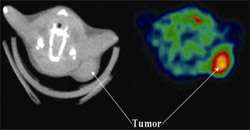
Hawkins and colleagues have linked anticancer agents to a PET tracer substance to deliver the treatment directly to tumors in mice (red and yellow color shows highest amounts of tracer).
Cancer cells are sick, but they keep growing because they don't react to internal signals urging them to die. Now researchers at Washington University School of Medicine in St. Louis have found an efficient way to get a messenger into cancer cells that forces them to respond to death signals. And they did it using one of the most sinister pathogens around — HIV.
"HIV knows how to insert itself into many different types of cells," says senior author William G. Hawkins, M.D., assistant professor of surgery and a member of the Siteman Cancer Center at the School of Medicine and Barnes-Jewish Hospital. "A portion of the HIV protein called TAT can transport biologically active compounds into cells. TAT is small, but it can move massive molecules. You could almost hook TAT up to a train, and TAT would drag it inside a cell. So we've taken advantage of this ability."
In an article published online in January 2007 in the Annals of Surgical Oncology, the researchers describe using TAT to pull a protein called Bim into cancer cells. TAT alone cannot cause AIDS and has no adverse health effects. Bim acts as a tumor suppressor and causes cancer cells to die through apoptosis, a process by which cells "commit suicide."
The research team found that the TAT-Bim compound activated apoptosis mechanisms in cancer cells and augmented the cell-killing effect of radiation. When mice with malignant tumors were treated with TAT-Bim, their tumors shrank, and they survived longer than mice that didn't get the treatment. After 40 days, 80 percent of mice receiving TAT-Bim were alive compared to 20 percent of mice that didn't get the treatment.
Hawkins asserts that this success marks the beginning of a very promising new approach to cancer therapy. "This is the tip of the iceberg," he says. "Now that we've proven we can do this, we've started creating a battery of proteins that can push cancer cells to die."
Hawkins says he thinks treatments that activate apoptosis mechanisms could provide new options for patients with the deadliest cancers — such as pancreatic cancer — which have very low rates of survival. He says he believes that clinical trials of these compounds could be just a few years away.
Hawkins began researching TAT-Bim after discussions with co-author Richard S. Hotchkiss, M.D., professor of anesthesiology, medicine and surgery and associate professor of molecular biology and pharmacology. Hotchkiss was seeking proteins that inhibit apoptosis in patients with life-threatening infections and found that TAT-Bim had the unwanted effect of increasing cell death. Hawkins wondered if TAT-Bim could be effective against cancer, and a productive scientific collaboration began between their labs to exploit the anticancer potential of TAT-Bim.
"Unlike most healthy cells, cancer cells grow very fast. So they are always on the verge of running out of natural ingredients like sugars, and mistakes are accumulating in their DNA," Hawkins says. "This results in signals telling cancer cells to die, but the cells don't quite have the permission they need to do it. Proteins like TAT-Bim can tip the balance in favor of death."
To further enhance the cancer-killing power of TAT-Bim and similar proteins under development, Hawkins and his colleagues are working on a technique that will concentrate them within tumors while sparing healthy cells. In collaboration with Robert H. Mach, Ph.D. professor of radiology, they are linking the anticancer proteins to tracer molecules that selectively bind to cancer cells.
"Dr. Mach designed tracers to visualize cancer in PET (positron emission tomography) scans," Hawkins says. "By binding our molecules to the tracers, we can deliver them to cancer cells. We've seen phenomenal results in the lab."
Next Hawkins plans to combine pro-apoptotic proteins such as TAT-Bim with chemotherapy, radiation therapy and other anticancer therapeutics in hopes of further increasing cell-suicide signals within cancer cells.
Source: Washington University School of Medicine in St. Louis
-
Engineers build first sub-10-nm carbon nanotube transistor
Feb 01, 2012 |
4.9 / 5 (31) |
30
-
Something old, something new: Evolution and the structural divergence of duplicate genes
Jan 31, 2012 |
4.6 / 5 (7) |
1
-
The hidden nanoworld of ice crystals: Revealing the dynamic behavior of quasi-liquid layers
Jan 30, 2012 |
5 / 5 (3) |
1
-
Stock market network reveals investor clustering
Jan 27, 2012 |
3.9 / 5 (23) |
8
-
Of microchemistry and molecules: Electronic microfluidic device synthesizes biocompatible probes
Jan 26, 2012 |
5 / 5 (1) |
0
-
Is Everyday Technology Killing Us?
Feb 08, 2012
-
Exercise and weight loss
Feb 08, 2012
-
Why do we have head aches? Our brains can't feel anything.
Feb 07, 2012
-
"The end of diseases" by David Agus, interview from Daily Show with Jon Stewart
Feb 04, 2012
-
Oncolytic adenovirus
Feb 04, 2012
-
Nutrition label stuffs and diets
Feb 02, 2012
- More from Physics Forums - Medical Sciences
More news stories
Study finds that anti-diabetic medication can prevent the long-term effects of maternal obesity
In a study to be presented today at the Society for Maternal-Fetal Medicine's annual meeting, The Pregnancy Meeting, in Dallas, Texas, researchers will report findings that show that short therapy with the anti-diabetic medication ...
14 hours ago |
5 / 5 (1) |
1
Steroid injections prove effective in treatment of lumbar disc herniations
The use of epidural steroid injections may be a more efficient treatment option for lumbar disc herniations, according to research presented today at the American Orthopaedic Society for Sports Medicine's Specialty Day in ...
14 hours ago |
not rated yet |
0
Amateur football players not always keen on returning to play after ACL injuries
Despite the known success rates of reconstructive Anterior Cruciate Ligament (ACL) surgery, the number of high school and collegiate football players returning to play may not be as high as anticipated, say researchers presenting ...
14 hours ago |
not rated yet |
0
Study finds elevated levels of cell-free DNA in first trimester do not predict preeclampsia
In a study to be presented today at the Society for Maternal-Fetal Medicine's annual meeting, The Pregnancy Meeting, in Dallas, Texas, researchers will report findings that indicate that elevated levels of cell-free DNA in ...
14 hours ago |
not rated yet |
0
PRP treatment aids healing of elbow injuries say researchers
As elbow injuries continue to rise, especially in pitchers, procedures to help treat and get players back in the game quickly have been difficult to come by. However, a newer treatment called platelet rich plasma (PRP) may ...
14 hours ago |
5 / 5 (1) |
0
Walney offshore wind farm is world's biggest (for now)
(PhysOrg.com) -- The Walney wind farm on the Irish Sea--characterized by high tides, waves and windy weather--officially opened this week. The farm is treated in the press as a very big deal as the Walney ...
GPS court ruling leaves US phone tracking unclear
A US Supreme Court decision requiring a warrant to place a GPS device on the car of a criminal suspect leaves unresolved the bigger issue of police tracking using mobile phones, legal experts say.
Europeans protest controversial Internet pact
Tens of thousands of people marched in protests in more than a dozen European cities Saturday against a controversial anti-online piracy pact that critics say could curtail Internet freedom.
Europe stakes billion-dollar bet on new rocket
A pencil-slim rocket is scheduled to lift into space from South America on Monday, carrying a billion-dollar bet that Europe can grab a juicy slice of the market to place satellites in low orbit.
Netflix settlement trims 14 pct off 4Q earnings
(AP) -- Netflix pressed the rewind button on its fourth-quarter earnings after settling allegations that the video subscription service violated a consumer-privacy law.
Elbow position not a predictor of injury
Elbow position alone appeared to not affect injury rates and performance in college-level, male pitchers say researchers presenting at the American Orthopaedic Society for Sports Medicine's Specialty Day in San Francisco, ...