Unpeaceful co-existence: How strengths and weaknesses maintain biodiversity in an ant community
February 9, 2007 Ants Defend Cricket Dinner

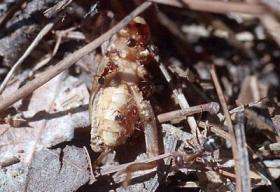
Ants swarm over a large cricket that must be defended and cut up to be returned to the nest. Credit: photograph by F. Adler

Many species of ants scavenge for the same kinds of food. Why then doesn't the single most efficient species drive the others to extinction? A research group based at the University of Utah conducted a detailed study of ants in the mountains of southeastern Arizona to identify exactly how they manage to share the same environment. The study appears in the March issue of the American Naturalist.

They found that some species are better at finding food resources (dead crickets left by researchers) while others are better at defending them. This so-called dominance-discovery tradeoff is complicated by the size of the cricket because small crickets can be collected so quickly that defense is unimportant.

For both large and small crickets, two ant species are adept at both finding and defending resources, and would be predicted to outcompete the others because they violate the tradeoff. But it is precisely these ants that are beset by parasitoid flies which lay their eggs specifically on these types of ant, eventually causing a gruesome death by decapitation. When the target ants see the flies hovering around, they run away and are unable to effectively defend resources.

Using mathematical models, the team showed that this combination of factors is indeed sufficient to explain how five of the six most common species manage to survive, with the sixth remaining a bit of a mystery.

"Just like people, different ants have different strengths and weaknesses, and these differences allow them to coexist, although not peacefully," says Ed LeBrun. "Developing a quantitative understanding of the mechanisms by which species coexist is essential to knowing how to preserve biodiversity," adds Fred Adler. "Our quantitative approach should be useful in modeling the potential success or failure of invasive ant species," concludes Don Feener.

Source: University of Chicago


print this article email this article download pdf blog this article bookmark this article     Stumble it Digg this share on Facebook retweet share on Reddit add to delicious
Rate this story - 3.8 /5 (8 votes)


February 9, 2007 all stories

Comments: 0

3.8 /5 (8 votes)
  • Stumble this up

  • Digg this

  • share this

  • hide
  • Related Stories

  • Like humans, ants use bacteria to make their gardens grow
    created Nov 19, 2009 | popularity not rated yet | comments 0
  • Rapacious Rasberry ants march north
    created Nov 13, 2009 | popularity not rated yet | comments 0
  • Ants are friendly to some trees, but not others
    created Nov 06, 2009 | popularity not rated yet | comments 0
  • When ants attack: Researchers recreate chemicals that trigger aggression
    created Oct 27, 2009 | popularity not rated yet | comments 0
  • Herbivory discovered in a spider
    created Oct 12, 2009 | popularity not rated yet | comments 0


Other News

Measuring and modeling blood flow in malaria

Biology / Cell & Microbiology

created 3 hours ago | popularity not rated yet | comments 0

When people have malaria, they are infected with Plasmodium parasites, which enter the body from the saliva of a mosquito, infect cells in the liver, and then spread to red blood cells. Inside the blood cells, the parasites ...


Bioengineers succeed in producing plastic without the use of fossil fuels

Biology / Biotechnology

created 1hour ago | popularity not rated yet | comments 0

A team of pioneering South Korean scientists have succeeded in producing the polymers used for everyday plastics through bioengineering, rather than through the use of fossil fuel based chemicals. This groundbreaking research, ...


Beyond sunlight: Explorers census 17,650 ocean species between edge of darkness and black abyss

Beyond sunlight: Explorers census 17,650 ocean species between edge of darkness and black abyss (w/ Video)

Biology / Plants & Animals

created 18 hours ago | popularity 4.9 / 5 (12) | comments 0

Census of Marine Life scientists have inventoried an astonishing abundance, diversity and distribution of deep sea species that have never known sunlight - creatures that somehow manage a living in a frigid ...


Rare Charles Darwin book found on toilet bookshelf (AP)

Rare Charles Darwin book found on toilet bookshelf

Biology / Other

created 17 hours ago | popularity 4.8 / 5 (5) | comments 1

(AP) -- An auction house says it is selling a rare first edition of Charles Darwin's "On the Origin of Species" found in a family's guest lavatory in southern England.


Extinct goat Myotragus balearicus

Extinct goat was cold-blooded

Biology / Plants & Animals

created Nov 18, 2009 | popularity 4.9 / 5 (34) | comments 11

(PhysOrg.com) -- An extinct goat that lived on a barren Mediterranean island survived for millions of years by reducing in size and by becoming cold-blooded, which has never before been discovered in mammals.