Supernovae -- cosmic lighthouses
February 9, 2007
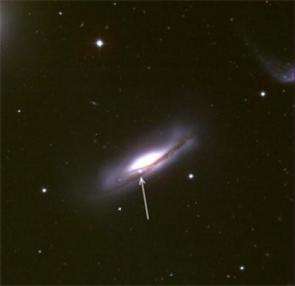
The arrow points to the supernova 2002bo, the explosion of a white dwarf in the galaxy NGC 3190 in the Leo constellation -- 60 million light years away from earth. Credit: Benetti et al., MNRAS 384, 261-278 (2004)
Supernovae stand out in the sky like cosmic lighthouses. Scientists at the Max Planck Institute for Astrophysics and at the National Astronomical Institute of Italy have now found a way to use these cosmic beacons to measure distances in space more accurately. The researchers have been able to show that all supernovae of a certain type explode with the same mass and the same energy - the brightness depends only on how much nickel the supernova contains.
This knowledge has allowed the researchers to calibrate the brightness of supernovae with greater precision. This means that in the future, they will use the brightness of a supernova that they are observing through their telescopes to determine more accurately how far away from the Earth the cosmic lighthouse is emitting its rays.
The end of a star's life, when the star has become heavy enough, is marked by a huge explosion - a supernova. For a few weeks, a supernova looks almost as bright as a whole galaxy containing billions of stars. Physicists designate the brightest of these supernovae as Type Ia. Their brightness, measured from the Earth, is a measure of their distance from us - but there are several uncertainties. "The question still remains: how suitable are supernovae really for measuring distance? For example, the knowledge that the Universe is expanding rapidly is largely based on observations of supernovae," explains Prof. Wolfgang Hillebrandt. All type Ia supernovae exhibit similar levels of brightness, but they are not exactly consistent.
Scientists from the Max Planck Institute for Astrophysics and the National Astronomical Institute of Italy have now made a breakthrough. They have come to the conclusion that the explosion energy of the type Ia supernovae is almost consistent - it is equivalent to the fusion energy which a white dwarf with around one and half times the mass of the Sun can develop. However, the amount of radioactive nickel and medium-weight chemical elements such as silicon vary from supernova to supernova and explain the difference in their brightness. The more nickel a supernova contains, the brighter it shines.
In the explosion, nuclear fusion of carbon and oxygen creates large quantities of radioactive atomic nuclei; in some supernovae, this is mainly the radioactive isotope 56 of the element nickel. The energy from its radioactive decay is converted to light in the supernova. The fusion therefore supplies both the energy and the light for the explosion. The nuclear fusion, however, can end with lighter atomic nuclei like silicon, for example. This creates the same amount of energy, but the supernova is not so bright. The researchers identify this situation when they also see the silicon in the light spectrum of the supernova.
Over the last four years, in a study forming part of a European joint venture lead by the Max Planck Institute for Astrophysics, scientists have looked at 20 Ia supernova explosions, following each one for several weeks. Using spectroscopic and photometric data and complicated numerical simulations, they arrived at results that now make it possible to refine existing calibration methods. Astronomers calibrate the differences in brightness of the supernovae with their light curves; that is, the way the brightness develops over time in newly discovered supernovae. The light curves of brighter supernovae diminish more slowly than those of less bright supernovae.
Up to now, the weakest link in this calibration method has been limited knowledge about the supernova explosions themselves: what causes the differences in brightness and are the corrections made to them justified? The supernovae that play a part in cosmology in measuring distances exploded just as our solar system was coming into existence, or even earlier. Consequently, there is no guarantee that these are the same explosions as those for which the light curves have been calibrated.
In order to exclude possible systematic differences, scientists need to have a very good understanding of the explosions, and the scientists from the Max Planck Institute for Astrophysics and the National Astronomical Institute of Italy have now made a large contribution to this.
"Our surprising results have for the first time delivered a solid basis on which we can use supernovae to measure distances in space," says Wolfgang Hillebrandt. "We now understand the differences in the brightness of supernovae better and can calibrate this cosmic yardstick accurately in the future." These findings will also benefit cosmologists who use the brightness of supernovae to deduce dark energy. Scientists believe that it is this dark matter that is responsible for the rapid expansion of the Universe.
Citation: Paolo A. Mazzali, Friedrich K. Rapke, Stefano Benetti and Wolfgang Hillebrandt, A Common Explosion Mechanism for Type Ia Supernovae, Science, 9. February 2007
Source: Max-Planck-Gesellschaft
-
Earliest-yet observation of August SN2011fe supernova nails it: Destroyed star was white dwarf
Jan 11, 2012 |
4.9 / 5 (7) |
7
-
Closest Type Ia supernova in decades solves a cosmic mystery
Dec 14, 2011 |
4.7 / 5 (32) |
177
-
A tiny flame shines light on supernovae explosions
Nov 22, 2011 |
4 / 5 (1) |
6
-
Orphan supernovae?
Nov 14, 2011 |
4.9 / 5 (7) |
13
-
Discovery of two types of neutron stars points to two different classes of supernovae
Nov 09, 2011 |
4.1 / 5 (9) |
35
-
Engineers build first sub-10-nm carbon nanotube transistor
Feb 01, 2012 |
4.9 / 5 (30) |
30
-
Something old, something new: Evolution and the structural divergence of duplicate genes
Jan 31, 2012 |
4.6 / 5 (7) |
1
-
The hidden nanoworld of ice crystals: Revealing the dynamic behavior of quasi-liquid layers
Jan 30, 2012 |
5 / 5 (3) |
1
-
Stock market network reveals investor clustering
Jan 27, 2012 |
3.9 / 5 (23) |
8
-
Of microchemistry and molecules: Electronic microfluidic device synthesizes biocompatible probes
Jan 26, 2012 |
5 / 5 (1) |
0
-
Titan's lack of impact craters
5 hours ago
-
Real pictures of black hole eating a star?
22 hours ago
-
Hypothetical way to travel faster than light, but not technically exceed lightspeed
Feb 06, 2012
-
How do scientists monitor the Sun's activity?
Feb 05, 2012
-
Search patterns in observational studies
Feb 05, 2012
-
Derivation of Pogson's law
Feb 03, 2012
- More from Physics Forums - General Astronomy
More news stories
Deconstructing a mystery: What caused Snowmaggedon?
In the quiet after the storms, streets and cars had all but disappeared under piles of snow. The U.S. Postal Service suspended service for the first time in 30 years. Snow plows struggled to push the evidence ...
Space & Earth / Earth Sciences
57 minutes ago |
not rated yet |
0
|
NASA sees Tropical Storm 12S - a possible threat to Madagascar
The twelfth tropical depression formed in the Southern Indian Ocean today and quickly became a tropical storm, dubbed Tropical Storm 12S. NASA's Aqua satellite passed over the storm and captured infrared data that revealed ...
Space & Earth / Earth Sciences
1 hour ago |
not rated yet |
0
New views show old NASA Mars landers
(PhysOrg.com) -- The High Resolution Imaging Science Experiment (HiRISE) camera on NASA's Mars Reconnaissance Orbiter recorded a scene on Jan. 29, 2012, that includes the first color image from orbit showing ...
Space & Earth / Space Exploration
8 hours ago |
4.9 / 5 (7) |
3
|
Tidal forces could squeeze out planetary water
Alien planets might experience tidal forces powerful enough to remove all their water, leaving behind hot, dry worlds like Venus, researchers said.
Space & Earth / Space Exploration
6 hours ago |
5 / 5 (1) |
1
|
Ocean microbe communities changing, but long-term environmental impact is unclear
As oceans warm due to climate change, water layers will mix less and affect the microbes and plankton that pump carbon out of the atmosphere but researchers say it's still unclear whether these processes ...
Space & Earth / Earth Sciences
2 hours ago |
not rated yet |
0
|
Ultraviolet protection molecule in plants yields its secrets
Lying around in the sun all day is hazardous not just for humans but also for plants, which have no means of escape. Ultraviolet (UV) radiation from the sun can damage proteins and DNA inside cells, leading ...
Materials that shrink when heated
One common reason that people with fillings experience toothache is that their fillings expand at a different rate to the original tooth when, for example, drinking a hot drink. Contrary to intuition, however, ...
Shorter hospital stay for knee replacement linked with greater revision, mortality risks
No previous research has quantified and compared the costs and outcomes between total knee replacement (TKR) patients who have differing lengths of hospital stay following surgery.
First prospective clinical trial of adaptive radiotherapy for head and neck cancer patients
Researchers led by a senior investigator at Hofstra-North Shore LIJ School of Medicine and The Feinstein Institute for Medical Research have released initial findings from a first-of-a-kind clinical trial in adaptive radiotherapy ...
Hydrogen from acidic water: Researchers develop potential low cost alternative to platinum for splitting water
A technique for creating a new molecule that structurally and chemically replicates the active part of the widely used industrial catalyst molybdenite has been developed by researchers with the Lawrence Berkeley ...
Researchers weigh in on ethics of H5N1 research
(Medical Xpress) -- In a commentary on the biosecurity controversy surrounding publication of bird flu research details, a bioethicist and a vaccine expert at Johns Hopkins reaffirm that "all scientists have an affirmativ ...