Reactor upgrades help researchers study nuclear fusion as energy source
February 9, 2007 Reactor upgrades help researchers study nuclear fusion as energy source

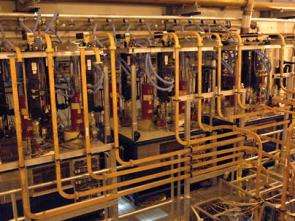
A major objective of Alcator C-Mod is demonstrating that large currents can be driven in our plasma using radio frequency (rf) waves. To generate this rf power requires the use of advanced tubes called klystrons which are the red cylindrical objects in the picture. Up to 3 MW of microwave power can be produced and transferred to the plasma using the copper waveguides also seen in the picture, and a special antenna in the vacuum chamber launches the power in the proper way to generate current. Photo: Donna Coveney

For about six months of the year, bursts of a hot, electrically charged gas, or plasma, swirl around a donut-shaped tube in a special MIT reactor, helping scientists learn more about a potential future energy source: nuclear fusion.

During downtimes when the reactor is offline, as it is right now, engineers make upgrades that will help them achieve their goal of making fusion a viable energy source--a long-standing mission that will likely continue for decades.
Reactor upgrades help researchers study nuclear fusion as energy source

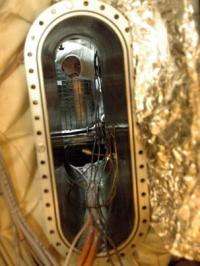
Shyri Marazita, an engineer at the MIT Plasma Science and Fusion Center, peers out of the Alcator C-Mod vacuum vessel. He is in the process of installing a liquid helium cooled cryopump, a modification that will help the reactor achieve a steady-state flow of plasma. Photo: Donna Coveney

MIT's reactor, known as Alcator C-Mod, is one of several tokamak plasma discharge reactors in the world. Inside the reactor, magnetic fields control the superheated plasma (up to 50 million degrees Kelvin) as it flows around the tube.

Fusion occurs when two deuterons, or one deuteron and one triton--nuclei of heavy hydrogen--fuse, creating helium and releasing energy. The reactions can only occur at extremely high temperatures.

Although MIT's reactor is smaller than others, it has a stronger magnetic field than some larger reactors, allowing the plasma to become denser at comparable temperatures. "That positions us to provide important data you can't get anywhere else," said Earl Marmar, head of MIT's Alcator C-Mod project and senior research scientist in the Department of Physics.

One major goal of the upgrades is to create a system where plasma can flow in a steady state, rather than short pulses, or bursts.

Last year, engineers added a microwave generator that creates phased waves that flow around the ring, reinforcing the plasma current. The microwaves interact with the highest velocity electrons in the plasma, pushing them around the ring.

"It's possible to use this approach to go to fully steady-state plasma," Marmar said. "As an attractive energy source, ultimately we want steady state."

Benefits of a steady-state system include a constant energy output, less need for energy storage and less stress on the system, he said.

This year's modifications include the installation of a cryopump, which will allow scientists to control the density of the plasma over a long period of time--another necessary step to achieving a steady-state flow.

Several other modifications will allow the researchers to more accurately measure properties of the plasma, such as density and temperature. The new devices will also allow them to more accurately detect and measure magnetic and electric fields generated by the plasma.

The reactor, which has been offline for upgrades since August, is expected to be ready to use again starting in March.

More than 100 MIT researchers from the Departments of Physics, Nuclear Science and Engineering, and Electrical Engineering and Computer Science, including about 30 graduate students, use the Alcator C-Mod reactor to run experiments.

On a recent morning, the control room, normally packed with scientists at about 100 computer monitors, was nearly empty while engineers, scientists and students worked on modifications to the reactor, located in the next room.

When experiments are going on, researchers from around the world can participate in and watch the proceedings through the Internet.

There is high demand for time to run experiments on the reactor, but priority is given to projects that have high relevance to the Alcator goals and also to MIT graduate student research projects.

"One of our highest priorities is to get graduate students the run time they need," Marmar said.

For more information on the Alcator project, visit http://www.psfc.mit.edu/research/alcator/ .

Source: by Anne Trafton, MIT


print this article email this article download pdf blog this article bookmark this article     Stumble it Digg this share on Facebook retweet share on Reddit add to delicious
Rate this story - 4.5 /5 (38 votes)


February 9, 2007 all stories

Comments: 0

4.5 /5 (38 votes)
  • Stumble this up

  • Digg this

  • share this

  • hide
  • Related Stories


  • hide
  • Relevant PhysicsForums posts

  • Normal Forces
    created 1hour ago
  • Just a quick question of the escape velocity equation
    created 1hour ago
  • mystery equation
    created 2 hours ago
  • Light Intensity and Number of Photons
    created 4 hours ago
  • Monkey and Hunter
    created 5 hours ago
  • Where could I buy electron guns?
    created 8 hours ago
  • More from Physics Forums - General Physics

Other News

Spinons -- confined like quarks

Physics / General Physics

created 10 hours ago | popularity 4.3 / 5 (9) | comments 0

The concept of confinement is one of the central ideas in modern physics. The most famous example is that of quarks which bind together to form protons and neutrons. Now Prof. Bella Lake from Helmholtz-Zentrum Berlin (Germany) ...


Superconductor magnet heat shield being developed

Superconductor magnet spacecraft heat shield being developed

Physics / General Physics

created Nov 26, 2009 | popularity 4.8 / 5 (37) | comments 25

(PhysOrg.com) -- European space agencies and an aerospace giant are developing a new re-entry heat shield that will use superconductor magnets to generate a magnetic field strong enough to deflect the superhot ...


Scientists react as they stand in front of a screen at CERN

First atoms reported smashed in Large Hadron Collider (Update)

Physics / General Physics

created Nov 23, 2009 | popularity 4.6 / 5 (37) | comments 26

Two circulating beams on Monday produced the first particle collisions in the world's biggest atom smasher, the Large Hadron Collider (LHC), three days after its restart, scientists announced.


In the Brain, Seven Is A Magic Number

In the Brain, Seven Is A Magic Number

Physics / General Physics

created Nov 23, 2009 | popularity 4.5 / 5 (43) | comments 14

Having a tough time recalling a phone number someone spoke a few minutes ago or forgetting items from a mental grocery list is not a sign of mental decline; in fact, it's natural.


A quantum leap forward?

A quantum leap forward?

Physics / Quantum Physics

created Nov 23, 2009 | popularity 4.6 / 5 (5) | comments 6

The dusty boxes that line the walls of Jeff Barrett's UC Irvine office mark a high point in his academic career. Their contents: pages and pages of notes, most more than 50 years old, penned by late quantum ...