Spider Robots And The Space Web
December 14, 2005
Robotic 'spiders' could be the key to building large-scale structures in space, according to ESA's Advanced Concepts Team. The tiny mechanical spiders would inch their way across large nets of fabric in space performing small tasks or lining up to create an antenna or some other structure.
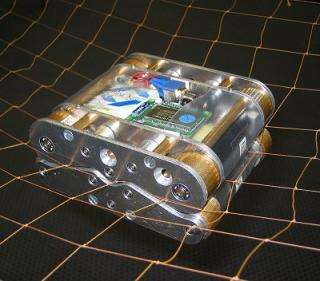
Image above: The Japanese Aerospace Exploration Agency (JAXA) is planning to test a Furoshiki spacecraft in January 2006. Assisted by ESA's Advanced Concepts Team, it has chosen the robotics institute of the Vienna University of Technology to develop the small robots. Credits: ESA
The concept is known as a Furoshiki satellite after the Japanese word for a cloth used to wrap up possessions. It could revolutionise satellite-based applications such as telecommunications, navigation and Earth observation using radars, by providing cost effective large antennas in space that can be launched on relatively small rockets.
The Japanese Aerospace Exploration Agency (JAXA) is planning to test a Furoshiki spacecraft in January 2006. Assisted by ESA's Advanced Concepts Team, it has chosen the robotics institute of the Vienna University of Technology to develop the small robots. The Vienna team is led by Prof. Kopacek, who is known for his world championship victories in robot soccer!
The experiment will be launched in a compact configuration aboard a Japanese sounding rocket. Once in space, the mother satellite will deploy three 'daughters'. These will pull out a woven net into a triangle, leaving the mother satellite at the centre. Once the net is deployed, two palm-sized robots will 'crawl' along the net into prearranged positions.
Because the test is only taking place on a sounding rocket, the satellites will not actually go into orbit around the Earth. Instead they will be placed on a suborbital trajectory that will loop up into space before falling back and burning up in Earth's atmosphere. The experiment will experience around 10 minutes of weightlessness.
During that time, the 40-metre-long triangular net will take between 3–5 minutes to deploy and then the robots will take a further 3–5 minutes to crawl out from the mother satellite to prearranged positions.
Tiny cameras on the mother and daughter satellites will send images of the deployment and crawling test back to Earth for analysis. "I hope that we can demonstrate for the first time that it is possible to move along a very thin, free floating net in a controlled fashion," says Leopold Summerer from ESA's Advanced Concepts Team.
To do this, the team have created a cunning system of wheels for the robots that can grip both sides of the fabric in order to not loose the net when there is no gravity.
Another aspect of the test is for the four satellites to line themselves up in space and transmit a synchronized signal to the ground. So each satellite must know the locations of the others and then adjust its radio output accordingly. To do this, the satellites exchange radio signals and use tiny jets to line themselves up. They will then listen for a pilot signal from the ground. Once they receive this, they will begin transmitting their response. The technology required to do this was developed at Kobe University of Japan.
This is the first small step towards satellites that collect solar energy using large arrays of solar panels and then beam the energy down to Earth. Such satellites could revolutionise the Earth's energy supply systems by providing large amounts of clean solar energy. "A solar power satellite would need very large structures for its solar panels and antenna. Small experiments like this can help us mature the technology needed to build them," says Summerer.
Source: ESA
-
Robot competition in zero-gravity
Jan 25, 2012 |
5 / 5 (6) |
2
-
Professor's research helps restore sight to the blind
Jan 23, 2012 |
5 / 5 (2) |
0
-
NASA 'Smart SPHERES' tested successfully on international space station
Dec 20, 2011 |
5 / 5 (3) |
0
-
Medical robotics experts help advance NASA's 'satellite surgery' project
Dec 06, 2011 |
not rated yet |
2
-
Paul Spudis' plan for a sustainable and affordable lunar base
Oct 21, 2011 |
4.7 / 5 (20) |
166
-
Engineers build first sub-10-nm carbon nanotube transistor
Feb 01, 2012 |
4.9 / 5 (31) |
30
-
Something old, something new: Evolution and the structural divergence of duplicate genes
Jan 31, 2012 |
4.6 / 5 (7) |
1
-
The hidden nanoworld of ice crystals: Revealing the dynamic behavior of quasi-liquid layers
Jan 30, 2012 |
5 / 5 (3) |
1
-
Stock market network reveals investor clustering
Jan 27, 2012 |
3.9 / 5 (23) |
8
-
Of microchemistry and molecules: Electronic microfluidic device synthesizes biocompatible probes
Jan 26, 2012 |
5 / 5 (1) |
0
More news stories
Could Venus be shifting gear?
(PhysOrg.com) -- ESAs Venus Express spacecraft has discovered that our cloud-covered neighbour spins a little slower than previously measured. Peering through the dense atmosphere in the infrared, the ...
Space & Earth / Space Exploration
23 hours ago |
5 / 5 (8) |
10
|
Two new moons for Jupiter
Advances in technology have lead to the discovery of new planets outside of our Solar System, and now even new moons in our own backyard.
Space & Earth / Space Exploration
23 hours ago |
4 / 5 (1) |
7
NASA sees wide-eyed cyclone Jasmine
Cyclone Jasmine's eye has opened wider on NASA satellite imagery, as it moves through the Southern Pacific Ocean.
Space & Earth / Earth Sciences
15 hours ago |
3.5 / 5 (2) |
2
NASA sees Giovanna reach cyclone strength, threaten Madagascar
Tropical Storm 12S built up steam and became a cyclone on February 10, 2012 as NASA's Terra satellite passed overhead. Residents of east-central Madagascar should prepare for this cyclone to make landfall ...
Space & Earth / Earth Sciences
15 hours ago |
not rated yet |
0
What does a nebula sound like?
What do things sound like out in the cosmos? Of course, sound waves cant travel through the vacuum of space; however, electromagnetic waves can. These electromagnetic waves can be recorded by devices called spectrographs ...
Space & Earth / Space Exploration
23 hours ago |
5 / 5 (1) |
0
Anonymous knocks CIA website offline (Update)
The website of the Central Intelligence Agency was inaccessible on Friday after the hacker group Anonymous claimed to have knocked it offline.
Fool's gold may prove an unlikely alternative to overexploited catalytic materials
Catalytic materials, which lower the energy barriers for chemical reactions, are used in everything from the commercial production of chemicals to catalytic converters in car engines. However, with current catalytic materials ...
The power of estrogen -- male snakes attract other males
A new study has shown that boosting the estrogen levels of male garter snakes causes them to secrete the same pheromones that females use to attract suitors, and turned the males into just about the sexiest ...
Employers feel no love for unscrupulous practice of 'service sweethearting'
A new study led by two Florida State University marketing professors finds that some frontline service employees who are rewarded for hikes in customer loyalty and satisfaction also may engage in "service ...
Google users warned of threat to smartphone wallets
Users of Google smartphone wallets were being warned on Friday that there is a way to crack pass codes intended to thwart thieves from going on illicit shopping sprees.
Complex wiring of the nervous system may rely on a just a handful of genes and proteins
Researchers at the Salk Institute have discovered a startling feature of early brain development that helps to explain how complex neuron wiring patterns are programmed using just a handful of critical genes. ...