Physicists Find Evidence for Highest Energy Photons Ever Detected From Milky Way's Equator
December 14, 2005
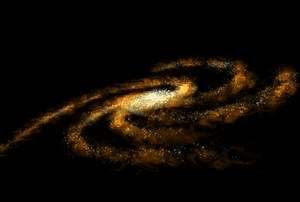
Physicists at nearly a dozen research institution have discovered evidence for very high energy gamma rays emitting from the Milky Way, marking the highest energies ever detected from the galactic equator. Their findings, published in the Dec. 16 issue of the Physical Review of Letters, were obtained using the Milagro Gamma Ray Observatory, a new detector located near Los Alamos, N.M., that allows monitoring of the northern sky on a 24-hour, 7-day-per-week basis.
Gamma rays are considered by scientists to be the best probe of cosmic rays outside the solar neighborhood.
The research team, which includes nearly 40 physicists, reported that Milagro, positioned at an altitude of 8600 feet in the Jemez Mountains, detected a signal along the galactic equator region and interpreted it as arising from gamma rays with a median energy of 3.5 trillion electron-volts, or 3500 times the mass-energy of a proton. Previous satellite experiments have seen gamma-ray emissions along the galactic equator reaching up to energies of only 30 billion electron-volts.
These emissions are understood to be produced by interactions of cosmic-ray particles with the abundant interstellar medium near the galactic equator. Previously, some researchers had speculated that additional mechanisms were needed to explain the large number of particles observed at high energies. However, the measurements by Milagro can be understood by assuming a cosmic ray energy spectrum near the galactic center similar to that in the solar system and the standard properties of particle interactions.
The results presented in the Physical Review of Letters paper were gathered over a three-year period, beginning in July 2000.
Source: New York University
-
Explaining the mystery of the missing sunspots
Apr 05, 2011 |
4.4 / 5 (5) |
6
-
Back to the Moon: Lunar Reconnaissance Orbiter Project
Apr 19, 2007 |
3.3 / 5 (3) |
0
-
Six Years Into Its Mission, Chandra Continues To Achieve Scientific Firsts
Aug 23, 2005 |
not rated yet |
0
-
Classic portrait of a barred spiral galaxy
Feb 03, 2012 |
4.7 / 5 (7) |
3
-
VLBA, RXTE team up to pinpoint black hole's outburst
Jan 10, 2012 |
5 / 5 (2) |
0
-
Engineers build first sub-10-nm carbon nanotube transistor
Feb 01, 2012 |
4.9 / 5 (31) |
30
-
Something old, something new: Evolution and the structural divergence of duplicate genes
Jan 31, 2012 |
4.6 / 5 (7) |
1
-
The hidden nanoworld of ice crystals: Revealing the dynamic behavior of quasi-liquid layers
Jan 30, 2012 |
5 / 5 (3) |
1
-
Stock market network reveals investor clustering
Jan 27, 2012 |
3.9 / 5 (23) |
8
-
Of microchemistry and molecules: Electronic microfluidic device synthesizes biocompatible probes
Jan 26, 2012 |
5 / 5 (1) |
0
More news stories
Putting the squeeze on planets outside our solar system
(PhysOrg.com) -- Using high-powered lasers, scientists at Lawrence Livermore National Laboratory and collaborators discovered that molten magnesium silicate undergoes a phase change in the liquid state, abruptly ...
11 hours ago |
4.3 / 5 (7) |
0
|
Hovering not hard if you're top-heavy, researchers find
Top-heavy structures are more likely to maintain their balance while hovering in the air than are those that bear a lower center of gravity, researchers at New York University's Courant Institute of Mathematical Sciences ...
12 hours ago |
5 / 5 (1) |
1
|
SLAC, Stanford team focuses on high-energy electrons to treat cancer
Accelerator physicists at SLAC and cancer specialists from Stanford are working on a new technology that could dramatically reduce the time needed for cancer radiation treatments. The team ran an initial experiment ...
15 hours ago |
5 / 5 (2) |
0
Measurements from high-energy collisions lead to better understanding of why meson particles disappear
For several years, physicists at the Relativistic Heavy Ion Collider (RHIC) at Brookhaven National Laboratory (BNL), USA, have studied an unusual state of matter called the quarkgluon plasma, which they ...
16 hours ago |
4.5 / 5 (4) |
0
Explained: Sigma
It's a question that arises with virtually every major new finding in science or medicine: What makes a result reliable enough to be taken seriously? The answer has to do with statistical significance -- but ...
Feb 09, 2012 |
5 / 5 (16) |
53
Anonymous knocks CIA website offline (Update)
The website of the Central Intelligence Agency was inaccessible on Friday after the hacker group Anonymous claimed to have knocked it offline.
Google users warned of threat to smartphone wallets
Users of Google smartphone wallets were being warned on Friday that there is a way to crack pass codes intended to thwart thieves from going on illicit shopping sprees.
New error-correcting codes guarantee the fastest possible rate of data transmission
Error-correcting codes are one of the triumphs of the digital age. Theyre a way of encoding information so that it can be transmitted across a communication channel such as an optical fiber o ...
Humans may have helped the decline of African rainforests 3000 years ago
(PhysOrg.com) -- Large areas of rainforests in Central Africa mysteriously disappeared over three thousand years ago, to be replaced by savannas. The prevailing theory has been that the cause was a change ...
New power source discovered
(PhysOrg.com) -- Researchers at the Massachusetts Institute of Technology (MIT) and RMIT University have made a breakthrough in energy storage and power generation.
The power of estrogen -- male snakes attract other males
A new study has shown that boosting the estrogen levels of male garter snakes causes them to secrete the same pheromones that females use to attract suitors, and turned the males into just about the sexiest ...