Intel Research Chip Advances 'Era Of Tera'
February 12th, 2007 Intel Research Chip Advances 'Era Of Tera'

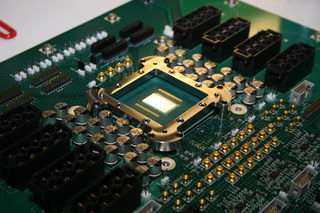
This board houses Intel’s 80-Core Teraflops Research Chip. The board contains working silicon and it is the world’s first programmable chip to achieve teraflops performance while consuming very little power. Credit: Intel

Intel researchers have developed the world's first programmable processor that delivers supercomputer-like performance from a single, 80-core chip not much larger than the size of a finger nail while using less electricity than most of today's home appliances.

This is the result of the company's innovative 'Tera-scale computing' research aimed at delivering Teraflop -- or trillions of calculations per second -- performance for future PCs and servers.

Technical details of the Teraflop research chip will be presented at the annual Integrated Solid State Circuits Conference (ISSCC) this week in San Francisco.

Tera-scale performance, and the ability to move terabytes of data, will play a pivotal role in future computers with ubiquitous access to the Internet by powering new applications for education and collaboration, as well as enabling the rise of high-definition entertainment on PCs, servers and handheld devices. For example, artificial intelligence, instant video communications, photo-realistic games, multimedia data mining and real-time speech recognition - once deemed as science fiction in Star Trek shows - could become everyday realities.

Intel has no plans to bring this exact chip designed with floating point cores to market. However, the company's Tera-scale research is instrumental in investigating new innovations in individual or specialized processor or core functions, the types of chip-to-chip and chip-to-computer interconnects required to best move data and most importantly, how software will need to be designed to best leverage multiple processor cores. This Teraflop research chip offered specific insights in new silicon design methodologies, high-bandwidth interconnects and energy management approaches.

"Our researchers have achieved a wonderful and key milestone in terms of being able to drive multi-core and parallel computing performance forward," said Justin R. Rattner, Intel's chief technology officer. "It points the way to the near future when Teraflop-capable designs will be commonplace and will reshape what we can all expect from our computers and the Internet at home and in the office."

The first time Teraflop performance was achieved was in 1996, on the ASCI Red Supercomputer built by Intel for the Sandia National Laboratory. That computer took up more than 2000 square feet, was powered by nearly 10,000 Pentium Pro processors, and consumed over 500 kilowatts of electricity. Intel's research chip achieves this same performance on a multi-core chip that could rest on the tip of a finger.

Also remarkable is that this 80-core research chip achieves a teraflop of performance while consuming only 62 watts - less than many single-core processors today.

The chip features an innovative tile design in which smaller cores are replicated as "tiles," making it easier to design a chip with many cores. With Intel's discovery of new and robust materials to build future transistors and no immediate end in sight for Moore's Law, this lays a path to manufacture multi-core processors with billions of transistors more efficiently in the future.

The Teraflop chip also features a mesh-like "network-on-a-chip" architecture allowing super high bandwidth communications between the cores, and capable of moving Terabits of data per second inside the chip. The research also investigated methods to power cores on and off independently, so only the ones needed to complete a task are used, providing more energy efficiency.

Further Tera-scale research will focus on the addition of 3-D stacked memory to the chip as well as developing more sophisticated research prototypes with many general-purpose Intel Architecture-based cores. Today, the Intel Tera-scale Computing Research Program has over 100 projects underway that explore other architectural, software and system design challenges.

Source: Intel


print this article email this article download pdf blog this article bookmark this article     Digg this Stumble it share on Facebook share on Reddit add to delicious save to Yahoo! bookmarks
4.7/5 after 171 votes


February 12th, 2007 all stories
Electronics / Hardware

Comments: 0
Rank: 4.7/5 after 171 votes

  • Stumble this up

  • Digg this

  • Share it:
  • share on Facebook
  • share on MySpace
  • share on Slashdot
  • rss-newsfeed
  • share on Google
  • share on Reddit
  • add to delicious
  • save to Yahoo! bookmarks
  • share on Windows Live
  • Add to Mixx!
Rating: 4.7/5 after 171 votes

  • Related Stories

  • Intel Previews Xeon 'Nehalem-EX' Processor
    created May 27, 2009 | popularity not rated yet | comments 0
  • AMD Planning 16-Core Server Chip For 2011 Release
    created Apr 27, 2009 | popularity not rated yet | comments 0
  • Chips with everything
    created Feb 24, 2009 | popularity not rated yet | comments 0
  • More chip cores can mean slower supercomputing, simulation shows
    created Jan 14, 2009 | popularity not rated yet | comments 0
  • Dell Talking About 80-Core Chip Processor
    created Nov 20, 2008 | popularity not rated yet | comments 0

Tags


  • Physicists Demonstrate Quantum Memory with Matter Qubits
    Physicists Demonstrate Quantum Memory with Matter Qubits
    Physics / General Physics
    created 20 hours ago | popularity 4.5 / 5 (11) | comments 1
  • 'Holey' Nanosheets for Wastewater Dye Removal
    Nanotechnology / Nanomaterials
    created Jul 01, 2009 | popularity 5 / 5 (5) | comments 1
  • Jellyfish Robot Swims Like its Biological Counterpart
    Jellyfish Robot Swims Like its Biological Counterpart
    Electronics / Robotics
    created Jun 26, 2009 | popularity 4.4 / 5 (7) | comments 1
  • Could Maxwell's Demon Exist in Nanoscale Systems?
    Could Maxwell's Demon Exist in Nanoscale Systems?
    Physics / General Physics
    created Jun 24, 2009 | popularity 4.4 / 5 (18) | comments 29
  • Living Safely with Robots, Beyond Asimov's Laws
    Living Safely with Robots, Beyond Asimov's Laws
    Electronics / Robotics
    created Jun 22, 2009 | popularity 4.6 / 5 (51) | comments 39
  • Other News

    Zenith Flash-Matic

    TV remotes to undergo big change

    Electronics / Consumer & Gadgets

    created Jul 01, 2009 | popularity 5 / 5 (1) | comments 4

    In 1955, Zenith introduced the first wireless TV remote control, the Flash-Matic, followed a year later by the Space Command.


    HP Introduces First Professional Workstation with Six-core AMD Opteron Processor

    Electronics / Hardware

    created Jul 01, 2009 | popularity 5 / 5 (2) | comments 3

    HP today announced the integration of the highly anticipated Six-Core AMD Opteron 2400 Series processor into its family workstations.


    Digital Entertainer brings PC content to big screen

    Electronics / Consumer & Gadgets

    created Jul 02, 2009 | popularity not rated yet | comments 1

    So there you are with all those videos, photos and MP3 music files, and the only place you can play all that digital entertainment is on your computer. It's probably sequestered away somewhere in the room you've designated ...


    Jellyfish Robot Swims Like its Biological Counterpart

    Jellyfish Robot Swims Like its Biological Counterpart

    Electronics / Robotics

    created Jun 26, 2009 | popularity 4.4 / 5 (7) | comments 1

    (PhysOrg.com) -- "Jellyfish are one of the most awesome marine animals, doing a spectacular and psychedelic dance in water," explain engineers Sung-Weon Yeom and Il-Kwon Oh from Chonnam National University ...


    A group of students of robotics setup a football robot on the eve of the "RoboCup" the world largest robotic event

    Robots face off on football pitch, in kitchen at RoboCup 2009

    Electronics / Robotics

    created Jul 01, 2009 | popularity 5 / 5 (3) | comments 0

    RoboCup 2009, the world's largest robotics event, kicked off Wednesday in the southern Austrian city of Graz, with some 400 teams and 2,000 robots ready to compete in sports and rescue operations.