Finding survivors, protecting drivers
February 12, 2007 UWB Radar Chip

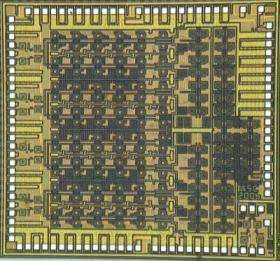
This radar chip, operating in the Ultrawideband range and made from pure CMOS, may help rescuers find lving victims trapped in rubble by detecting heartbeat and respiration. Credit: USC Viterbi School of Engineering

At the IEEE International Solid-State Circuits Symposium, Assistant Professor Hossein Hashemi of the USC Ming Hsieh department of electrical engineering will discuss two radar chips created in his laboratory, both of which detect and generate radio signals, parallel to chips used in cell phones and other wireless devices.

But the new devices also accurately scan, accurately focusing precise beams in specific directions, and also do the reverse, detect, accurately determining the direction of incoming signals.

And unlike other high performance chips with these functions, the USC researchers' designs use ordinary CMOS silicon bases, allowing extremely economical fabrication in standard chip foundries.

According to Hashemi, one chip operating in the 24 GHz range uses an ingenious architecture that combines the functionality of multiple coherent transmitters-receivers ('transceivers'), making it much more compact than previous arrays.

This chip has already attracted the attention of General Motors for possible use in car radar, because ten such devices could be installed in a car for a little more than $100 - less than a tenth of what single devices now in use for car self-parking and blind spot detection systems cost.

These chips can guide parking, and not only detect other vehicles but also pedestrians.

Hashemi believes the same chips can be used to create Local Area Networks with far greater capacity than existing units.

The other radar device also uses a low-cost CMOS chip to detect 'ultrawideband,' probes, low-intensity signals spread across a wide spectrum, emitted in a timed array system. According to Hashemi, a compact beam-forming chip architecture allows processing of the echo picked up by the chip's receiver function to analyze spatial (or directional) data; temporal data, and frequency data to generate detailed information through solid barriers.

The application being most intensively pursued for the chip is “biometric radar,” in which rescuers going through rubble will not only be able to detect living (but not dead) victims trapped in the rubble by picking up the minute movements of their chest caused by breathing and heartbeat.

In clinical settings devices could monitor - without touching - patients who have, for example, severe burns and who cannot endure any contact at all. This chip has attracted intense interest both from industry and government, with funding from Boeing Phantom Works, the National Science Foundation, and the office of Naval Research.

Hashemi's group is collaborating with USC Professor of Electrical Engineering Anthony Levi, SAIC, and Lifewave Inc, who are working to integrate the chips into systems.

Hashemi said that most of the work on both chips was done by graduate students. In both cases, the students came from disciplines outside of chip design and, he said, approached the problem with new eyes, from entirely new points of attack.

The automobile radar chip, he said, is mainly the creation of Harish Krishnaswamy. The wideband biometric radar chip was the inspiration of Ta-Shun Chu - who started his studies as a civil engineer. Jonathan Roderick designed one of the building blocks for the biometric radar chip.

Source: University of Southern California


print this article email this article download pdf blog this article bookmark this article     Stumble it Digg this share on Facebook retweet share on Reddit add to delicious
Rate this story - 4.9 /5 (8 votes)


February 12, 2007 all stories

Comments: 0

4.9 /5 (8 votes)
  • Stumble this up

  • Digg this

  • share this

  • hide
  • Related Stories

  • European research's bit part in Ben Hur Live?
    created Sep 17, 2009 | popularity not rated yet | comments 0
  • 45-nanometer chips for ultra-fast WiFi
    created Jul 29, 2009 | popularity not rated yet | comments 0
  • Chips in official IDs raise privacy fears
    created Jul 11, 2009 | popularity not rated yet | comments 0
  • Ground speed sensor technology developed for motor vehicles
    created Oct 20, 2008 | popularity not rated yet | comments 0
  • Engineers develop world's most complex silicon phased-array chip
    created Oct 30, 2007 | popularity not rated yet | comments 0


  • hide
  • Relevant PhysicsForums posts

  • Achromat lens - magnifying LCD
    created 15 hours ago
  • Control System
    created Nov 24, 2009
  • Base Isolation Systems in Skyscrapers?
    created Nov 23, 2009
  • Need to interview a Computer Hardware Engineer for school project
    created Nov 23, 2009
  • More from Physics Forums - General Engineering

Other News

The goal of robot hockey: to become better engineers

The goal of robot hockey: to become better engineers (w/ Video)

Technology / Engineering

created 1hour ago | popularity not rated yet | comments 0

(PhysOrg.com) -- It may be a long time before we see robots shooting pucks and making saves in professional hockey, but second-year mechanical engineering students at the University of Alberta put some pretty ...


Should I buy a PC or Mac?

Technology / Software

created 14 hours ago | popularity 4.2 / 5 (5) | comments 9

Q. Our 6-year-old PC computer is dying a slow death and we are considering moving to a new iMac but have a few concerns. First, of all, we have several Word documents on our disk drive now that we want to keep and add to ...


Sony optimistic on 3-D TVs, in-house display (AP)

Sony optimistic on 3-D TVs, in-house display

Technology / Hi Tech

created 3 hours ago | popularity not rated yet | comments 0

(AP) -- A third to a half of the Sony Corp. TV sets sold annually will be packed with 3-D features by the year ending March 2013, a senior executive said Thursday.


Post Office card error leaves Italians in the red: report

Technology / Other

created 3 hours ago | popularity 4 / 5 (1) | comments 0

A computer glitch left Italian Post Office customers in the red by processing card transactions at 100 times their value, Italian press reported Thursday.


Time Inc., Conde Nast and Hearst are preparing to launch an online newsstand described as an "iTunes for magazines"

Magazine publishers creating 'iTunes for magazines': reports

Technology / Internet

created 16 hours ago | popularity 5 / 5 (1) | comments 1

US magazine publishers Time Inc., Conde Nast and Hearst are preparing to launch an online newsstand described as an "iTunes for magazines," according to published reports.