Glaciers Not on Simple, Upward Trend of Melting
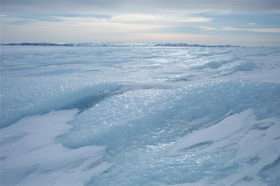
Two of Greenland's largest glaciers shrank dramatically and dumped twice as much ice into the sea during a period of less than a year between 2004 and 2005. And then, less than two years later, they returned to near their previous rates of discharge.
The variability over such a short time, reported online Feb. 9 on Science magazine's Science Express, underlines the problem in assuming that glacial melting and sea level rise will necessarily occur at a steady upward trajectory, according to lead author Ian Howat, a post-doctoral researcher with the University of Washington's Applied Physics Laboratory and the University of Colorado's National Snow and Ice Data Center.
The paper comes a year after a study in the journal Science revealed that discharge from Greenland's glaciers had doubled between 2000 and 2005, leading some scientists to speculate such changes were on a steady, upward climb.
"While the rates of shrinking of these two glaciers have stabilized, we don't know whether they will remain stable, grow or continue to collapse in the near future," Howat says. That's because the glaciers’ shape changed greatly, becoming stretched and thinned.
"Our main point is that the behavior of these glaciers can change a lot from year to year, so we can't assume to know the future behavior from short records of recent changes," he says. "Future warming may lead to rapid pulses of retreat and increased discharge rather than a long, steady drawdown."
The findings come on the heels of the widely publicized Intergovernmental Panel of Climate Change's report issued Feb. 2. Some scientists criticized the report for disregarding the surprisingly high discharges of ice from Greenland’s glaciers since 2000 when the panel estimated the amount of future sea level rise that will be caused by melting glaciers.
In the summary for policy makers (www.ipcc.ch/SPM2feb07.pdf), the Intergovernmental Panel on Climate Change explained its position saying, "Dynamical processes related to ice flow and not included in current models but suggested by recent observations could increase the vulnerability of the ice sheets to warming, increasing sea level rise. Understanding of these processes is limited and there is no consensus on their magnitude."
"I think the IPCC authors made a responsible decision in producing their estimates while noting the recent discharges are a real concern that we do not yet understand well enough to make accurate predictions," says Ian Joughin, a glaciologist with the UW's Applied Physics Laboratory and co-author on the Science Express article.
Getting accurate computer models of Greenland and Antarctic glaciers is important because 99 percent of the Earth's glacial ice is found in those two places. Glacial ice is second only to the oceans as the largest reservoir of water on the planet.
Previous findings published a year ago showed that Greenland's glaciers had doubled their discharge between 2000 and 2005, but these results were based on "snapshots" of discharge taken five years apart, Howat says.
"Did an equal amount of discharge occur every year? Did it happen all in one year? Is there a steady upward trajectory? We didn't know," he says.
Last week's Science Express article adds details from Greenland's second and third largest glaciers, Kangerdlugssuaq and Helheim, in the southwest part of Greenland. The two are known as "outlet" glaciers because their front edges reach all the way to the sea, unlike other glaciers that are landlocked.
Together the two glaciers represent 35 percent of East Greenland's total discharge. The scientists examined the glaciers' speed, geometry and discharge between 2000 and 2006.
At Kangerdlugssuaq, roughly 80 percent of the total increase in discharge occurred in less than one year in 2005, followed by a 25 percent drop the following years, the authors say. At Helheim, discharge increased between 2000 and 2003, and then by an even greater amount between 2004 and 2005. It then dropped in 2006 to its near 2000 value.
The scientists say what they’ve learned is that the shape of these two glaciers changed as they surged toward the sea, changes that put the brakes on. The glaciers lost ice as their front edges began calving, became lighter and floated off the bottom, which led to more ice breaking off as the ice was buoyed up by water. The fronts stablized once the ice had retreated to shallower parts of the fjords and again rested on the bottom.
They also found the pace toward the sea was faster at the front edge of the glaciers than farther up the mountain. For example Kangerdlugssuaq’s front edge increased in speed by 80 in 2005 percent while 19 miles inland the speed increased 20 percent. This caused the glaciers to thin, stretch and weigh less overall, which also slowed them down.
“All this in a matter of a few short years for these two glaciers is not the way glaciologists are used to thinking,” Howat says. “We’re used to thinking of the ice sheets in terms of millennia or centuries.”
Source: University of Washington


