Scientists Use Nanoparticle to Discover Disease-causing Proteins
February 12th, 2007 Scientists Use Nanoparticle to Discover Disease-causing Proteins

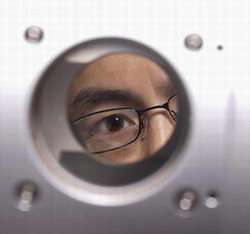
The linear ion trap mass spectrometer in Andy Tao´s lab allows the Purdue biochemist to quickly analyze biological samples such as snake venoms. It has the capability to analyze several hundred proteins in one hour. Here, Tao peers through the small window of the nanosprary ion source. (Purdue Agricultural Communication photo/Tom Campbell)

A complex molecule and snake venom may provide researchers with a more reliable method of diagnosing human diseases and developing new drugs.

Purdue University researchers bound a complex nanomolecule, called a dendrimer, with a glowing identification tag that was delivered to specific proteins in living venom cells from a rattlesnake. The scientists want to find a better way to ascertain the presence, concentration and function of proteins involved in disease processes. They also hope the new method will facilitate better, more efficient diagnosis in living cells and patients.

Most diagnostic methods must be done on minute dead blood or tissue cell samples in a laboratory dish, said Andy Tao, a Purdue biochemist and senior author of the study. Because molecular interactions and protein functions are disturbed when samples are collected, researchers can't obtain an accurate picture of biochemical mechanisms related to illnesses such as cancer and heart disease.

Tao and his research team used dendrimers because they can pass through cell walls efficiently with little disturbance to the cells and then label specific proteins with isotopic tags while cells are still alive. This allows the scientists to determine the activities of proteins that play roles in specific diseases. Proteins carry genetic messages throughout the cell causing biochemical changes that can determine whether a cell behaves normally or abnormally. Proteins also are important in directing immune responses.

The Purdue scientists report on their new strategy to discover proteins and protein levels, called soluble polymer-based isotopic labeling (SoPIL), in the current issue of the journal Chemical Communications. The study also is featured in the journal's news publication Chemical Biology.

"The problem with the current method of using proteomics - protein profiling - is that we use very small sample amounts so sensitive that we can't effectively use existing technologies to study them," Tao said. "In addition, to study a specific protein and its function, we want to preserve its natural environment and see where two molecules meet and what the interaction is when they bind.

"Taking small samples of blood, cells or tissue to study extracted proteins in laboratory dishes damages the sample and the natural environment is destroyed."

The dendrimers would carry one of the stable isotopic or fluorescent labels to identify the presence or absence of a protein that can be further developed for use as a disease indicator, or biomarker.

Snake venom cells were used because they have a very high concentration of proteins similar to some found in human blood, Tao said. The proteins apparently are part of the biochemical process that affects blood clotting or hemorrhage. Understanding how the proteins behave could help determine predisposition to heart disease and cancer and also be useful in diagnosis and drug development.

In future research, Tao plans to investigate how dendrimers are able to enter the cell so easily, what happens to them once they are in the cell and whether there are any long-term effects.

Source: Purdue University


print this article email this article download pdf blog this article bookmark this article     Digg this Stumble it share on Facebook share on Reddit add to delicious save to Yahoo! bookmarks
4.1/5 after 8 votes


February 12th, 2007 all stories
Nanotechnology / Bio & Medicine

Comments: 0
Rank: 4.1/5 after 8 votes

  • Stumble this up

  • Digg this

  • Share it:
  • share on Facebook
  • share on MySpace
  • share on Slashdot
  • rss-newsfeed
  • share on Google
  • share on Reddit
  • add to delicious
  • save to Yahoo! bookmarks
  • share on Windows Live
  • Add to Mixx!
Rating: 4.1/5 after 8 votes

  • Related Stories

  • The 2 faces of Mdmx: Why some tumors don't respond to radiation and chemotherapy
    created 1hour ago | popularity not rated yet | comments 0
  • Researchers highlight new direction for drug discovery
    created 22 hours ago | popularity not rated yet | comments 0
  • MicroRNAs hold promise for treating diseases in blood vessels
    created Jul 05, 2009 | popularity not rated yet | comments 0
  • Cells use import machinery to export their goods as well
    created Jul 03, 2009 | popularity not rated yet | comments 0
  • Harnessing Nanoparticles To Track Cancer Cell Changes
    created Jul 03, 2009 | popularity not rated yet | comments 0

Tags


  • Physicists Demonstrate Quantum Memory with Matter Qubits
    Physicists Demonstrate Quantum Memory with Matter Qubits
    Physics / General Physics
    created Jul 03, 2009 | popularity 4.4 / 5 (17) | comments 1
  • 'Holey' Nanosheets for Wastewater Dye Removal
    Nanotechnology / Nanomaterials
    created Jul 01, 2009 | popularity 5 / 5 (5) | comments 1
  • Jellyfish Robot Swims Like its Biological Counterpart
    Jellyfish Robot Swims Like its Biological Counterpart
    Electronics / Robotics
    created Jun 26, 2009 | popularity 4.4 / 5 (8) | comments 1
  • Could Maxwell's Demon Exist in Nanoscale Systems?
    Could Maxwell's Demon Exist in Nanoscale Systems?
    Physics / General Physics
    created Jun 24, 2009 | popularity 4.4 / 5 (18) | comments 29
  • Living Safely with Robots, Beyond Asimov's Laws
    Living Safely with Robots, Beyond Asimov's Laws
    Electronics / Robotics
    created Jun 22, 2009 | popularity 4.6 / 5 (54) | comments 40
  • Other News

    Physics research with atomic force microscope could lead to better health care

    Atomic force microscope research could lead to better health care

    Nanotechnology / Nanophysics

    created 27 minutes ago | popularity not rated yet | comments 0

    Where biology, chemistry and physics intersect, a Kansas State University professor expects to find applications to improve human health.


    Canadian researchers set to study impact of nanomaterials on aquatic ecosystems

    Nanotechnology / Bio & Medicine

    created 2 hours ago | popularity 5 / 5 (1) | comments 0

    A team of Canadian scientists and engineers, led by the University of Alberta and the National Research Council of Canada, will collaborate on a $3.39 million, three-year study to assess the potential effects of nanoparticles ...


    Nano Measurement in the 3rd Dimension

    Nano Measurement in the 3rd Dimension

    Nanotechnology / Nanophysics

    created 3 hours ago | popularity 3 / 5 (1) | comments 0

    From the motion sensor to the computer chip - in many products of daily life components are used whose functioning is based on smallest structures of the size of thousandths - or even millionths - of millimetres. ...


    A 'quantum of sol' -- how nanotechnology could hold the key to a solar-powered future

    A 'quantum of sol' -- how nanotechnology could hold the key to a solar-powered future

    Nanotechnology / Nanomaterials

    created Jun 30, 2009 | popularity 3.9 / 5 (16) | comments 17

    (PhysOrg.com) -- A new generation of 'nano-structured' millimetre-sized solar cells that could convert the sun's energy to electricity more than twice as efficiently as current technology, is the subject of ...


    Australian researchers are set to begin human trials of a tiny nano-cell that acts as a "Trojan horse" against cancer

    Hi-tech 'Trojan horse' can kill cancer cells: researchers

    Nanotechnology / Bio & Medicine

    created Jun 29, 2009 | popularity 4.7 / 5 (12) | comments 7

    Australian researchers are set to begin human trials of a tiny nano-cell that acts as a "Trojan horse" against cancer cells, a breakthrough they say may curb the need for debilitating chemotherapy.