Researchers Create Tiny, Self-Propelled Devices

February 12th, 2007

North Carolina State University scientists have figured out a method to supply microscopic devices with enough energy to not only allow them to propel themselves through liquid – a difficult function in its own right – but also to perform some other functions, like emitting light.

The findings have the potential to lead to “smart devices” or “microrobots” that can interact with their environment and perform certain tasks – like moving, sensing other materials, including biological materials, lighting up and spinning – on their own.

The millimeter-sized devices can be controlled externally and have the potential to be powered by radio waves.

The research is published in the February 2007 edition of Nature Materials.
Researchers Create Tiny, Self-Propelled Devices

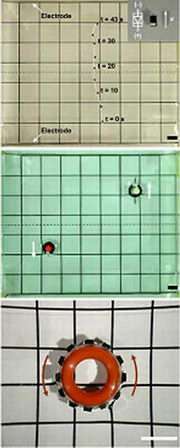
NC State´s tiny, self-propelling diodes move (top); move and light up (middle); and spin around (bottom) in liquid.

The researchers – Dr. Orlin Velev, associate professor of chemical and biomolecular engineering at NC State and principal investigator of the project, Suk Tai Chang, a graduate student at NC State and their colleagues Dr. Dimiter Petsev from the University of New Mexico and Dr. Vesselin Paunov from the University of Hull in the United Kingdom – took various types of millimeter-sized diodes, or electronic devices containing two electrodes, and placed them in a liquid-filled dish with two external electrodes placed on the outer edges of the dish.

The researchers applied alternating electric fields to the electrodes at the outer edges of the dish, which provided energy for the diodes to move on their own. The diodes absorb the external field energy and convert it into motion in a process called electro-osmosis.

“There are very few ways to make microdevices move around, especially in liquid, because as you scale down the size of the device, viscosity plays a more important role . It’s somewhat like swimming in molasses,” Velev said. “We have shown how to provide devices with external energy from electrical fields, which the devices convert into directional motion that can be controlled electronically.”

But the researchers’ self-propelling microdevices do more than just move through liquid. The paper describes how the voltage induced within the devices’ electrodes can be used to perform other functions, like emitting light or spinning around. Velev and his colleagues also controlled the speed at which some diodes move by directing a laser beam at the tiny devices, proving further that the devices can sense their environment and act in certain ways.

This sensing function could be very important, Velev says, if it can be used to separate biological molecules, such as looking for a particular protein and analyzing it. He also envisions future tiny devices that can move through biological fluids for applications like drug delivery or microsurgery.

Now that they’ve proven the concept, Velev and his team are working to create better microfluidic devices where the flow of microscopic volumes of liquid can be steered and controlled by electronic diode pumps, valves and mixers. Microfluidic devices with diode pumps can achieve better analysis of biological samples, assist in development of drugs or perform other biotechnology operations.

Citation: “Remotely Powered Self-Propelling Particles and Micropumps Based on Miniature Diodes”, Authors: Suk Tai Chang and Dr. Orlin D. Velev, NC State University; Vesselin N. Paunov, University of Hull; Dimiter N. Petsev, University of New Mexico, Published: Feb. 2007, in Nature Materials

Source: North Carolina State University


print this article email this article download pdf blog this article bookmark this article     Digg this Stumble it share on Facebook share on Reddit add to delicious save to Yahoo! bookmarks
4.5/5 after 33 votes


February 12th, 2007 all stories
Physics / Condensed Matter

Comments: 0
Rank: 4.5/5 after 33 votes

  • Stumble this up

  • Digg this

  • Share it:
  • share on Facebook
  • share on MySpace
  • share on Slashdot
  • rss-newsfeed
  • share on Google
  • share on Reddit
  • add to delicious
  • save to Yahoo! bookmarks
  • share on Windows Live
  • Add to Mixx!
Rating: 4.5/5 after 33 votes

  • Related Stories

  • Nanojewels made easy
    created Jul 30, 2008 | popularity not rated yet | comments 0
  • Simple Magnet Can Control Color of Liquid
    created Jul 03, 2007 | popularity not rated yet | comments 0
  • Researchers Construct Tiny, Floating 'Eyeballs,' 'Billiard Balls' on Microchip
    created Jan 17, 2005 | popularity not rated yet | comments 0
  • Translate this: 'cognition-strength interfaces'
    created 4 hours ago | popularity not rated yet | comments 0
  • Energy-Efficient Intelligent House that Can Learn our Routines
    created Jul 03, 2009 | popularity not rated yet | comments 0

Tags


  • Physicists Demonstrate Quantum Memory with Matter Qubits
    Physicists Demonstrate Quantum Memory with Matter Qubits
    Physics / General Physics
    created Jul 03, 2009 | popularity 4.4 / 5 (17) | comments 1
  • 'Holey' Nanosheets for Wastewater Dye Removal
    Nanotechnology / Nanomaterials
    created Jul 01, 2009 | popularity 5 / 5 (5) | comments 1
  • Jellyfish Robot Swims Like its Biological Counterpart
    Jellyfish Robot Swims Like its Biological Counterpart
    Electronics / Robotics
    created Jun 26, 2009 | popularity 4.4 / 5 (8) | comments 1
  • Could Maxwell's Demon Exist in Nanoscale Systems?
    Could Maxwell's Demon Exist in Nanoscale Systems?
    Physics / General Physics
    created Jun 24, 2009 | popularity 4.4 / 5 (18) | comments 29
  • Living Safely with Robots, Beyond Asimov's Laws
    Living Safely with Robots, Beyond Asimov's Laws
    Electronics / Robotics
    created Jun 22, 2009 | popularity 4.6 / 5 (54) | comments 40
  • Other News

    Physical reality of string theory demonstrated

    Physics / General Physics

    created 3 hours ago | popularity 4.7 / 5 (16) | comments 11

    String theory has come under fire in recent years. Promises have been made that have not been lived up to. Leiden (The Netherlands) theoretical physicists have now for the first time used string theory to describe a physical ...


    UQ researchers break the law -- of physics

    Physics / General Physics

    created 8 hours ago | popularity 4.6 / 5 (14) | comments 4

    (PhysOrg.com) -- Two UQ Science researchers have proved two famous physical laws that have been widely used for the past 25 years do not always work.


    Scientists create first electronic quantum processor

    Scientists create first electronic quantum processor

    Physics / General Physics

    created Jun 28, 2009 | popularity 4.8 / 5 (55) | comments 45

    A team led by Yale University researchers has created the first rudimentary solid-state quantum processor, taking another step toward the ultimate dream of building a quantum computer.


    Science journals

    How to Spot an Influential Paper Based on its Citations

    Physics / General Physics

    created Jul 04, 2009 | popularity 3.9 / 5 (10) | comments 6

    (PhysOrg.com) -- At first it may seem that the number of citations received by a published scientific paper is directly related to that paper's quality of content. The higher the quality, the more people read ...


    Fermilab's CDF observes Omega-sub-b baryon

    Fermilab's CDF observes Omega-sub-b baryon

    Physics / General Physics

    created Jun 29, 2009 | popularity 4.6 / 5 (19) | comments 7

    (PhysOrg.com) -- At a recent physics seminar at the Department of Energy’s Fermi National Accelerator Laboratory, Fermilab physicist Pat Lukens of the CDF experiment announced the observation of a new particle, ...