ILC Physics: The Analysis Has Already Begun
February 12, 2007 ILC Physics: The Analysis Has Already Begun

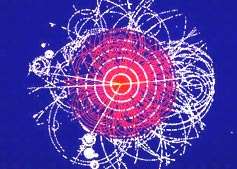
A simulation of what the decay of a Higgs particle will look like in a detector. (Image courtesy of ATLAS, CERN.)

For the proposed International Linear Collider, physicists are trying to both design the most precise calorimeter ever and still be able to afford it. A calorimeter measures the energy of particles in a detector, and is typically the single most expensive part. If you reduce its performance slightly to reduce costs, how much have you sacrificed?

One way to answer that question is to calculate the mass of the undiscovered Higgs particle. It may sound like a non sequitur, but analyzing data produced from simulated particle collisions gives a good idea of how sensitive the experiment remains to important physics.

"We are studying physics processes that are sensitive to the new detection method that the calorimeter will use," said physicist Tim Barklow. "We want to know how important it is to achieve the unprecedented precision in the calorimeter that we're attempting to achieve."

Barklow has several ways to measure the mass of the Higgs. His software starts with a list of particles identified from simulated collisions and groups the data into jets—stable particles pointed in the same direction. By adjusting the angle of each jet, within the range of error, Barklow can get a much better measurement of the Higgs mass, one that takes into account the undetected energy that neutrinos carry away from collisions.

The analysis also has to filter out background activity. For example, if the Higgs turns out to be light, say 120 GeV, physicists will have to filter out Z particles that are masquerading as Higgses. The mass of the Z is listed as 91.187 GeV, but that's only its central value. Individual Z particles can come in a variety of sizes.

A graph from one of Barklow's analyses shows the errors shrinking as calorimeter performance improves. The better performance was equivalent of a 40 percent gain in luminosity, which is like adding more collisions to your detector without improving the particle beam.

"You get a sharper peak, which means a more accurate Higgs mass, and reduced error because of better calorimeter performance. Ultimately this is money. A better calorimeter costs more, so people have to judge."

Source: by Heather Rock Woods, Stanford Linear Accelerator Center


print this article email this article download pdf blog this article bookmark this article     Stumble it Digg this share on Facebook retweet share on Reddit add to delicious
Rate this story - 3.3 /5 (7 votes)


February 12, 2007 all stories

Comments: 0

3.3 /5 (7 votes)
  • Stumble this up

  • Digg this

  • share this

  • hide
  • Related Stories

  • Before God particle, scientists must learn soul of new machine
    created May 26, 2009 | popularity not rated yet | comments 0
  • World’s fastest image processor aids search for elusive form of matter
    created Feb 06, 2006 | popularity not rated yet | comments 0
  • DZero: Elusive Top Quark Discovery
    created Oct 17, 2005 | popularity not rated yet | comments 0
  • New Results Change Estimate of Higgs Boson Mass
    created Jun 09, 2004 | popularity not rated yet | comments 0
  • Prototype developed to detect dark matter
    created Sep 25, 2009 | popularity not rated yet | comments 0


  • hide
  • Relevant PhysicsForums posts

  • Wave dispersion
    created 1hour ago
  • Neutron
    created 2 hours ago
  • Obtaining research papers from journals
    created 7 hours ago
  • Vibration into Electricity?
    created 9 hours ago
  • More from Physics Forums - General Physics

Other News

Spin polarization achieved in room temperature silicon

Spin polarization achieved in room temperature silicon

Physics / General Physics

created 23 hours ago | popularity 4.9 / 5 (17) | comments 0

(PhysOrg.com) -- A group in The Netherlands has achieved a first: injection of spin-polarized electrons in silicon at room temperature. This has previously been observed only at extremely low temperatures, ...


Multiferroic compounds used to produce smaller and cheaper digital memories

Multiferroic compounds used to produce smaller and cheaper digital memories

Physics / Condensed Matter

created 17 hours ago | popularity 4.7 / 5 (3) | comments 0

(PhysOrg.com) -- Is it possible to make even more compact digital memories for portable electronic devices and which consume even less energy? A team of French researchers has recently demonstrated that it ...


Superconductor magnet heat shield being developed

Superconductor magnet spacecraft heat shield being developed

Physics / General Physics

created Nov 26, 2009 | popularity 5 / 5 (25) | comments 23

(PhysOrg.com) -- European space agencies and an aerospace giant are developing a new re-entry heat shield that will use superconductor magnets to generate a magnetic field strong enough to deflect the superhot ...


Restored machine to explore mysteries of Big Bang (AP)

Restored machine to explore mysteries of Big Bang

Physics / General Physics

created Nov 21, 2009 | popularity 4.6 / 5 (18) | comments 26

(AP) -- Scientists are preparing the world's largest atom smasher to explore the depths of matter after successfully restarting the $10 billion machine following more than a year of repairs.


Scientists react as they stand in front of a screen at CERN

First atoms reported smashed in Large Hadron Collider (Update)

Physics / General Physics

created Nov 23, 2009 | popularity 4.5 / 5 (31) | comments 22

Two circulating beams on Monday produced the first particle collisions in the world's biggest atom smasher, the Large Hadron Collider (LHC), three days after its restart, scientists announced.