Researchers create new super-thin laser mirror
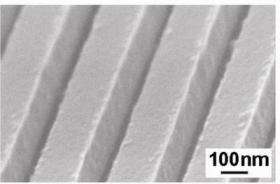
Engineers at the University of California, Berkeley, have created a new high-performance mirror that could dramatically improve the design and efficiency of the next generation of devices relying upon laser optics, including high-definition DVD players, computer circuits and laser printers.
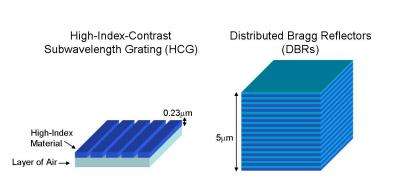
The new mirror packs the same 99.9 percent reflective punch as current high-grade mirrors, called distributed Bragg reflectors (DBRs), but it does so in a package that is at least 20 times thinner, functional in a considerably wider spectrum of light frequencies, and easier to manufacture. All these characteristics present critical advantages for today's ever smaller integrated optical devices.
Connie J. Chang-Hasnain, director of UC Berkeley's Center for Optoelectronic Nanostructured Semiconductor Technologies, developed the super-thin mirror, or "high-index contrast sub-wavelength grating (HCG)," with her graduate students, Michael Huang and Ye Zhou. Their work is described in this month's issue of the journal Nature Photonics.
"Today's semiconductor lasers demand mirrors that can deliver high reflectivity, but without the extra thickness," said Chang-Hasnain, who is also a UC Berkeley professor of electrical engineering and computer science. "When you reduce the thickness of a mirror, you are significantly reducing the mass of the device, which also translates into lower power consumption. The mirror we've developed overcomes the hurdles that have stalled the advancement of certain lasers."
To get the coherent, single wavelength light of a laser beam requires a pair of mirrors at opposite ends of a photon-generating gain medium. Light photons of a specific frequency bounce back and forth between the mirrors, building up energy with each pass. As this effect levels off, the gain is said to be saturated, and the light energy is transferred into a laser beam.
Early versions of semiconductor lasers used crystal for the mirrors, which yielded a mere 30 percent reflection. Such a low reflectivity is too inefficient for vertical-cavity surface-emitting lasers (VCSEL) – used in short-range optical communications, optical mice for computers and other applications requiring low power consumption. VCSELs have a particularly short gain medium, so a highly reflective mirror is needed.
High reflectivity can be achieved with DBRs, in which light passes through alternating layers of aluminum gallium arsenide, which has a refractive index of 3.0, and gallium arsenide, which has a higher refractive index of 3.6. The difference in refractive indices allows a small amount of light to be reflected from each pair of alternating layers. The light from the multiple layers adds up to form a strongly reflected coherent beam.
"DBRs can reflect 99.9 percent of light, but it can take up to 80 layers of material to achieve this high reflectivity," said Huang, lead author of the paper. "The DBR ends up being a relatively thick 5 micrometers wide. The precision necessary for the layers also requires a complicated manufacturing process. Our mirror is thinner and will be easier to manufacture, which keeps the cost low."
Instead of multiple levels of alternating refractive-index layers, the HCG mirror developed by the UC Berkeley engineers contains only one pair. In this study, the engineers used aluminum gallium arsenide for the high refractive index layer, coupled with a layer of air, which has a very low refractive index of 1. In addition, the high refractive index layer contained grooves spaced by a distance that is less than a wavelength of light.
In this configuration, light hitting the mirror surface was directed over the grooves. As the light waves passed each semiconductor-air interface, they were strongly reflected back in the opposite direction. The researchers noted that other materials could replace air as the low refractive index material. Silicon dioxide, for instance, has a refractive index of 1.5.
To demonstrate the reflectivity of the HCG, the researchers replaced one of the two DBRs in a vertical-cavity surface-emitting laser with the new mirror. They confirmed that the HCG is capable of providing reflectivity greater than 99.9 percent, equivalent to the DBR.
"The HCG mirror overcomes many of the hurdles that had slowed the advance of VCSEL research," said study co-author Zhou. "In addition to being thinner, it has the advantage of working in a broader range of light frequencies."
The latter attribute is particularly important as optical disc technologies increasingly employ blue-violet lasers, which operate on a shorter wavelength than red lasers. Shorter wavelengths make it possible to focus on smaller units, enabling significantly higher density data storage.
The engineers are also studying applications for the mobile HCG mirror in micro-electromechanical systems (MEMS), such as wavelength tunable lasers, which are used in broadband communications.
"Reducing the size of the laser's mirror also means a dramatic reduction in weight, which is particularly important for high-speed MEMS devices," said Chang-Hasnain.
The researchers added that it may be possible to print this mirror on various surfaces, and that it could one day be used to create organic, plastic displays that can be rolled up for easy transport.
"There is a wide range of products based upon laser optics that could benefit with this thinner mirror," said Huang. "They include light emitting diodes, photovoltaic devices, sensors, computer chips and telecommunications equipment."
Source: University of California - Berkeley


