The Colorful Demise of a Sun-Like Star
February 13, 2007 The Colorful Demise of a Sun-Like Star

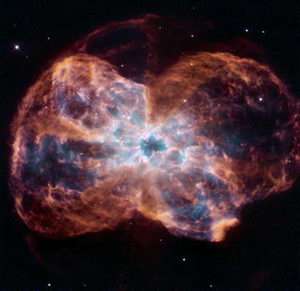
Hubble´s Wide Field Planetary Camera 2 captured this image of planetary nebula NGC 2440 on Feb. 6, 2007. Credit: NASA, ESA, and K. Noll (STScI) Acknowledgement: The Hubble Heritage Team (STScI/AURA)

This image, taken by NASA's Hubble Space Telescope, shows the colorful "last hurrah" of a star like our Sun. The star is ending its life by casting off its outer layers of gas, which formed a cocoon around the star's remaining core. Ultraviolet light from the dying star makes the material glow. The burned-out star, called a white dwarf, is the white dot in the center. Our Sun will eventually burn out and shroud itself with stellar debris, but not for another 5 billion years.

Our Milky Way Galaxy is littered with these stellar relics, called planetary nebulae. The objects have nothing to do with planets. Eighteenth- and nineteenth-century astronomers named them planetary nebulae because through small telescopes they resembled the disks of the distant planets Uranus and Neptune. The planetary nebula in this image is called NGC 2440.

The white dwarf at the center of NGC 2440 is one of the hottest known, with a surface temperature of nearly 400,000 degrees Fahrenheit (200,000 degrees Celsius). The nebula's chaotic structure suggests that the star shed its mass episodically. During each outburst, the star expelled material in a different direction. This can be seen in the two bow tie-shaped lobes. The nebula also is rich in clouds of dust, some of which form long, dark streaks pointing away from the star. NGC 2440 lies about 4,000 light-years from Earth in the direction of the constellation Puppis.

The image was taken Feb. 6, 2007, with Hubble's Wide Field Planetary Camera 2. The colors correspond to material expelled by the star. Blue corresponds to helium; blue-green to oxygen; and red to nitrogen and hydrogen.

Source: Space Telescope Science Institute


Rate this story - 4.7 /5 (26 votes)


February 13, 2007 all stories

Comments: 0

4.7 /5 (26 votes)

  • hide
  • Related Stories

  • The Ring Nebula
    created Nov 02, 2009 | popularity not rated yet | comments 0
  • A Look into the Hellish Cradles of Suns and Solar Systems
    created Aug 19, 2009 | popularity not rated yet | comments 0
  • Unique sky survey brings new objects into focus
    created Jun 15, 2009 | popularity not rated yet | comments 0
  • Spacewalkers equip Hubble with new computer
    created May 15, 2009 | popularity not rated yet | comments 0
  • Solar systems around dead Suns?
    created Apr 20, 2009 | popularity not rated yet | comments 0


  • hide
  • Relevant PhysicsForums posts

  • Spreading Life in the Universe
    created 5 hours ago
  • Force of Gravity in terms of Density
    created Feb 08, 2010
  • what is the relation between gravity and light?
    created Feb 08, 2010
  • Does the Thermoelectric effect apply in sun?
    created Feb 07, 2010
  • More from Physics Forums - General Astronomy

Other News

Rho Ophiuchus cloud

Professor: We have a 'moral obligation' to seed universe with life

Space & Earth / Astronomy

created 15 hours ago | popularity 3.3 / 5 (22) | comments 43 | with audio podcast report

(PhysOrg.com) -- Eventually, the day will come when life on Earth ends. Whether that’s tomorrow or five billion years from now, whether by nuclear war, climate change, or the Sun burning up its fuel, the last ...


38 percent of world's surface in danger of desertification

38 percent of world's surface in danger of desertification

Space & Earth / Environment

created 1hour ago | popularity 2.3 / 5 (3) | comments 4

A team of Spanish researchers has measured the degradation of the planet's soil using the Life Cycle Assessment (LCA), a scientific methodology that analyses the environmental impact of human activities, and ...


A new 3-D map of the interstellar gas within 300 parsecs from the sun

A new 3D map of the interstellar gas within 300 parsecs from the Sun

Space & Earth / Astronomy

created 7 hours ago | popularity 5 / 5 (3) | comments 0 | with audio podcast

(PhysOrg.com) -- Astronomy & Astrophysics is publishing new 3D maps of the interstellar gas in the local area around our Sun. A French-American team of astronomers presents new absorption measurements toward ...


Climate 'Tipping Points' May Arrive Without Warning, Says Top Forecaster

Space & Earth / Environment

created 4 hours ago | popularity 3 / 5 (4) | comments 5 | with audio podcast

(PhysOrg.com) -- A new University of California, Davis, study by a top ecological forecaster says it is harder than experts thought to predict when sudden shifts in Earth's natural systems will occur -- a worrisome finding ...


URI researcher calls for global effort to monitor marine pollutants

Space & Earth / Environment

created 5 hours ago | popularity 3 / 5 (2) | comments 1

A University of Rhode Island researcher who studies chemical pollutants in the marine environment has called on colleagues around the world to establish a global monitoring network to verify that the chemicals banned by the ...