Cosmic Explosion Could Be Black Hole Swallowing Neutron Star
Scientists using the NASA Swift satellite have found evidence of a black hole swallowing a neutron star. The discovery is reported in the December 15 issue of the journal Nature.
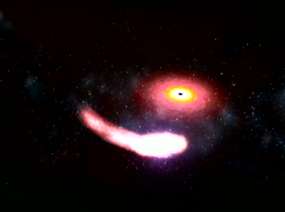
Image: Scientists have found evidence of a black hole swallowing a neutron star in the afterglow of a split-second flash of intense energy known as a short gamma-ray burst. The events leading up to the gamma-ray burst are shown here. In the minutes and hours that followed, the black hole gobbled up the remaining remnants of the neutron star, producing a series of X-ray flares. Credit: NASA
This rare event, seen on 24 July 2005, created a gamma-ray burst that lasted only for a few milliseconds. Observations of the lingering afterglow, however, provided evidence of what could have been the bizarre demise of a neutron star orbiting a black hole. The black hole may have first stretched the dense neutron star into a crescent, breaking off crumbs in the process. The black hole then could have swallowed the star largely in one gulp, feeding on the crumbs in the minutes and hours that followed. Such a black hole would grow more massive, like a python that downs a wild boar.
"For billions of years this black hole and neutron star orbited each other in a gravitational tug-of-war," said Scott Barthelmy of NASA Goddard Space Flight Center in Greenbelt, Maryland, lead author on one of three the Nature articles on the subject. "The neutron star lost."
In recent months the Swift team has reported that "short" gamma-ray bursts arise from a merger either between two neutron stars or a neutron star and black hole. The specific scenario was not clear. This latest analysis of a July burst, although not definitive, is the best evidence of a black hole-neutron star merger, Barthelmy said.
A neutron star is the core remains of an exploded star once about 10 to 25 times more massive than our Sun. It contains about the Sun's mass crammed into a sphere only about 12 miles across. A black hole is the core remains of an even larger exploded star, over 25 times the mass of the Sun.
The July burst, called GRB 050724, was one of the most thoroughly observed short gamma-ray bursts to date. Swift, NASA's Chandra telescope, and the Keck Observatory in Hawaii, among other observatories, captured the burst afterglow in detail. The combined data enabled scientists to speculate on the nature of the merging objects.
If GRB 050724 were a merger of two neutron stars, there would not be many crumbs falling into a black hole later. The two objects would smash, instantly form a black hole, and after a modest afterglow no more light would be seen. Similarly, two black holes would smash and release very little residual light. But GRB 050724 had a long, flaring afterglow.
Peter Mészáros, the Holder of the Eberly Family Chair in Astronomy and Astrophysics at Penn State, and Bing Zhang, of the University of Nevada in Las Vegas, co-authors on the Barthelmy-led Nature article, theorize that smaller flares of X-ray light and optical light, detected in the first tens of seconds after GRB 050724, could have resulted from crumbs of the neutron star falling into the black hole. Flares occurring later might be from magnetized crumbs of gas, which would behave differently. Supporting this merger scenario is the fact that GRB 050724 took place in the outskirts of an old, elliptical galaxy filled with neutron stars and black holes.
"Neutron stars are the densest objects known," said Mészáros. "There's only one thing I know of that could rip apart a neutron star with bits flying out, and that's a black hole. Now we have the first evidence that this kind of merger might actually be occurring."
Numerical simulations by Melvyn Davies and Andrew King, and others at Leicester University in England, have provided evidence for such a disruption of a neutron star by a black hole, including the late infall of crumbs of matter. Other simulations elsewhere indicate conversely that neutron-star mergers would leave no flaring afterglow.
Nial Tanvir of the University of Hertfordshire in Hatfield, England, and Edo Berger of the Carnegie Observatories in Pasadena are lead authors on the two accompanying Nature articles, which describe follow-up observations after Swift's detection of GRB 050724.
Swift, launched in November 2004, is a NASA mission in partnership with the Italian Space Agency and the Particle Physics and Astronomy Research Council, United Kingdom; and is managed by NASA Goddard. Penn State controls science and flight operations from the Mission Operations Center in University Park, Pennsylvania.
Source: Penn State


