U-M develops scalable and mass- producible quantum computer chip
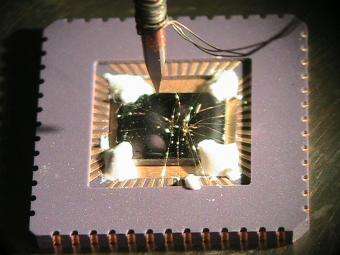
December 14th, 2005 Semiconductor quantum computer chip being wired up.

Researchers at the University of Michigan have produced what is believed to be the first scalable quantum computer chip, which could mean big gains in the worldwide race to develop a quantum computer.

Image: Semiconductor quantum computer chip being wired up.

Using the same semiconductor fabrication technology that is used in everyday computer chips, researchers were able to trap a single atom within an integrated semiconductor chip and control it using electrical signals, said Christopher Monroe, U-M physics professor and the principal investigator and co-author of the paper, "Ion Trap in a Semiconductor Chip." The paper appeared in the Dec. 11 issue of Nature Physics.

Quantum computers are promising because they can solve certain problems much faster than any possible conventional computer, owing to the bizarre features of quantum mechanics. For instance, quantum computers can process multiple inputs at the same time in the same device, and quantum circuitry can be wired via the quantum feature of entanglement, dubbed by Einstein as "spooky action-at-a-distance."

One of the most favored candidate quantum computer architectures is the use of individual atoms to store quantum bits ( qubits) of information, where each qubit can hold the number 1 or 0, or even both 1 and 0 simultaneously, Monroe said. Electrically charged atoms (ions) for such quantum computers are stored in what are known as ion traps. Trapping is necessary in order to isolate the qubits from the rest of the world, which is absolutely essential for the system to behave quantum mechanically. It is well known how to program a quantum computer composed of any number of trapped ions; the problem is to get the ions trapped in the first place.

Current ion traps can only hold a few atoms or qubits, and are not easily scaled. Rather, these ion traps are assembled laboriously by hand. Therefore, one of the obstacles to perfecting the quantum computer is making a scalable integrated quantum computer chip that can store thousands or more atomic ions. For this reason, efforts in the area of quantum computing are now focused on making ion traps on a chip that are scalable and mass producible, and can host larger numbers of qubits.

"The semiconductor chip we demonstrated holds an individual atom in free space inside the chip—we levitate the atom in the chip by applying certain electrical signals to the tiny nearby electrodes," Monroe said. "We directly view this single atom with specially-tuned lasers and a sensitive camera. This type of ion trap has never been demonstrated at such a small level and in an integrated chip structure."

The chip produced at U-M is about as big as a postage stamp. It is etched with electrodes using a process called lithography, which eliminates the need for manual assembly. Each electrode is connected to a separate voltage supply, and these various electrical voltages serve to control the ion by moving it in different ways as it hovers in a space carved out of the chip.

Using existing microfabrication technology, the quantum chip developed at U-M could be scaled up to include hundreds of thousands of electrodes, Monroe said.

"There is a worldwide race to build these (chips) right now, as such an integrated chip structure shows a way to scale the quantum computer to bigger systems—just like the microfabrication of conventional chips have given us the impressive gains in conventional computing speed and power," Monroe said.

The next step is to build the chip bigger with many more electrodes, so that it can store more ions. "There is still a great deal of work to be done in order to learn how to control lots of ions in one of these chips. It won’t be nearly as easy as it was with conventional computer chips, but at least we know what to do in principle," Monroe said.

Doctoral student Daniel Stick, in Monroe’s group in the U-M Physics Department and FOCUS Center (Frontiers in Optical, Coherent, and Ultrafast Science), led this work in collaboration with the Laboratory for Physical Sciences at the University of Maryland.

Source: University of Michigan


print this article email this article download pdf blog this article bookmark this article     Digg this Stumble it share on Facebook share on Reddit add to delicious save to Yahoo! bookmarks
4.5/5 after 56 votes


December 14th, 2005 all stories
Physics /

Comments: 0
Rank: 4.5/5 after 56 votes

  • Stumble this up

  • Digg this

  • Share it:
  • share on Facebook
  • share on MySpace
  • share on Slashdot
  • rss-newsfeed
  • share on Google
  • share on Reddit
  • add to delicious
  • save to Yahoo! bookmarks
  • share on Windows Live
  • Add to Mixx!
Rating: 4.5/5 after 56 votes

  • Related Stories

  • Scientists create first electronic quantum processor
    created Jun 28, 2009 | popularity not rated yet | comments 0
  • Manipulating light on a chip for quantum technologies
    created Jun 05, 2009 | popularity not rated yet | comments 0
  • Tiny lasers plug the 'green gap'
    created Apr 30, 2009 | popularity not rated yet | comments 0
  • Scientists to study diamond-based quantum information processing, communication
    created Apr 15, 2009 | popularity not rated yet | comments 0
  • Life Expectancy on the Rise -- Even for Quantum States
    created Apr 14, 2009 | popularity not rated yet | comments 0

Tags


  • Physicists Demonstrate Quantum Memory with Matter Qubits
    Physicists Demonstrate Quantum Memory with Matter Qubits
    Physics / General Physics
    created Jul 03, 2009 | popularity 4.4 / 5 (17) | comments 1
  • 'Holey' Nanosheets for Wastewater Dye Removal
    Nanotechnology / Nanomaterials
    created Jul 01, 2009 | popularity 5 / 5 (5) | comments 1
  • Jellyfish Robot Swims Like its Biological Counterpart
    Jellyfish Robot Swims Like its Biological Counterpart
    Electronics / Robotics
    created Jun 26, 2009 | popularity 4.4 / 5 (8) | comments 1
  • Could Maxwell's Demon Exist in Nanoscale Systems?
    Could Maxwell's Demon Exist in Nanoscale Systems?
    Physics / General Physics
    created Jun 24, 2009 | popularity 4.4 / 5 (18) | comments 29
  • Living Safely with Robots, Beyond Asimov's Laws
    Living Safely with Robots, Beyond Asimov's Laws
    Electronics / Robotics
    created Jun 22, 2009 | popularity 4.6 / 5 (52) | comments 40
  • Other News

    Scientists create first electronic quantum processor

    Scientists create first electronic quantum processor

    Physics / General Physics

    created Jun 28, 2009 | popularity 4.8 / 5 (53) | comments 39

    A team led by Yale University researchers has created the first rudimentary solid-state quantum processor, taking another step toward the ultimate dream of building a quantum computer.


    Science journals

    How to Spot an Influential Paper Based on its Citations

    Physics / General Physics

    created Jul 04, 2009 | popularity 4 / 5 (9) | comments 5

    (PhysOrg.com) -- At first it may seem that the number of citations received by a published scientific paper is directly related to that paper's quality of content. The higher the quality, the more people read ...


    Fermilab's CDF observes Omega-sub-b baryon

    Fermilab's CDF observes Omega-sub-b baryon

    Physics / General Physics

    created Jun 29, 2009 | popularity 4.7 / 5 (17) | comments 7

    (PhysOrg.com) -- At a recent physics seminar at the Department of Energy’s Fermi National Accelerator Laboratory, Fermilab physicist Pat Lukens of the CDF experiment announced the observation of a new particle, ...


    New insights, and a new angle, on high-temperature superconductivity

    New insights, and a new angle, on high-temperature superconductivity

    Physics / Superconductivity

    created Jun 29, 2009 | popularity 4.8 / 5 (13) | comments 6

    (PhysOrg.com) -- A Princeton-led research team has revealed surprising information about how electron behavior influences the conduction of electricity in a class of high-temperature superconductors. An increased ...


    The art of invisibility and the perfect cat's eye

    The art of invisibility and the perfect cat's eye

    Physics / Optics & Photonics

    created Jun 30, 2009 | popularity 4 / 5 (8) | comments 6

    (PhysOrg.com) -- In recent years scientists have explored the impossible by developing invisibility or 'cloaking' devices, but can the same technology also help make things more visible?